
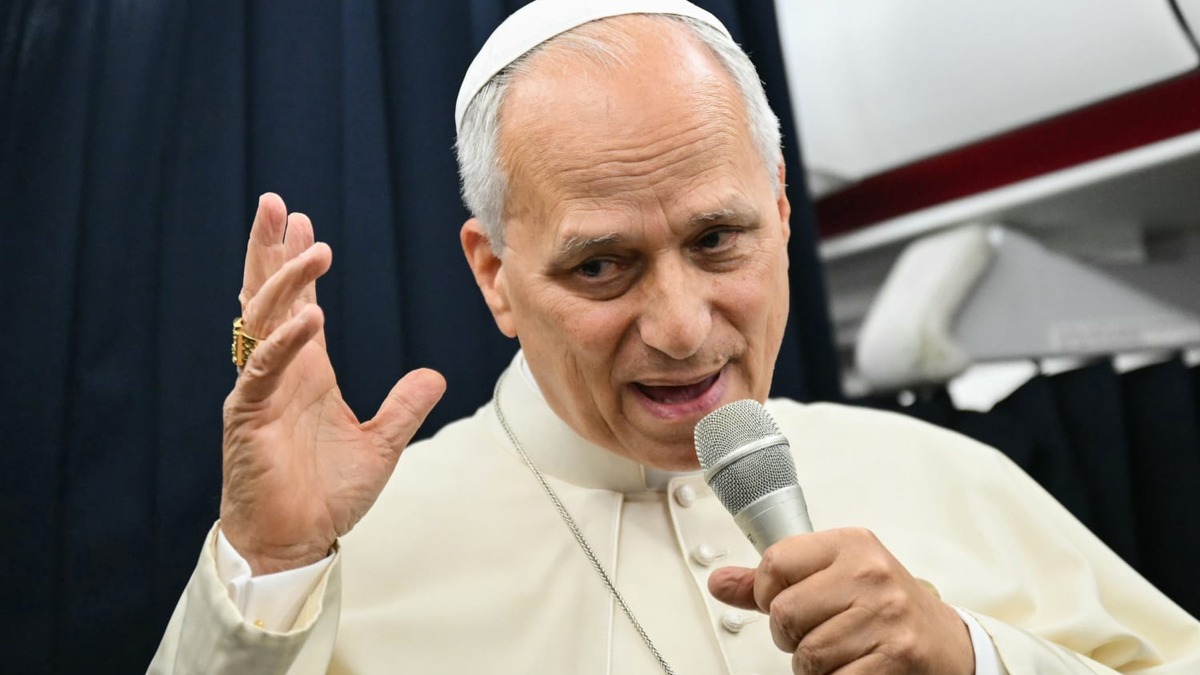
Pope Leo XIV said Monday, Sept. 28, that warnings from AI experts about the risks of artificial intelligence are not "fake news" and should be taken seriously. He spoke to reporters on his flight home to Rome from a four-day trip to France, in answer to a question about whether AI could pose catastrophic risks to humanity. Leo has made protecting human dignity in the age of AI a central theme of his teaching. His words wade into a heated debate over how far governments should regulate the technology.
"If someone were to ask me, am I in panic mode? No, I'm not. I sleep at night," Leo said. "I do think that the concerns raised by many of the experts, specialists in AI, should be taken seriously." He said he did not think those concerns were "fake news, as some have said," but he did not say whom he meant. President Donald Trump, who has often warned that the United States must stay ahead of China in AI, has dismissed concerns that AI could go rogue as a "hoax." A day after Leo spoke, Trump and the leaders of six tech companies signed a voluntary pledge to police the safety of their own AI.
Asked what nations, especially the United States and China, should do to make their AI safe, Leo did not name either country. He said he had read that day that the head of Nvidia claims to have found a way to build "guardrails" into AI. Leo described them as limits meant to keep AI systems from straying outside their intended tasks and causing the harm people worry about. "He's the same one, however, that says there should be no limits placed and no government regulation," Leo said.
Nvidia had announced a safety system that day designed to stop AI agents, AI that carries out tasks on its own, from moving outside set boundaries. Its chief executive, Jensen Huang, said in the announcement that AI's potential "will only be realized if we solve AI safety."
"This is a problem that I think we need to sit down and talk about," he said. "We need to continue to invite political leaders, the leaders of AI, social organizations, associations to come together and look at what is happening already and what could be down the road. To simply say, 'Oh, it's not going to happen,' and close our eyes to it, I think is probably not the most responsible way to go about that."
He said the Vatican has set up its own commission on artificial intelligence, which began by coordinating how the Vatican itself uses AI. Since his first encyclical, "Magnifica Humanitas," a papal letter on safeguarding people in the age of AI, came out in May, people in many fields have contacted the Vatican, he said. The Vatican is promoting dialogue and study, he said, to find ways "to make sure that AI does not get to a point where it could destroy humanity or remove humanity from the conversation."
Leo said he is "relatively optimistic" that this can happen, and that he thinks enough people are seriously interested in it. "We have to keep working," he said. "We can't just sit back and pretend nothing is going to happen." He did not say what form such talks should take, and it is not yet clear whether governments or AI companies will answer the call.