
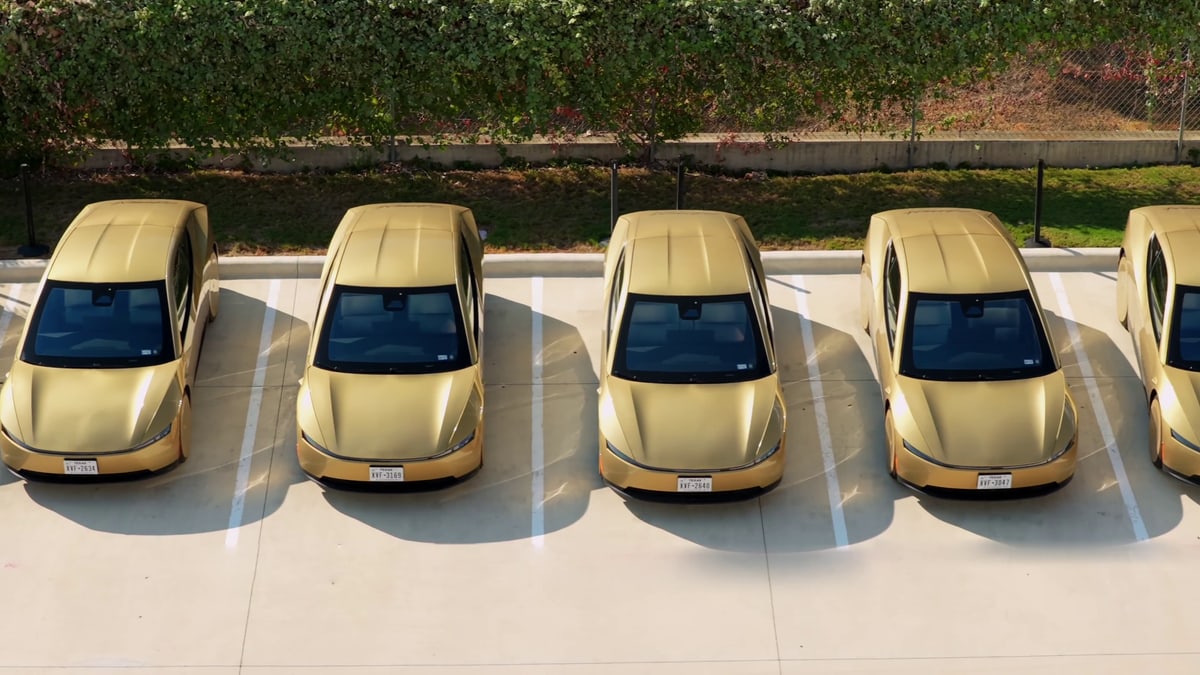
Tesla says it now has more than 300 Cybercabs serving Austin, Texas, a month after it started offering rides in the car. The company's Robotaxi account said on X on Oct. 10 that it had "scaled to 300+ Cybercabs serving Austin", eight times as many as 30 days earlier. Ashok Elluswamy, who leads AI work at Tesla, wrote the same day that "the cabs are everywhere in Austin now. Dallas soon." He gave no date.
The Cybercab is a two-seat robotaxi that Tesla says has no steering wheel because it drives itself, using cameras and sensors to find its way. Tesla's own pages say Cybercab rides are available only in limited areas of Austin. Tesla's other robotaxis, self-driving Model Y cars, carry riders in Austin, Dallas, Houston, Miami, Orlando and Tampa, booked through the Robotaxi app.
In the U.S., carmakers certify on their own that their cars meet federal safety standards. The National Highway Traffic Safety Administration (NHTSA), the U.S. auto safety regulator, oversees those claims and investigates when a certified car appears not to meet the rules. NHTSA opened a review of Tesla's Cybercab certification on Sept. 3, the day Tesla started its Cybercab service. It is looking at the data Tesla relied on for a car without the usual human controls, and at whether Tesla treated some of the standards as not applying to the Cybercab. NHTSA says it is rewriting some of those rules, including ones on brake pedals and rearview mirrors, but until that is done the current rules still apply.
On Sept. 10, NHTSA ordered Tesla to answer its questions under oath, including how many Cybercabs it has, every place they run or where Tesla expects to run them, and how it plans to grow the service. The answers were due Sept. 30. Tesla asked for eight more weeks, citing "the voluminous nature of the request", and NHTSA gave it 30 more days, until Oct. 30. The order says a failure to answer fully or truthfully can bring fines of up to $27,874 a day.
Tesla's post did not say how many of the cars carry riders at any one time, or what it counts as serving the city. According to a news report, Texas's list of registered self-driving vehicles shows 319 Tesla Cybercabs. Being on that list means a car is cleared to run as a self-driving vehicle in Texas, not that it is on the road on a given day. The same report says a running count of Cybercabs that riders and onlookers have spotted in service in Austin over the past month stood at 105 on Saturday, a floor rather than a full count. When it opened its review on Sept. 3, NHTSA estimated it would cover about 1,000 Cybercabs.
It is not yet known what NHTSA will conclude about Tesla's certification, whether it will ask Tesla to change anything, or when Cybercab rides will start in Dallas.