
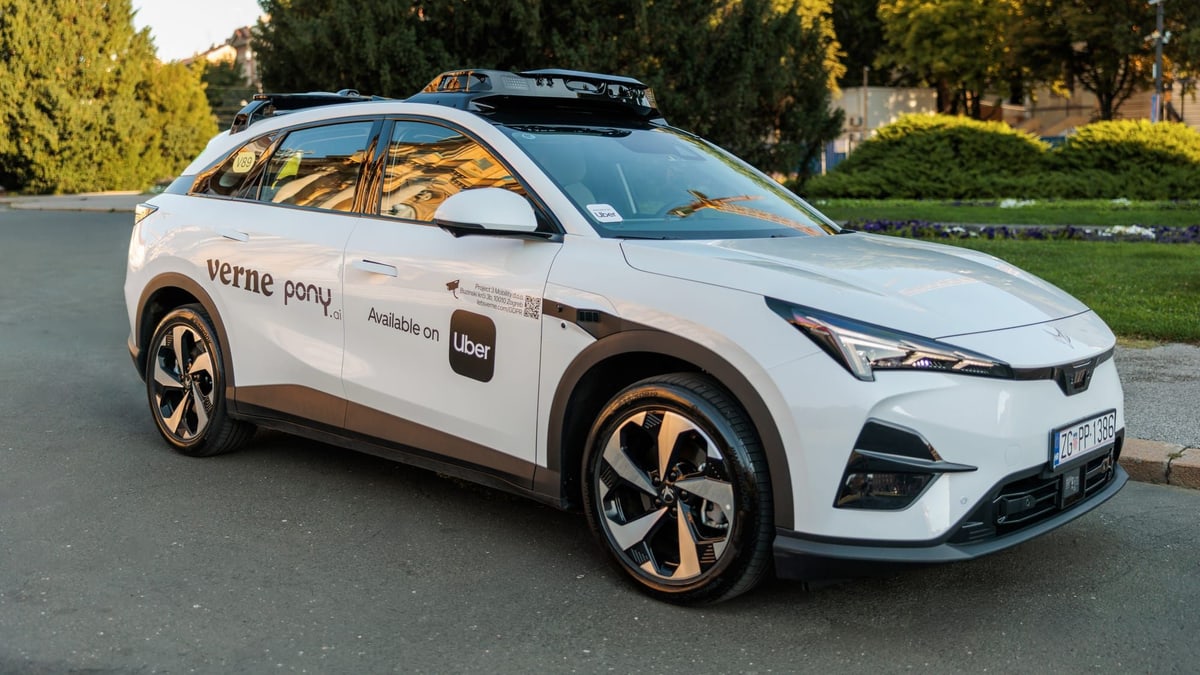
Self-driving taxis, often called robotaxis, are now being tested on Manchester's streets. On Oct. 14, Uber said it is working with two partners to try out the cars in the city: Pony.ai, which makes the self-driving system, and Verne, a Croatian company. Pony.ai said testing of its Gen-7 cars is underway and that the companies plan to bring them to the city. A week earlier, Pony.ai and Uber announced plans to bring the same cars to London.
The three companies already work together in Zagreb, Croatia's capital. Since Aug. 20, people there can book a self-driving ride in the Uber app in parts of the city, including the center, between 7 a.m. and 9 p.m. Pony.ai supplies the driving system, Verne owns the cars and runs the service, and Uber brings the riders. When the Uber service opened, a licensed operator sat behind the wheel watching the road. In September, Pony.ai and Verne began fully driverless test rides for invited passengers on a 22-kilometer route to Zagreb's airport. In August, Pony.ai and Uber said they plan to bring more than 2,000 Pony.ai self-driving taxis to Europe and to expand from Zagreb to four more European cities, without naming them.
A test is a long way from a taxi service. Under the UK government's code for trials, a self-driving car on trial must carry a safety driver who is ready, able and willing to take control; a separate government scheme lets approved cars run without one. According to a news report, the Manchester cars are mapping the city's streets with a safety driver at the wheel and no passengers. To carry passengers with nobody at the wheel in a taxi-like service in England, a company needs a permit from the national government, and the permit can't be granted unless every local taxi licensing authority where the cars would run agrees.
Local approval could be hard to win, and there is pushback in London too. The London Assembly's transport committee said on Oct. 11 that it had not heard enough evidence to persuade it that London should welcome driverless passenger services. According to a news report, unions representing ride-hailing drivers have warned that thousands of jobs would be lost, and Greater Manchester's transport body said no one has yet applied to run driverless taxis there, though it knows some companies are interested.
Uber says the tests are a first step toward making the technology available to people across the UK. None of the three companies has said publicly how many cars are testing in Manchester, who would run a service there, when riders could book one, or whether it would start with a safety driver on board, as the Uber service in Zagreb did.