
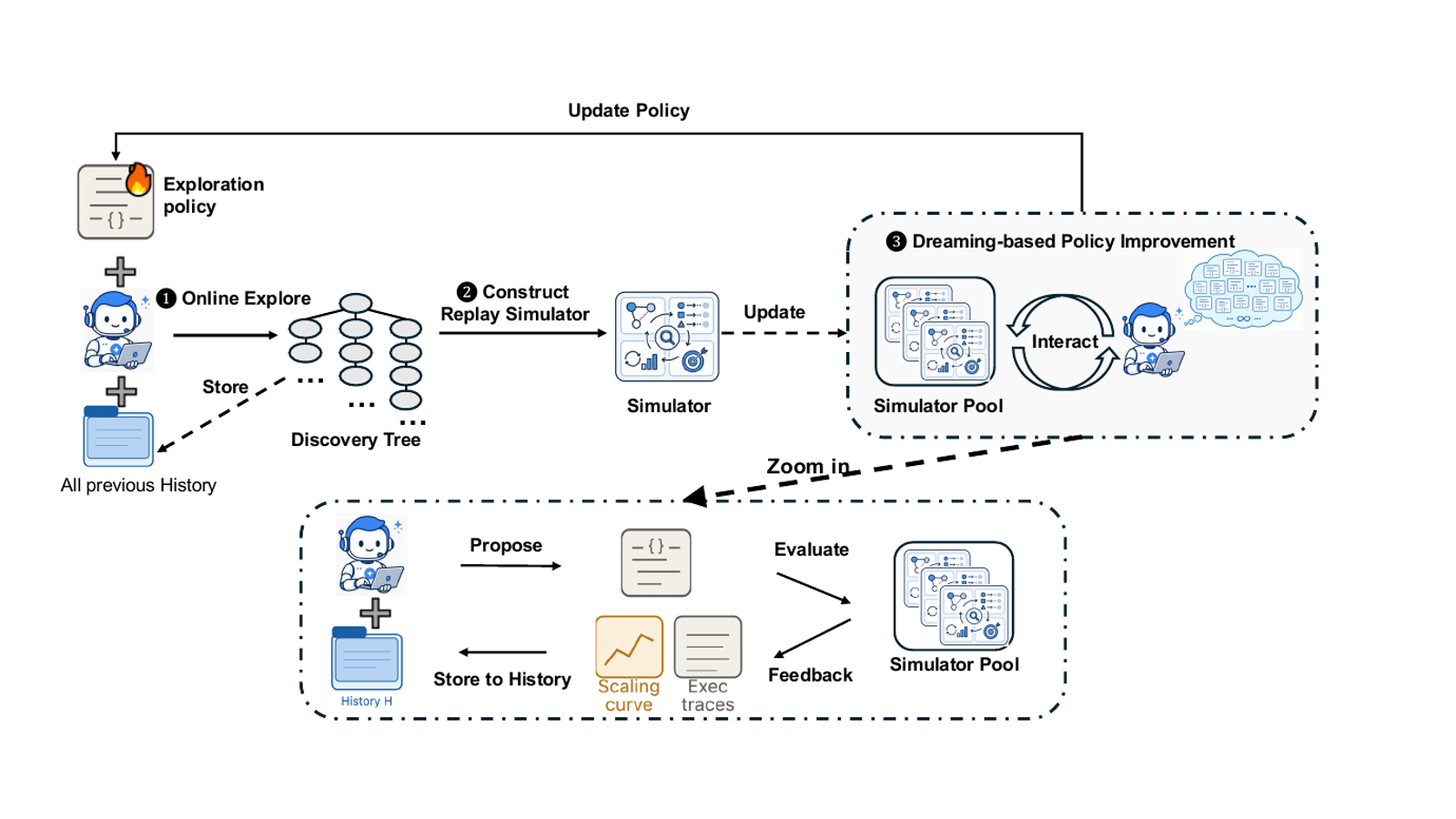
Google and Google DeepMind posted Dream-RSI on Sept. 14, 2026, recursively improving how discovery agents explore while model weights stay fixed. The paper matters because recursive self-improvement talk often means models rewriting themselves; this loop instead improves where to look, with auditable exploration-policy diffs rather than a new training run.
In plain terms, Dream-RSI is not a chat-model fine-tune and not weight-level self-improvement. An exploration policy decides which branch a coding agent tries next, how many paths to run in parallel and when to stop. After an online run, the agent's discovery tree becomes an exact replay simulator of the search space already visited, so candidate policies can be scored offline without new agent or evaluator calls; the winner ships for the next online round.
Tong Zheng and coauthors at Google, Google DeepMind, the University of Maryland and the University of Virginia describe a lightweight orchestration layer that makes branching, parallelism and stopping programmable while leaving the underlying coding agent unchanged. The project site stresses that the replay simulator is exact over the realized search space, not a learned world-model approximation. Only the exploration-policy code changes; models, evaluator and execution interfaces remain fixed. Three stages repeat: online explore, construct the replay simulator, then dreaming-based policy improvement and redeploy.
On a Lasso path solver task, the paper reports up to 162x fewer discovery-agent calls versus SimpleTES and about 1.7x fewer versus Recursive Fixed Exploration, a controlled same-agent baseline. Math tasks claim more than 50x budget savings versus SimpleTES within about 1,000 generations. On KernelBench, authors report 1.79x to 2.43x fewer generations or up to 2.09x better kernel performance under comparable budgets. Those efficiency figures are author claims; CellCog and Binary Verse AI independently warn that viral posts often drop the SimpleTES baseline and lead with 162x alone.
CellCog, Binary Verse AI and StartupHub.ai independently restate the explore-replay-dream loop and the fixed-weights scope. The GitHub repository github.com/zhengkid/Dream-RSI exists, but the README says the full codebase is still being prepared for release; the interactive walkthrough lives on dream-rsi.com as a live canvas drawn live, not a recorded demo video. Autocorrelation tables in the paper are a reality check: SimpleTES still leads some metrics there, so Dream-RSI is not uniformly best on every task.
Limits stay sharp. A replay simulator only covers branches the agent already visited; dreaming cannot invent an unvisited path that holds the better solution. What remains open is independent reproduction of the Lasso, math and KernelBench call counts, how far the online and offline loop must run before policy gains plateau, and when full code lands. Author benches and outsider briefings should be weighed separately until those points are settled.