
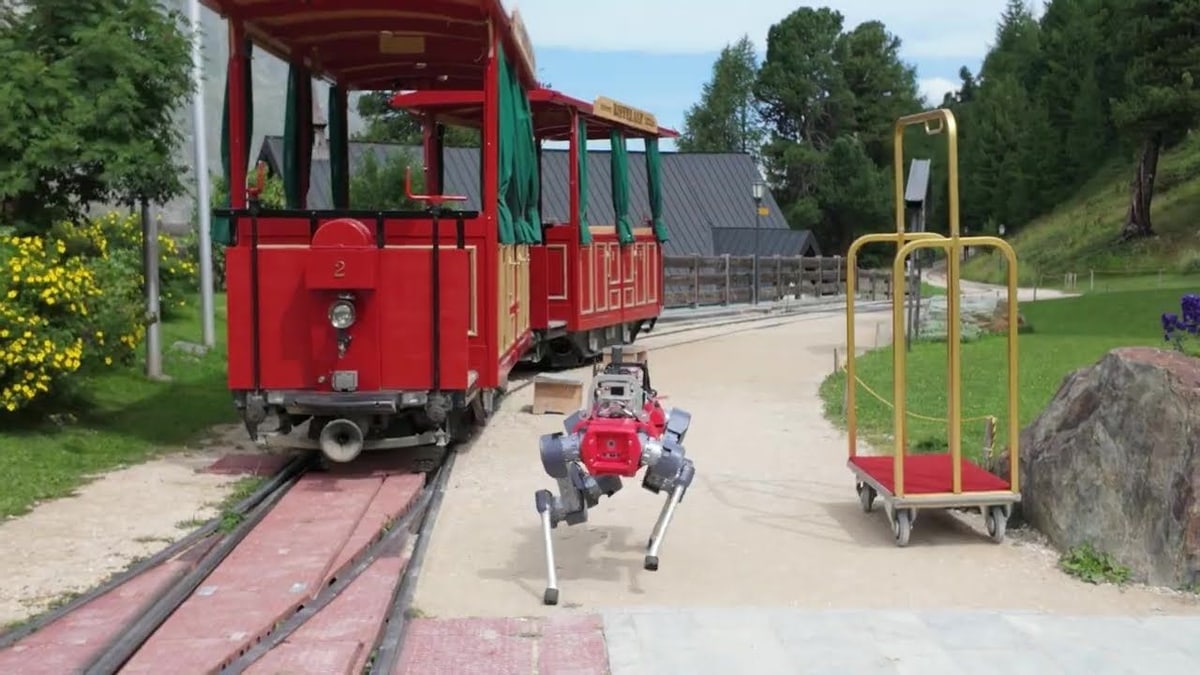
A four-legged robot walks down a mountain trail near Zermatt, in the Swiss Alps, keeping to the gravel path. On another hike it shares a lakeside trail with hikers and cows. Researchers at the Swiss Federal Institute of Technology in Zurich built the system that guides it, called ROAM, and describe it in a paper in the journal Science Robotics, which they posted on Nov. 18. One of the nine authors is at Apple, which helped fund the work.
This robot can already walk over almost any ground when a person steers it with a remote, the researchers say. What it lacks is common sense: gravel is fine, a lake is not, and a sign can close a trail.
ROAM borrows that common sense from an AI model that looks at a picture and answers in words. In the field tests, the team used a version of OpenAI's GPT-4 that can read images. Several times a minute, it looks at a picture from the robot's camera, names what it sees and rates how risky each thing is, from a gravel path that is safe to cows and trees to steer clear of. The AI never tells the robot exactly where to step or how fast to go. A second, faster program finds each named thing in the camera picture, and the ratings are painted onto a map of the ground ahead. Two more programs, trained by trial and error in a computer simulation, read that map to steer the robot and place each foot.
Because the AI can read, the robot follows signs. On the university's campus, a sign warning of road work marked the path as risky on the robot's map and sent it onto the grass, and a second sign marking the end of the road work brought it back. Run with a system that judges the ground only by its shape, the same robot walked into the construction site. At a test site, a "do not step here" sign on wooden pallets made the robot keep off them and walk on the grass.
The longest test, in August 2024, ran about 10 kilometers from Gornergrat station down to the Furi cable car station near Zermatt, over gravel, rock, grass, lakesides and alongside train tracks. People had to step in five times across that hike and a shorter one around a lake called Seealpsee. They stopped the robot as it neared the lake's edge and stepped in on a steep, slippery slope where it took a path that sloped toward the lake. They also carried it over a turnstile it could not fit through, and stepped in twice at construction sites, once after it walked into a fence. The researchers trace four of the five to the program that finds the named things in the camera picture, and none to the AI's own judgment. Each hike and each campus test was run once. Takahiro Miki, who led the work, wrote online that team members followed the robot along the trail, carrying batteries and filming.
The AI judges risk by sight, and the researchers say telling thin ice, deep mud or loose gravel apart depends heavily on touch. The hikes ran in daylight, and the team did not test much in heavy fog, heavy rain or at night. In the tests, the robot needed an internet connection to reach the AI model, and it still follows a route planned in advance, because the AI could not read maps well enough to plan one. The lab has shared code online for the AI step and the step that finds things in the picture. The researchers write that AI models like this one will need to improve before robots can find their way everywhere on their own.