
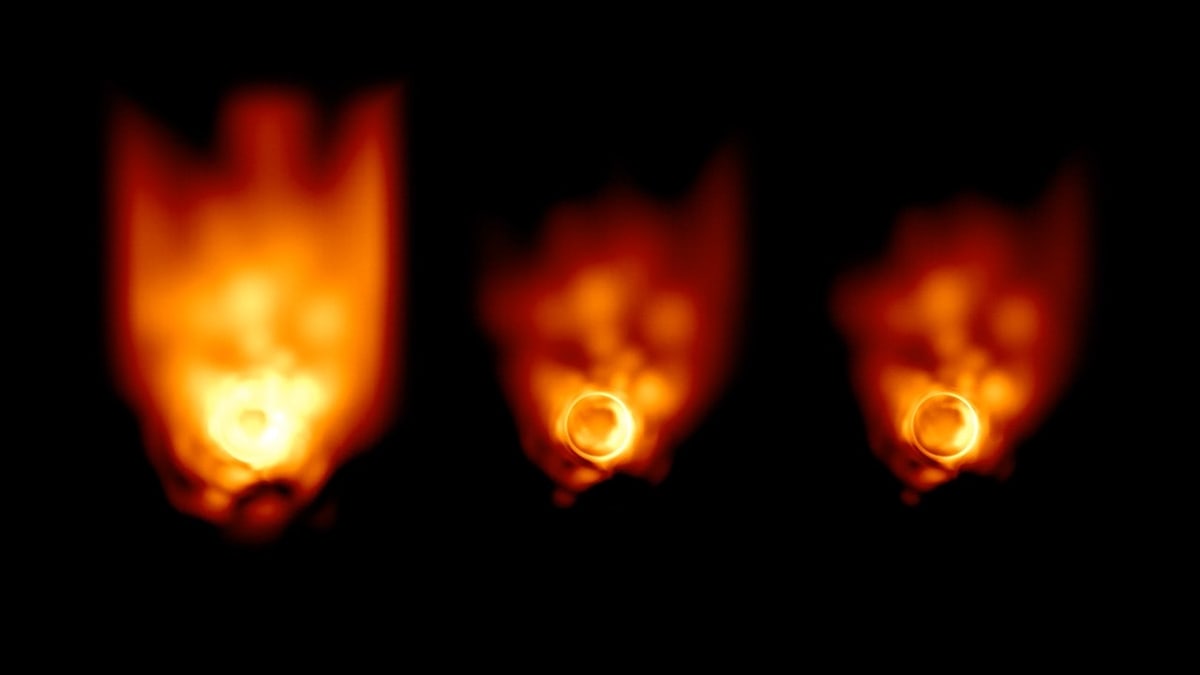
Taking a picture of a black hole needs a telescope the size of Earth. The Event Horizon Telescope gets there by linking radio dishes in places such as Hawaii, Chile, Spain, Mexico and the South Pole. Each dish records the radio glow of hot gas swirling around the black hole. Before anyone can make an image, the recordings from every pair of dishes have to be lined up in time and combined. NVIDIA says the telescope's recordings add up to millions of gigabytes of data.
NVIDIA described a part of its cuPhoton software called xBeam in a technical post on Nov. 13, and highlighted it in a Nov. 16 announcement. xBeam does that combining step on NVIDIA's own chips. NVIDIA says the work that once took more than a month now takes eight minutes. It says the software has already combined observations of two black holes that shoot out powerful jets. NVIDIA also says it can run on large clusters of its chips or on its small DGX Spark computer.
NVIDIA says it works on the tool with the Harvard-Smithsonian Center for Astrophysics and MIT's Haystack Observatory. The code is free to download from NVIDIA's public page on GitHub, a site for sharing software, under a license that lets anyone use, change and share it. NVIDIA calls cuPhoton a set of example tools that research teams can run, inspect and adapt to their own instruments.
The speed figures come from NVIDIA, which has not said what computers or how much data the month-long and eight-minute times refer to. In a separate test it describes in more detail, NVIDIA says xBeam did in about a minute, on a large system of its chips, a job that took ordinary computer processors about nine hours. xBeam also covers only one step: NVIDIA says other programs do the later work of cleaning up the data and turning it into a picture. NVIDIA says it checks xBeam's results against another program that does the same job on ordinary computer processors, but it does not say how closely they match.
NVIDIA also pitches xBeam as something AI agents, AI that can carry out tasks on its own, could run from start to finish: reading details about the recordings, setting up and starting the jobs, and watching them run. It says its tests so far focus on the speed of its chips rather than on agents running the work, so that idea has not yet been shown.
NVIDIA's post also points to a proposed project called the Black Hole Explorer, which aims to measure a thin ring made by light that loops around a black hole before escaping. The ring's size and shape can help pin down how heavy the black hole is and how fast it spins.