
Odyssey unveiled Odyssey-3 on Sept. 15, 2026, a frozen foundation world model it says can steer arms, Flexion humanoids, cars, drones and game agents through small action decoders. That matters because physical AI usually trains a separate stack per body; a shared backbone that adapts with hours to tens of hours of embodiment data would change how labs amortize robot learning, if the demos hold outside Odyssey's clips.
In plain terms, Odyssey-3 is not a chat model and not a finished robot product. It is a pretrained world model that predicts how scenes evolve; Odyssey says it keeps that backbone frozen and trains a lightweight action decoder on observation-action pairs for each machine, so the same world knowledge is reused instead of training a new policy from scratch for every arm, humanoid or vehicle.
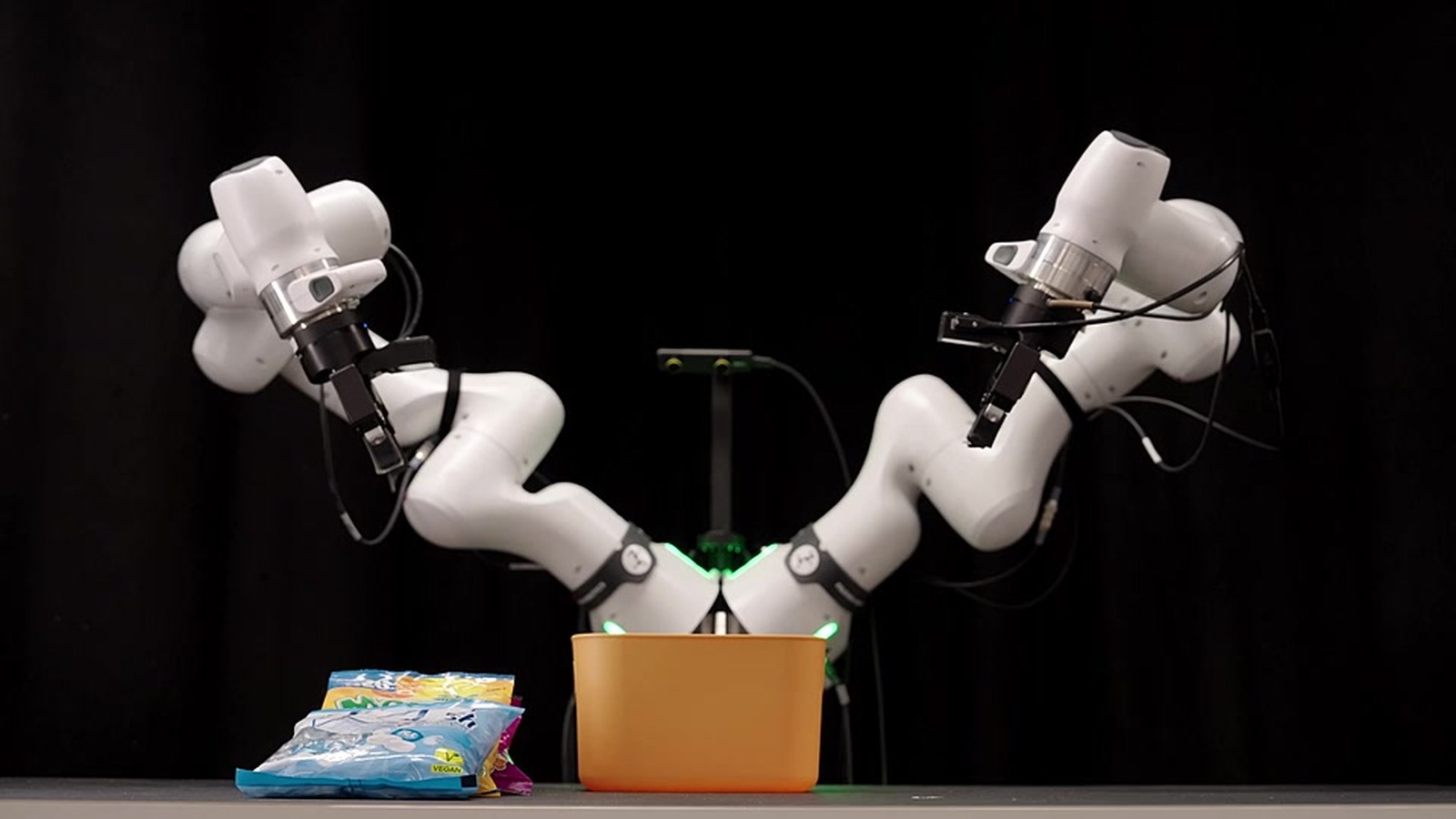
Founders Oliver Cameron and Jeff Hawke describe Odyssey-3 as an autoregressive diffusion transformer trained on diverse visual observations. On the company page, robot-arm policies use tens of hours of demonstrations and are said to show recovery moves missing from the demos, such as re-gripping after a miss. Flexion built humanoid controllers on the same backbone with tens of hours of teleoperation; Odyssey reports real-time execution and better tolerance to lighting changes than unnamed vision-language-action baselines, without publishing humanoid success rates or baseline names.
For driving, Odyssey says a policy trained with the backbone frozen on about 20 hours of simulated driving ran closed-loop on public roads in India, and that simulation-trained policies traveled about 77% as far between safety-driver interventions as policies trained on real footage using the same Odyssey stack. TechTimes notes that 77% compares two Odyssey policies, not commercial robotaxi systems, and that absolute kilometers-per-intervention figures were not published. Cross-game demos claim a mobility policy trained on roughly two hours of GTA footage transferred to horseback movement in Red Dead Redemption 2 without further training on that title. Drone clips on the launch page are simulated indoor flight, not outdoor aircraft autonomy.
Humanoids Daily, TAO Media, TechTimes, OrcaRouter and The AI Insider independently covered the Sept. 15 launch and the Flexion collaboration. Those outlets also flag what is still missing: no Odyssey-3 technical report or arXiv paper linked from the announcement, no public weights on the company's Hugging Face org as of Sept. 21, 2026, unnamed VLA baselines, and product-card language that Odyssey-3 materially advances state-of-the-art physical accuracy without a published scoreboard. Odyssey says it plans a public release in the coming weeks.
What remains open is whether third parties can match the recovery, lighting, driving-distance and cross-game transfer claims once weights and an evaluation protocol ship. Company demonstration videos and outsider briefings should be weighed separately until those points are settled.