
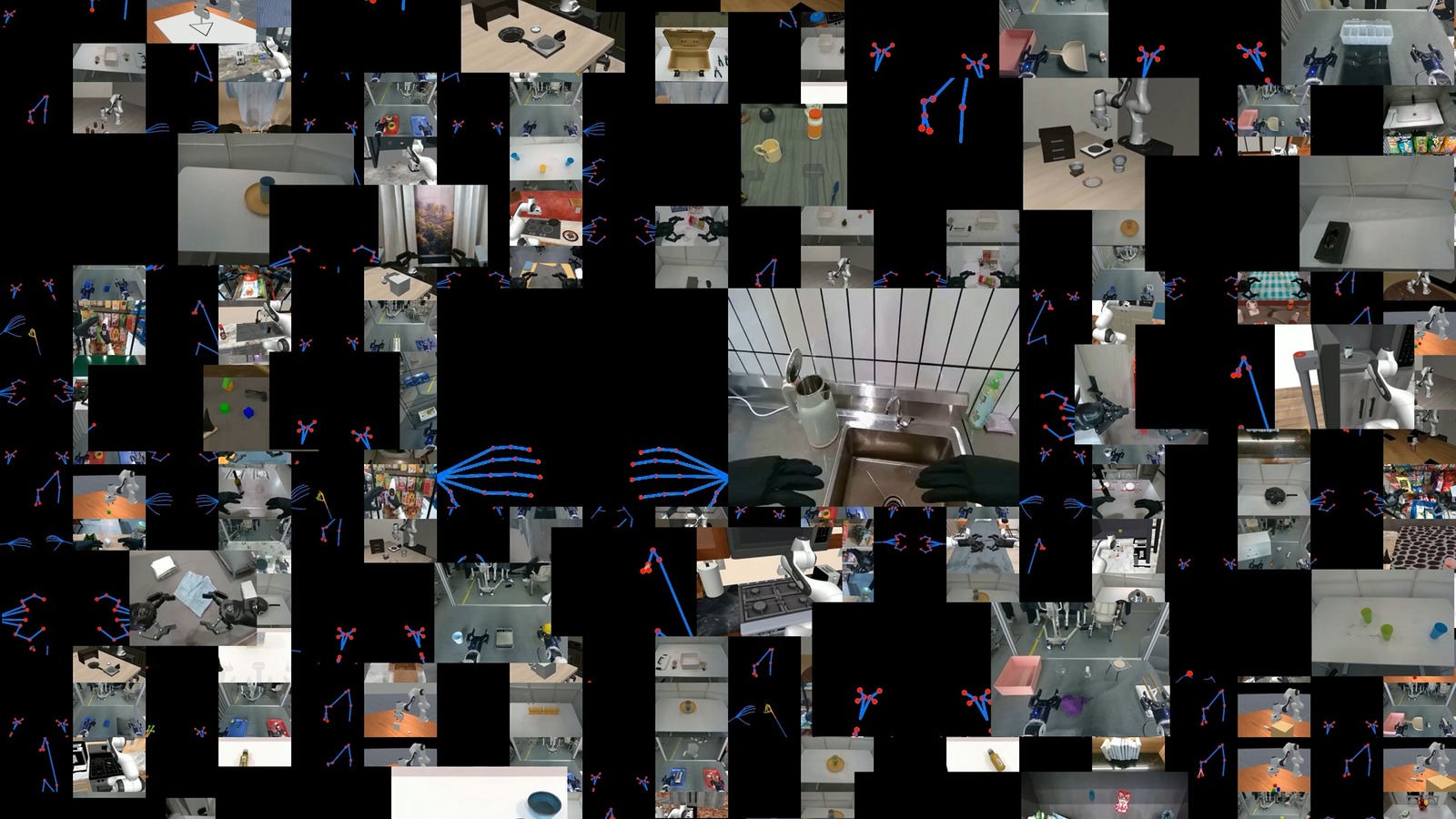
Beijing Innovation Center of Humanoid Robotics (X-Humanoid) submitted Pelican-Sim 1.0 on Sept. 10, 2026, an action-conditioned world-model simulator that predicts future robot camera frames from visual context and actions. That matters because embodied labs still lean on scarce teleoperation and slow physics sims; a queryable learned simulator would cut how much new robot time each skill needs, if author-reported gains hold outside the paper's suites.
In plain terms, Pelican-Sim 1.0 is not a chat model and not a finished robot controller. It is a world-model simulator: given an initial RGB frame and a robot action sequence, it rolls out predicted future observations so downstream code can mint training data, score policies, pick among action candidates, or improve a policy without running every trial on hardware.
The WFM System Group technical report (arXiv:2609.12036, cs.RO) describes four design pillars. A fixed 28-dimensional action-value layout covers left and right sides (arm joints, gripper opening, and hand joints, with unused slots zero-filled). Camera-aligned URDF-rendered action videos inject image-space motion geometry alongside those numbers. Sparse mixture-of-experts layers expand capacity for heterogeneous dynamics. Causal adaptation plus distillation yields a four-step autoregressive rollout the authors say is 5.67 times faster than a 35-step teacher. The training corpus is described as about one million real and simulated trajectories (about 8,000 hours) across seven datasets including AgiBotWorld Beta, RoboMIND, and RoboTwin; treat the corpus size as an author claim.
On held-out video prediction, authors report PSNR of 22.276 dB on AgiBotWorld Beta, 23.850 on RoboMIND, and 30.383 on RoboTwin, which they cast as gains of 4.636, 2.080, and 10.343 dB over the strongest baselines they retrained (EnerVerse-AC or Ctrl-World). On RoboTwin downstream with a pi0.5 policy, they report that 500 generated trajectories plus 50 demonstrations per task raise success from 70% to 93%, policy-evaluation Pearson correlation of 0.994 across five checkpoints, and relative success gains of 47.7% for action selection and 20.3% for policy improvement. Those benches are author-reported, not third-party re-runs.
Hugging Face Papers indexed the submission (listed Sep. 10; submitted to the feed by Shilong Zou on Sep. 14), Semantic Scholar carries a record, and a Sept. 16, 2026, 51CTO technical blog restates the dual-condition MoE design and the 70% to 93% data-gen claim without a controlled re-evaluation. Live project assets sit at zoushilong1024.github.io/Pelican-Sim1.0/; the GitHub stub ZouShilong1024/Pelican-Sim1.0 is Apache-2.0 with README and LICENSE only as of Sept. 21, 2026. Paper-printed Open-X-Humanoid and Pelican-Sim1.0.github.io URLs do not resolve to the working repos, and no Pelican-Sim weights appear on the Hugging Face model hub. The pack is distinct from Pelican-Unified and from peer Discover world-model stories Odyssey-3, XPACE, Fire3D, LingBot, WorldSculpt, Dream-RSI, and UnifoLM.
What remains open is whether third parties can match the PSNR margins and RoboTwin policy lifts under shared protocols once checkpoints and inference ship, how fair the baseline recipe match is, and how far qualitative OOD demos generalize beyond the reported suites. Author benches, outsider index and explainer restatements, and the stalled open-weights promise should be weighed separately until those points are settled.