
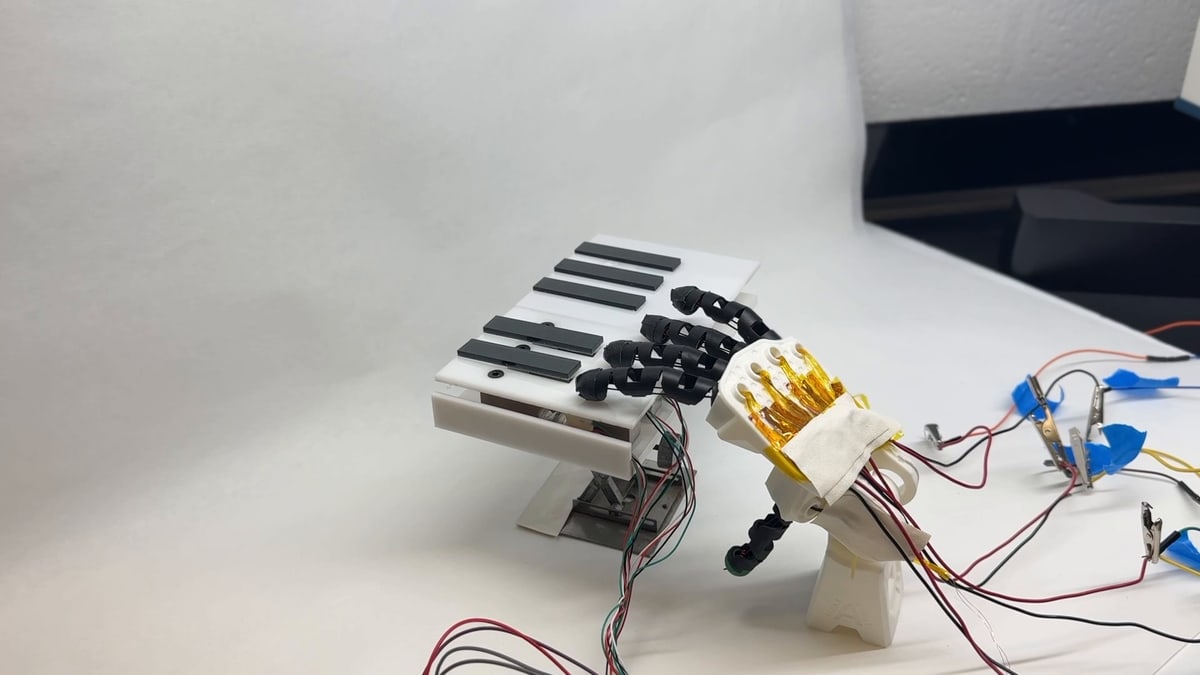
A robot finger presses a piano key, pauses and moves on to the next note. Engineers at the University of Pennsylvania built the artificial muscle that moves it: a thin fiber made from a flexible material that changes shape when heated. The team, led by Shu Yang and Cynthia Sung, describes the work in a paper published in September in the journal Advanced Functional Materials, and Penn shared it on Nov. 12.
Robots usually move with motors, and Penn says copying the fine control of a human hand with motors can take bulky parts and complicated designs. Soft fibers that pull like muscles could fit where motors can't. Penn says the approach could one day help robot faces, where dozens of small muscles must fit into a tight space to make natural expressions.
Materials like this one have had a weakness. Heat makes them tighten, but they can keep tightening, or slip back toward their starting shape as they cool, so it is hard to make them stop partway and stay there. The Penn team ran an ultrathin copper coil through each fiber. The coil warms the fiber, and its electrical resistance changes as it heats, which tells a controller how far the muscle has moved. The controller then turns the heat up or down to hold the muscle in place. The team also added graphene, which Penn says makes the material softer yet tougher. The paper says one muscle held a set position for more than 20 minutes.
In the demos, fingers driven by the muscles pressed laser-cut piano keys sitting on force sensors, and a note sounded when a press was hard enough. By changing how far and how long a muscle tightened, the team played soft and loud notes and short and long ones, and two or three fingers pressing at once played simple chords. A pair of robot eyes used pairs of muscles that pull against each other, the way eye muscles work, to look left, right and around in circles on command.
The eyes are slow so far: a sweep from one side to the other took about eight seconds, with each muscle's partner helping it stretch back out as it cooled. Both demos are lab models, and the researchers write that future work could focus on how the muscles handle heat and how much energy they use.
Ziyun Zhang, one of the two lead authors, says the next challenge is to bring more of these muscles together so they can make more complex movements. The team is also interested in using AI and cameras to coordinate bigger systems, but says it must first solve more practical problems.