
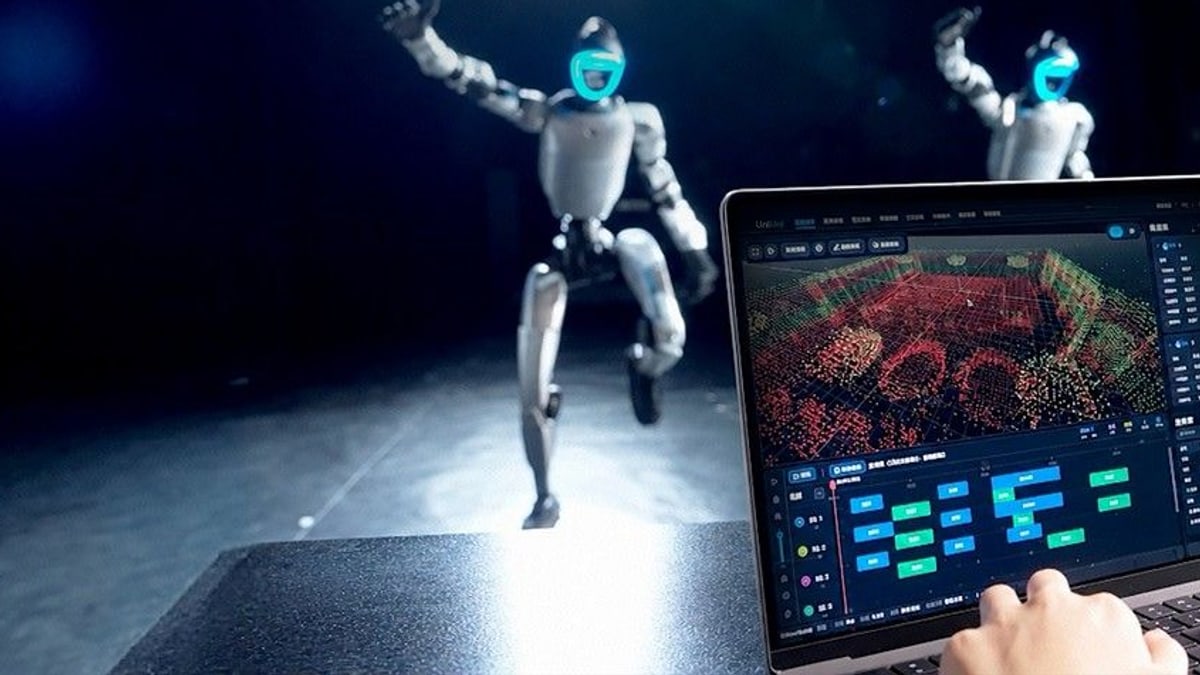
Robot maker Unitree has released UniUni, a free app for Windows and newer Mac computers that plans and runs group performances by its humanoid robots. Unitree announced it on Oct. 16 and says the app choreographs the moves and formations of the whole group, keeps watch on every robot while they perform, and can bring them to a stop for safety.
Planning a show works on a drag-and-drop timeline, a bit like video-editing software, with no code to write. A user draws each robot's path across the floor, watches the formation take shape in a 3D view, lines up moves such as a wave, a bow or a dance on the timeline, and can run the show in time with music. Before a show, the app maps the stage with laser scans so each robot knows where it stands to within centimeters, Unitree says, and it checks the planned formations for collisions. Moves come from a built-in set, an online store of Unitree's own moves and ones other users share, or can be made by hand.
Users can also just type what they want. In Unitree's own example, someone asks for six robots in two rows of three doing a dance called the yangko, then adds a spin in the second part and a wave at the climax. In that example, the app's AI lays out a path for each of the six robots and picks the moves, and the user can then adjust the timing of each part on the timeline. Unitree says this greatly cuts the work of complex choreography, since no one has to adjust each robot's path by hand.
Unitree says the same system has already run its robots' group performances at several high-profile events, including the Hong Kong Sevens rugby tournament, and that the tool is now open to all its customers, though it is built for its H2 and G1 humanoids. Its page also says the app can arrange a hundred robots to form the shapes of letters and words without bumping into each other.
The app is built for Unitree's own H2 and G1 humanoids and needs a Unitree account. Unitree doesn't say what AI sits behind the typed requests, and so far only its own examples show how well it handles longer or unusual requests, or how a big group of robots copes on a crowded stage.