
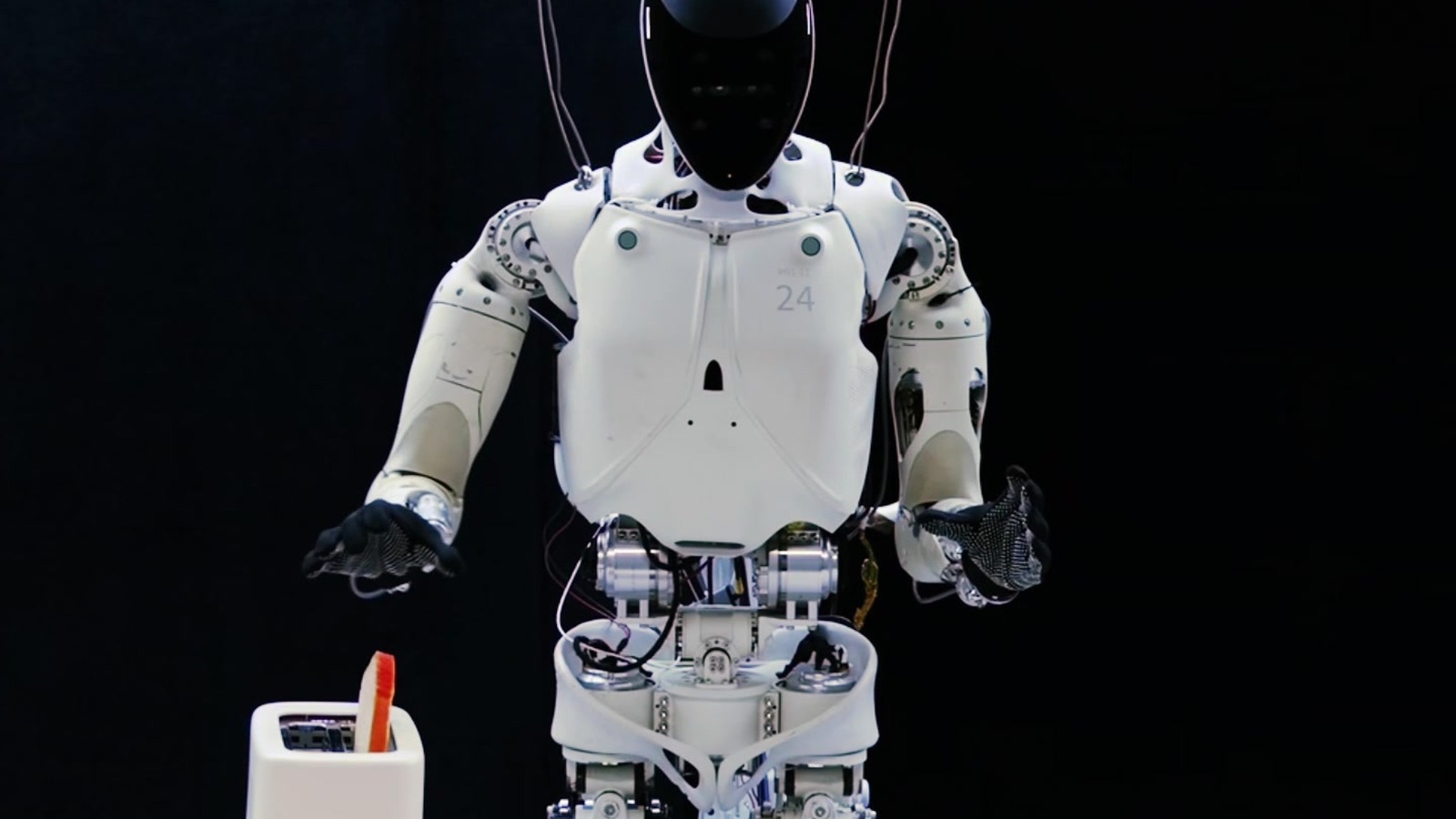
XPENG Robotics submitted XPACE on Sept. 15, 2026, a joint world-action and world-simulation model for its IRON humanoid. That matters because humanoid training still leans on scarce teleoperation; a shared video backbone that turns human footage into control and recovery data would cut how much new robot data each skill needs, if author-reported IRON gains hold outside XPENG's trials.
In plain terms, XPACE is not a chat model and not a public IRON software drop. It is a shared video transformer that, in one mode, predicts future frames plus executable action chunks from observation and instruction, and in another mode predicts how the scene would look under prescribed skeleton and camera controls without language. That joint setup is how the authors say human video can teach skills missing from robot demos, and how the model's own simulator can mint recovery examples for DAgger fine-tuning.
The tech report from XPENG Robotics' World Model Team describes an asymmetric mixture-of-transformers with a shared causal Video Transformer. Video-action mode predicts future video then 16-step action chunks through an Action Transformer; simulation mode prefers token-addition skeleton conditioning. Authors organize about 5,000 hours of embodied video into four layers (broad egocentric video, human video-action, bridge data, and IRON teleoperation) and train with a coarse-to-fine curriculum that progressively emphasizes robot control while retaining human experience. Treat the 5,000-hour corpus size as an author claim.
On IRON-R01-1.11, authors report 68.3% average success (progress 0.84) across banana pick-and-place, water pouring, and bowl stacking (20 trials per task) versus 40.0% for DreamZero and 6.7% for GR00T. Supervised robot teleop and action-labeled human data are matched, but only XPACE receives Stage I video-only adaptation, so the gap compares full recipes rather than equal ablations. Separately, after self-gradient-forcing simulator adaptation and an 8% recovery mix, they report mean success rising from 61.7% to 86.7% and progress from 0.81 to 0.93 on banana, water pour, and cola handover, with water pouring moving from 50% to 95%. Those two averages are not the same task set; bowl stacking is in the baseline suite and cola handover in the DAgger suite.
RobotToday's Sept. 17, 2026, industry brief and an arXiv TLDR page independently restate the ~5,000-hour framing and the author-reported 68.3% average without controlled re-evaluation. The lab project page hosts demos and a PDF mirror and links the GitHub org, but github.com/xpeng-robotics/xpace returns 404 as of Sept. 21, 2026, and no dedicated public training code or weights were located. XPENG's Sept. 8 corporate IRON note cites 76 body degrees of freedom, 21 per hand, and up to 2,250 TOPS from three Turing chips; those figures are company hardware claims, not XPACE method results.
What remains open is whether third parties can match the IRON success and recovery lifts under shared protocols once code and weights ship, how fair the Stage I video-adaptation asymmetry is against DreamZero and GR00T, and how far simulator-synthesized recovery generalizes beyond the reported suites. Author benches, RobotToday restatements, and corporate IRON specs should be weighed separately until those points are settled.