
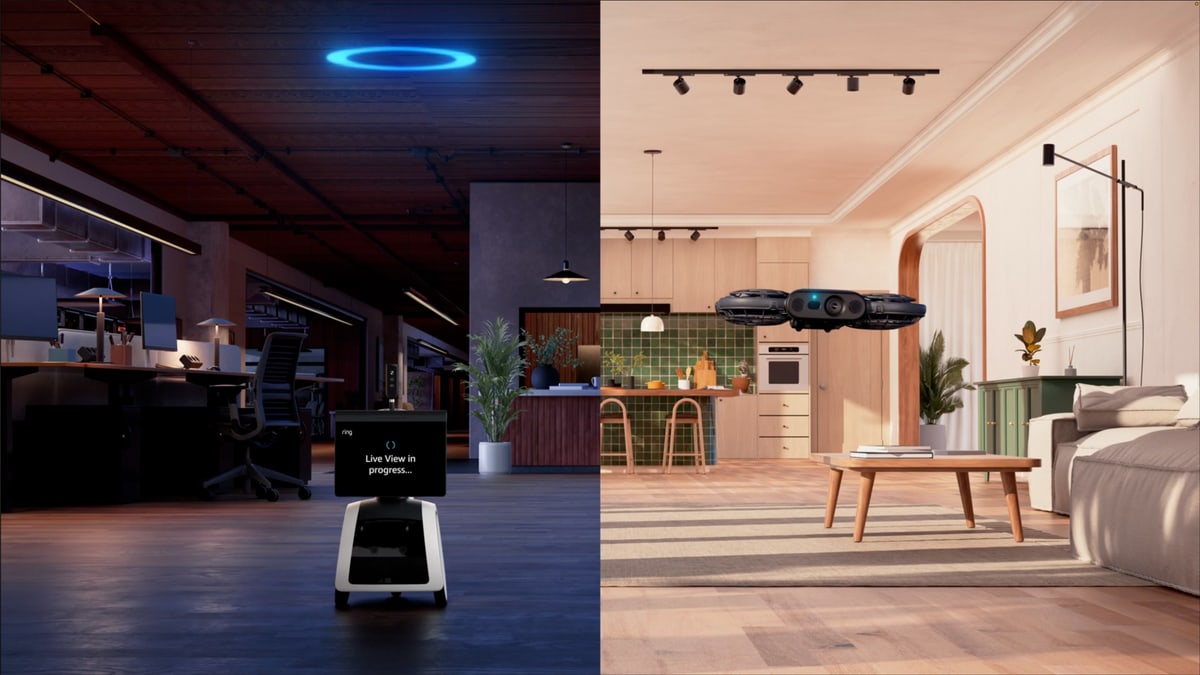
Ring, the home security brand Amazon owns, announced two robots on Nov. 10 that move a security camera around a home or business. Drone Cam is a small flying camera for inside a home. Rover Cam is a wheeled robot for offices, stores and warehouses. Both can patrol on a schedule or be sent out on demand, and both set off on their own when another Ring camera, sensor or alarm is triggered. Owners watch what they see in the Ring app.
What makes them work is a robot finding its own way indoors. Amazon says both run on a system it calls AI Pilot, which uses each robot's cameras and sensors along with computers it reaches over the internet. At setup, an owner carries Drone Cam through the home, while Rover Cam explores by itself. Amazon says the system turns what it sees into a floor plan and suggests spots worth checking, such as a side door or a cash register. On a patrol, Amazon says, the system plans a route and steers around furniture and shelves as it goes. Neither robot has shipped yet, so how well they find their way in real homes and shops is not yet known.
Rover Cam costs $999.99, can be preordered, and ships in the U.S. on Dec. 16. It has a camera on a mast that rises to see over counters and shelves, a siren, a tower of red lights, and two-way audio so the owner can talk to whoever is there. Drone Cam costs $249.99 and is due to ship in the U.S. on Jan. 27, 2027. Its pages offer only a sign-up for updates, and Ring's notice says the drone has not yet been authorized under the rules of the U.S. Federal Communications Commission and cannot be sold until it is. Neither ships to Canada. Scheduled patrols, and watching saved video later, need a compatible paid Ring plan. Both come with a free 30-day trial of the plan, which Ring says doesn't apply at a location that already has a plan.
Both have limits. Ring says Drone Cam flies for up to 8 minutes at a time, a figure from controlled tests with a new, fully charged battery, and real flights will vary. It flies back to its dock to recharge when a flight ends or the battery runs low. Because it steers by what its cameras see, it works best in rooms with plenty of visual detail, and Ring warns that shiny floors, blank walls, glass and mirrors may throw it off. Rover Cam works on a single indoor floor and can't use stairs. Ring says it doesn't currently work with black glossy floors, curved edges, sunken areas or raised edges between floor types taller than about 1.4 inches (3.5 centimeters), that it covers up to 5,000 square feet, and that it isn't suitable around children under 3 or small pets.
Ring says Drone Cam's camera is off while it sits in its dock. Rover Cam keeps watching for people even while docked and starts recording when it sees one, unless its owner puts it in a sleep mode that lowers its camera and turns off its microphone. Both show a light when they record. Ring also says the drone's propellers aren't quiet, and that both robots are meant to be noticed by anyone who shouldn't be there.
Amazon says Rover Cam grew out of its Astro home robot, whose owners said patrolling was the feature they liked most. Ring first showed this drone, then called the Always Home Cam, in 2020, and Ring founder Jamie Siminoff held it back until its design, sensors and data processing were ready, according to a news report.