
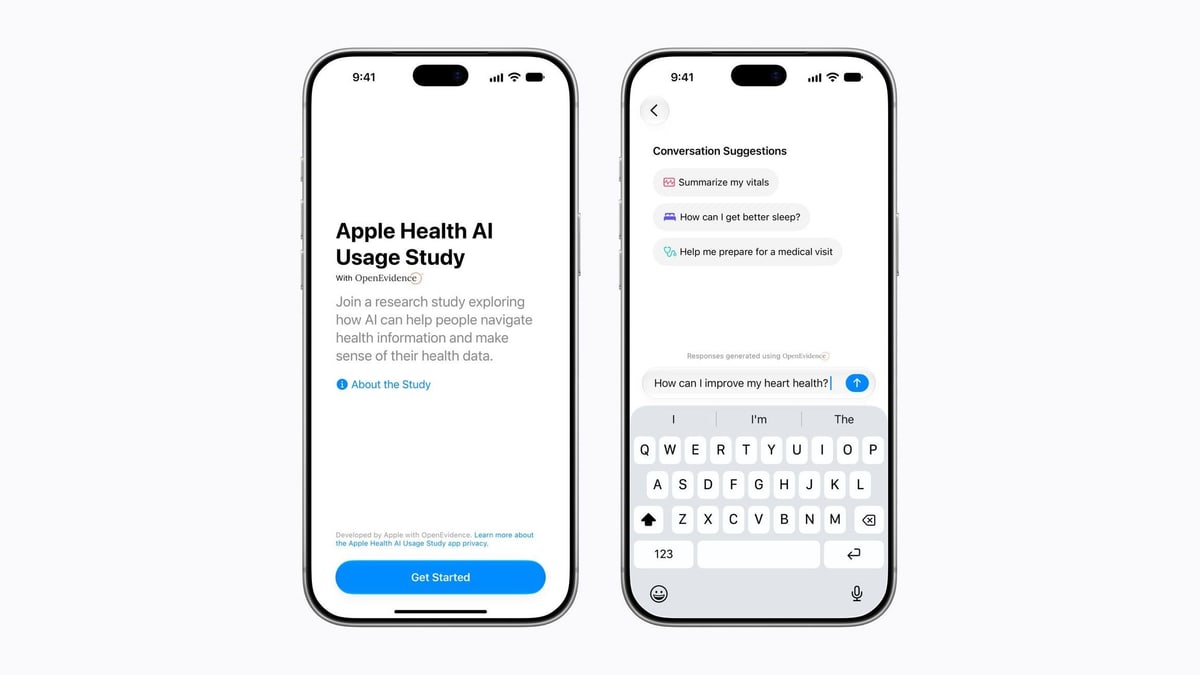
Apple on Sunday, Nov. 15, launched the Apple Health AI Usage Study, a U.S. research study built around a new iPhone app that answers health questions with AI. Apple says the study looks at what makes people trust such answers, how well they understand them, how good the answers are and what people then do about their health. Apple says it hopes what it learns will inform how Apple and others design health AI.
The answers come from OpenEvidence, an AI service that Apple says is widely used by health care workers and draws on journals such as The New England Journal of Medicine, The Journal of the American Medical Association and Nature. Participants can ask everyday health questions, get answers in plain language and follow links to the published research behind each one. They can also choose to share health data from their iPhone, such as resting heart rate, activity, sleep or lab results, which Apple says lets the app tailor its answers to them. Apple says the study will also explore whether the app can help people prepare for visits with their own doctors. The app also asks participants to rate the quality of its answers.
The study is open to up to 200,000 people 21 and older across the United States. They need an iPhone 15 Pro or a later model that supports Apple Intelligence, Apple's set of AI features, running iOS 26 or later. They join through the free Apple Health AI Study App on the App Store.
Apple says the app is not meant to diagnose or treat any condition or to replace a doctor's advice, and that participants should check health concerns and medical information with a doctor. Apple also says AI health tools "may at times offer responses that are incomplete or unclear," and that this is why the research is needed. Apple says the app has safety checks meant to spot certain worrying questions and point people to a doctor or other help.
Apple says study data will not be used to train AI models, and that participants decide whether to share any health data or survey answers. Apple's general privacy policy for its health study apps says that if someone leaves a study, Apple may not delete what it has already collected and may keep using it, though each study's consent form sets the details. The same policy says study data may be used to develop health products and, if the consent form allows, for other research, and that deleting the app does not take someone out of a study.
Apple has not said whether it plans to bring answers like these to its own Health app or to Siri, or when it will share what the study finds.