
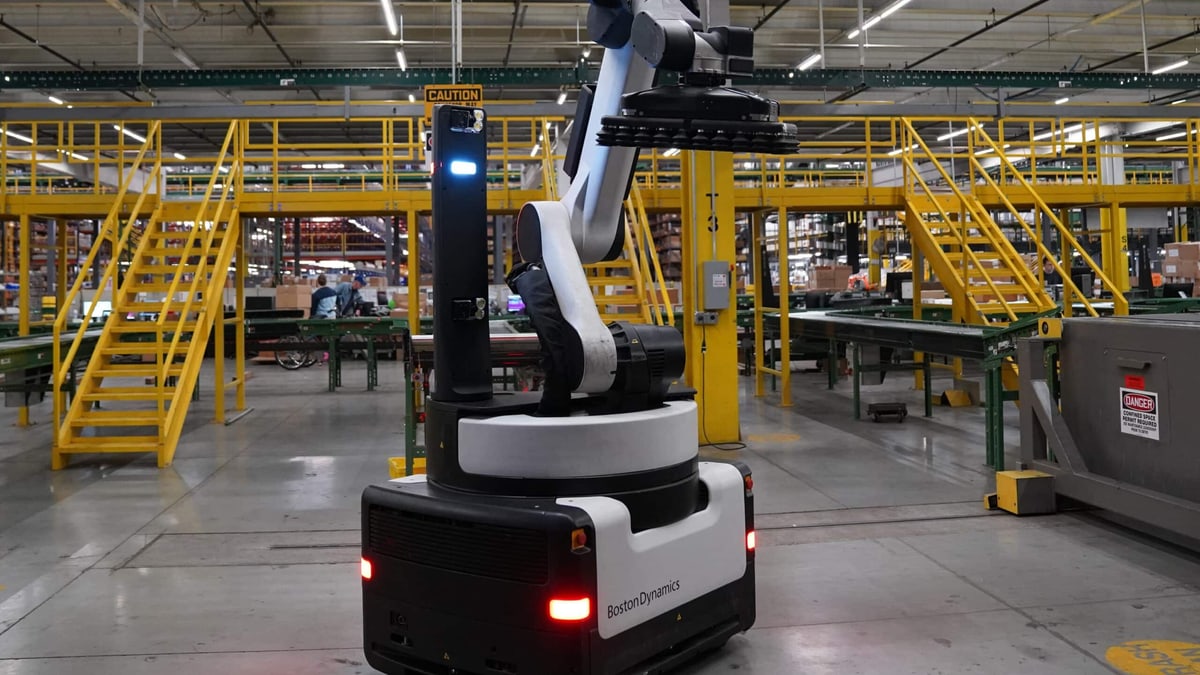
Boston Dynamics, the company behind the four-legged Spot robot, on Tuesday, Nov. 3, unveiled Stretch Gen 2, the next version of its robot that unloads boxes from truck trailers in warehouses. The company says it studied more than 100,000 hours of the first Stretch at work, and the tens of millions of boxes it has unloaded, to find the most common causes of unplanned stops.
Brian Donnelly, who leads the company's logistics robot business, says every hour a robot sits idle is an hour of work that piles up on the loading dock. "With Gen 2, we focused on the things that actually took robots offline in the real world," he said.
Many of the changes are to basic hardware. Boston Dynamics says it removed 81 percent of the robot's internal cabling, about half a mile of it, which it calls the biggest source of on-and-off electrical faults. The robot now uses heavy-duty, car-grade plugs that hold up to shaking. New joints can keep turning past a full circle instead of hitting a hard stop, which the company says caused mechanical stress. The emergency stop button sits lower, so a falling box is less likely to set it off by accident.
Repairs should be faster too, the company says. One big repair, swapping out a full drive unit, now takes about one hour instead of a full day. New diagnostic tools let a customer's own maintenance staff do more of the routine service. The robot also has a new onboard computer, and Boston Dynamics says regular software updates will improve how it spots boxes and plans its moves, with no new hardware needed.
Boston Dynamics says Stretch Gen 2 unloads up to 1,000 boxes an hour, though the rate depends heavily on things like how heavy the boxes are and how neatly they are stacked, and the top rate comes from picking several boxes at once. Its battery lasts two work shifts, and a fast charger fills it to 90 percent in about 75 minutes. Lights on the robot let it work in dark trailers, and the company says the robot's camera system recognizes most packages from day one with no programming.
The company also says Stretch has more deployments than any competing product in logistics, but it gives no count. Nor has it said how often the first Stretch broke down, or how much less often it expects Gen 2 to. It has not said what Gen 2 costs, when it ships or which customers will get it first, or whether robots already in warehouses can be upgraded.