
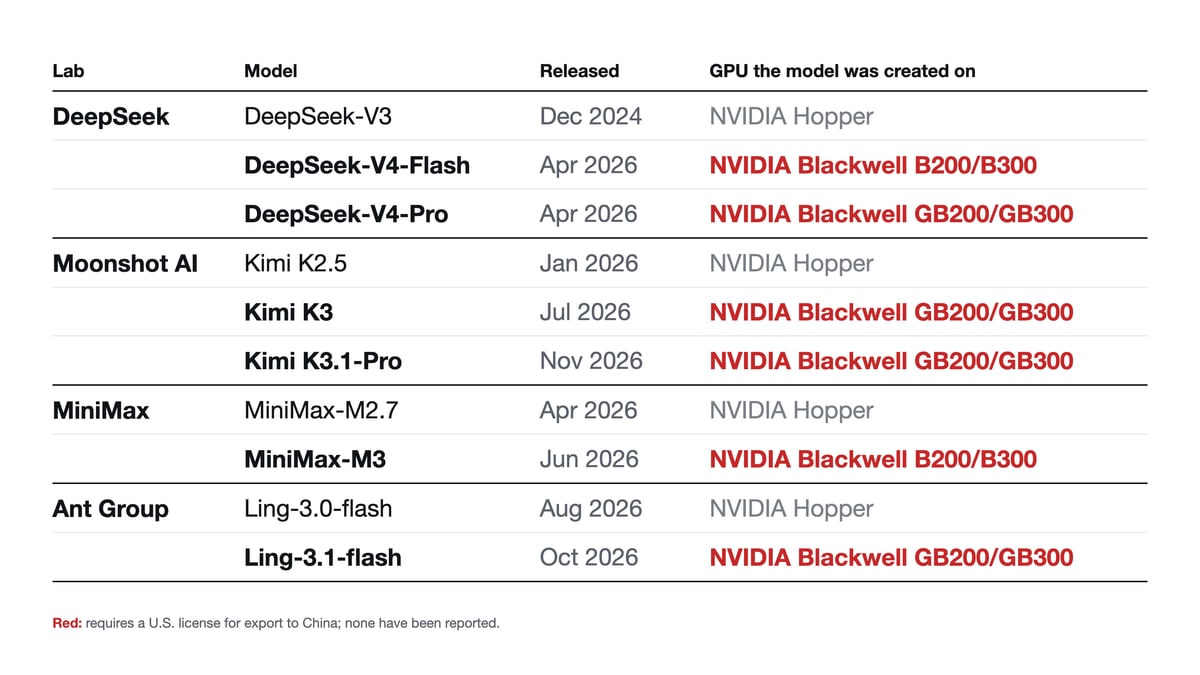
Will DePue, who started a small nonprofit research group called Unemployment Labs, published a report on Nov. 12 saying six AI models from four Chinese companies carry a pattern that matches NVIDIA's Blackwell chips, the generation after its Hopper chips. The models are DeepSeek-V4-Flash and DeepSeek-V4-Pro from DeepSeek, Kimi K3 and Kimi K3.1-Pro from Moonshot AI, MiniMax-M3 from MiniMax and Ling-3.1-flash from Ant Group, all released since April 2026. Earlier models from the same companies match the older Hopper chips, the report says. The newest models it could check from Alibaba, Zhipu, Tencent, Xiaomi and StepFun match Hopper chips, though that does not rule out later training on Blackwell.
The report says Blackwell chips have needed a U.S. export license for China since before they shipped, and that no such license has been reported. U.S. officials had already accused DeepSeek and Moonshot AI of using Blackwell chips, without publishing technical evidence, the report notes. It also says its findings do not show that any export rule was broken.
The evidence comes from the models' own files, which the companies published for anyone to download. Before an AI model is trained, its weights, the numbers a model tunes as it learns, need starting values. The software most AI developers use fills them in from a starting number called a seed, and the same seed and settings always give the same numbers. That software splits the work across the chip's processing units, so a chip with more units puts the same numbers in a different order. Some weights, such as those for words the model never sees in training, can be left untouched and keep their starting values almost exactly. The report says the order survives in them, and faintly even in trained weights, like a fingerprint of the kind of chip that set the model up.
DePue says he searched about 6 trillion combinations of seed and chip layout. On a Blackwell B300 chip, DeepSeek's seed reproduced the untouched starting values of DeepSeek-V4-Flash, while an older H100 chip did not. On a rented Blackwell GB200 chip, Moonshot's seed reproduced the untouched starting values of Kimi K3. The method also matched the developer's own account in all 24 cases where a developer had named the hardware behind a model, though some of those models are related, so the report calls it a consistency check rather than a measure of accuracy. DePue has published his code, and he says senior researchers at OpenAI and Anthropic checked the result. The report calls the evidence that the six were set up on export-controlled NVIDIA chips strong, and conclusive for DeepSeek-V4-Flash, and says that under its statistical model the matches are far stronger than chance would explain.
The report says the fingerprint shows which kind of chip created a model's starting values, which supports but does not prove that the same chips did the training. It cannot show where the chips were, how the companies got access or whether any export rule was broken. Blackwell systems can also be rented from data centers outside China, the report notes. The only other hardware the report found that could leave the same pattern is AMD's MI300X chip set up in an unusual way, which is also restricted from export to China. It ruled that out for DeepSeek-V4-Flash and calls it very unlikely for the other five. The method works only on models whose files are public, so models a company keeps private can't be checked. It also needs the starting values to have been set on an AI chip with software that leaves this pattern, and it found no trace at all in some models, including DeepSeek's later V4.1-Flash.
If each model was trained on the chips that set it up, the report estimates that the two largest training runs, for Kimi K3 and DeepSeek-V4-Pro, needed about 4,500 and 3,000 Blackwell chips for two to three months. At the pace of one disclosed Blackwell training run, those two would have needed about 8,000 to 9,000 chips. The report puts the cost of the larger of the two clusters at roughly $200 million to $300 million. It says it is not confident in those figures, which rest on guesses the files can't confirm, above all how long each run lasted, which no company has said. The report was revised on Nov. 12; its first version gave 2,000 to 3,000 chips and $150 million to $200 million.