
Google DeepMind on Nov. 11 released AlphaGenome 2, an AI model that looks at the small spots where one person's DNA differs from another's, such as a single changed letter. It predicts how each difference changes the activity of genes in a particular kind of cell, including whether it turns a gene up or down. Nearly every cell in the body carries the same DNA, but a heart muscle cell and an immune cell switch on different genes to do their jobs. The researchers write that most DNA differences linked to traits and diseases sit outside the parts of DNA that make proteins, where they can change how genes are switched on in particular kinds of cells.
The first AlphaGenome, released in 2025, made its predictions for broad tissues, which mix many kinds of cells. DeepMind says the new model answers for one tissue, kind of cell or cell state at a time, such as an immune cell at rest or one fighting an infection. It learned from DNA data from people and mice, including readings of gene activity in more than 100 million single human cells from 68 tissues. Scientists can also give it a snapshot of gene activity from a few dozen of their own cells, and it makes predictions for those cells without any extra training, the company says.
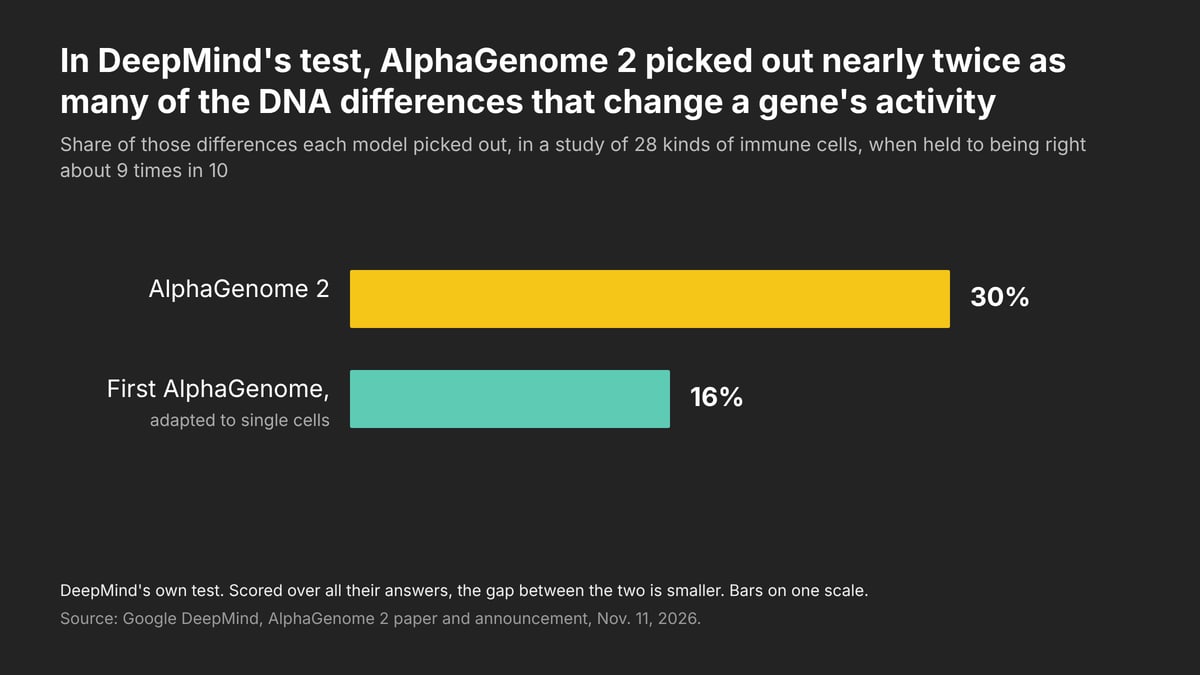
DeepMind tested the model on a large study of 28 kinds of blood immune cells. The test mixed DNA differences that earlier studies had linked to a change in a gene's activity with an equal number of similar differences that had no such link. When each model had to be right about nine times in ten on the differences it flagged, AlphaGenome 2 found 30% of the real ones. A version of the first AlphaGenome, retrained on the same kind of single-cell data, found 16%. The paper says that strict setting is where the new model gained the most. Scored over every level of strictness together, AlphaGenome 2 still comes out ahead, but the gap between the two models is much smaller.
DeepMind also says the model reproduced, on a computer, a recent lab finding about inflammatory bowel disease. It singled out the DNA difference behind that finding and showed that it boosts one gene, ETS2, in gut immune cells called macrophages, while leaving other kinds of cells and genes largely untouched, the company says.
AlphaGenome 2 is free for non-commercial research through the AlphaGenome API, a connection that lets developers plug a service into their own apps. Its terms open it only to individuals, universities, non-profit groups and research institutes, schools and government bodies, and to journalism, and they shut out companies even for non-commercial work. They also bar using its answers for medical decisions or to train similar models. Google charges nothing for now but says it may add fees with a month's notice. For commercial research, DeepMind is offering AlphaGenome 2 to companies in a private preview. DeepMind says the model has not been checked or approved for diagnosing patients.
The results so far come from DeepMind's own tests, described in a paper written by its researchers. It is not yet known how well the predictions hold up in other labs' experiments. DeepMind's genomics lead, Žiga Avsec, told reporters that the new model is more expensive to run than the first AlphaGenome, and that it won't replace the older model any time soon.