
Google DeepMind on Nov. 24 released Humanity's First Exam, a test of how reliably AI models answer straightforward, everyday questions. Google says today's top models excel at hard math, coding and science, and that most tests measure the best a model can do. This one asks whether a model solves a simple task, and slight variations of it, every single time.
The test has 544 questions, in plain text or with a picture, covering 20 basic skills such as counting objects, naming colors and following strict instructions. They come in 136 sets of four: one question plus three versions that rename things, reorder the wording or change the picture while the task stays the same, though the right answer may change. One asks for the color of the third letter of each word in a neon sign. Another shows bowls of fruit and asks which bowl holds exactly five oranges, when none does, so the right answer says so.
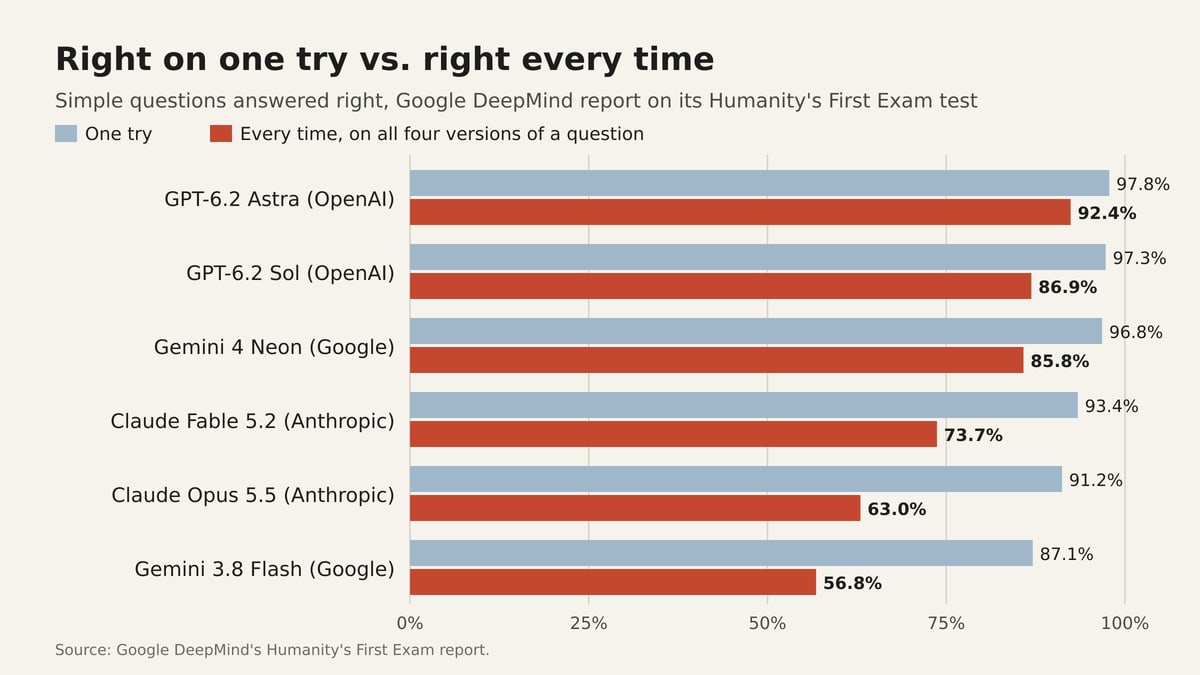
Each question is put to a model six times. A model earns full marks on a question only when all six answers are right, with partial credit for five, a sliver for four and nothing for fewer. In Google's report, which tested 18 models from Google, OpenAI and Anthropic, the five highest scorers answered 96% to 98% of the questions right on a single try.
Measured on getting whole sets right every time, OpenAI's GPT-6.2 Astra led at 92.4%, followed by OpenAI's GPT-6.2 Sol at 86.9% and Google's Gemini 4 Neon at 85.8%. The margins of error of these three and the fourth, OpenAI's GPT-6 Astra at 83.4%, overlap. Anthropic's best, Claude Fable 5.2, scored 73.7%. Claude Opus 5.5 scored 63.0%, behind Anthropic's Claude Sonnet 5.5 at 67.6%, which Google puts down largely to refusals to answer, counted as wrong. Without them, Google says, Opus would have scored 67.4%. Google's live leaderboard on Kaggle runs the test separately, and there Claude Opus 5.5 refused less often and scored 70.0%, while GPT-6.2 Astra scored 90.7%.
Pictures feature in 316 of the 544 questions, and most mistakes came from reading them. An Anthropic AI model that Google used to sort the mistakes counted roughly 73% of the wrong answers as errors of seeing, a share Google calls approximate. They include misjudging where something is in an image, which way it points or the path it follows (31%), and miscounting objects (23%). Many misses were off by just one in a count or a single item in a list. Letting a model think longer before it answers helped far more on logic and rule-following tasks than on pictures.
This is Google's own test, and a Google model, Gemini 3.1 Pro, grades the answers. Google says a check by an Anthropic model found about 3% of the answers marked wrong could have been judged right. Google kept only questions that tripped up at least one of a handful of earlier models from Google, Anthropic and OpenAI when the questions were written, between May and July 2026. So the test aims at known weak spots rather than typical use. Google also used the tested models' answers when it trimmed each set to four, dropping the version models found easiest. Many of the pictures were made with Google's Gemini, which Google says may not look like everyday photos, though models from other companies scored best on picture questions. 16 of the 18 models tested came out after the questions were collected.
Four people tried each starting question without tools, and Google kept only those at least three of the four got right. On the questions kept, a single person was right 90.8% of the time. People answered only the starting questions, once each, so their score can't be set directly against the models'. Models, too, answered in one turn with no web search, calculator or code.
Only 112 of the questions are public, free for anyone to reuse with credit, and Google keeps the rest private so models can't be tuned to them. Google says top models have improved a lot on the test over the past six months. It is asking people to submit everyday questions that today's models still get wrong, through a Kaggle contest that runs until Dec. 15. Entrants can win a share of $50,000 in merchandise, and questions Google approves join the test.