
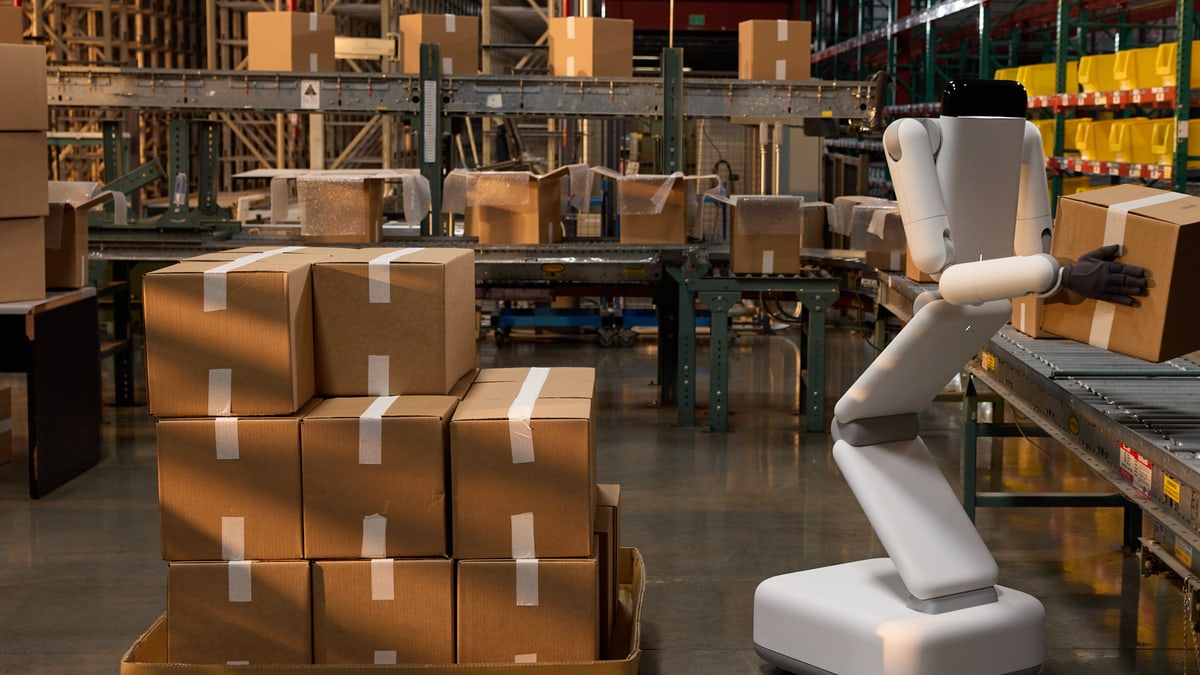
Genesis AI, a robot maker based in Paris and San Carlos, California, said on Nov. 17 that it had raised $500 million in a round that values the company at $3.5 billion. Premji Invest, Khosla Ventures and Eclipse led the round, and NVIDIA, AMD Ventures, Samsung Next, Ericsson and Zoom were among the other investors, along with former Google chief executive Eric Schmidt. Genesis first announced funding in July 2025: $105 million, led by Eclipse and Khosla Ventures.
Genesis says it designed its first robot, Eno, around what people can do rather than how they look. Eno rolls on a wheeled base, with a tower of jointed panels that rises to adjust its height and reach and folds down when it is not in use. Its two arms end in hands that Genesis says match human hands in shape and function, so the robot can handle tools and objects made for people. Genesis says it makes everything itself: the robot's body, the AI that runs it, which it calls GENE, and the systems used to train and test it.
The company's bet is on hands. Genesis says skilled hand work makes up more than 80% of physical labor. To teach the robot those skills, people wear data-collection gloves that record their hand movements and touch, and the robot's hands are built to match both the human hand and the glove, so the AI can learn directly from what people do. More than 100 workers around the world wear the gloves, along with head-mounted cameras, according to a news report. Genesis also tests its AI in a computer simulation that it says closely matches the real world, so mistakes can turn up across millions of practice situations before a robot makes them on the job.
Genesis argues that reliability, not a striking demo, is what holds robots back. A robot that gets each step right 99% of the time, it notes, has only an 82% chance of finishing a 20-step job without a mistake, because the small chance of a slip adds up at every step. The company says it will spend the money on more data and training, better hand skills, hiring, and putting Eno to work with customers. It plans to start in manufacturing, logistics and laboratories, then move to service businesses such as hotels and hospitals, and later to homes and outdoor work.
Eno is still at an early stage. Genesis said on June 16 that it planned to begin production and its first customer deployments by the end of 2026, and it now says it is ramping up production. Its chief executive, Zhou Xian, told reporters that Genesis is testing a small number of robots with customers and expects a wider rollout in 2027. It also has a partnership with LG CNS, a South Korean company that installs AI and robot systems for businesses. The two plan to try Eno in manufacturing and logistics work at LG operations in the U.S. and with other LG CNS industrial customers there, and later in other countries.
According to a news report, Genesis has built 30 to 40 Enos and has chosen a mass-production contractor that will start work in the U.S. in 2027. The same report says the robot's hands now last only a few weeks of regular work before they must be replaced, and that Eno was not ready to show its skills when the company demonstrated its AI to a reporter. The AI ran a pair of store-bought robot arms instead: on the first try they packed, taped and labeled a box, and on a second run they fumbled a box and struggled to peel off a label. Zhou told the reporter that the AI works better on Eno. The company has not said how much each investor put in, what Eno will cost, or how many Enos it will make in 2027.