
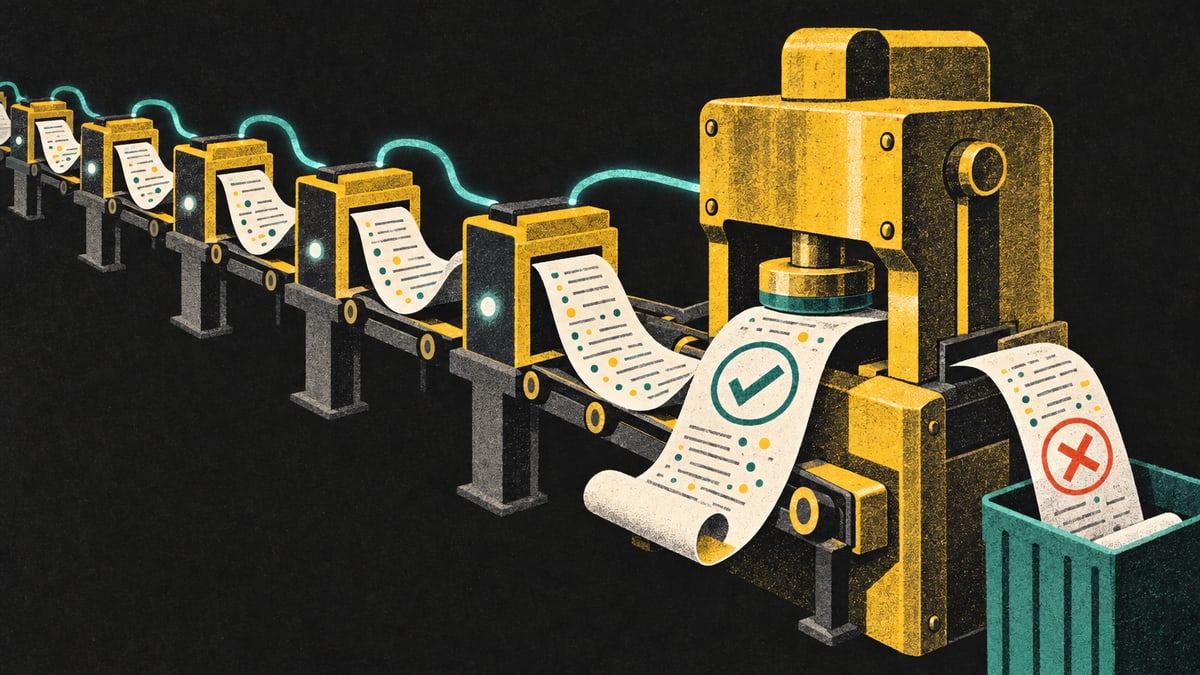
Google Research said on Nov. 13 that teams of AI agents, programs that can carry out tasks on their own instead of only answering questions, have produced new results in math and software. The agents write code and proofs and run tests. They work in Teamwork, a feature of Antigravity, Google's app for building software with AI, and are built on Gemini, Google's family of AI models. Teamwork splits a big job among many agents. Some propose answers, others try to knock them down, and an automatic checker, such as a program's own tests or a proof checker, decides which answers hold up. Google says each agent gets only the files and tools its step needs, which helps keep details from getting lost on jobs that run for days.
Google's biggest claim is in math. It says a Teamwork setup called Teamwork-LEAP, turned the Weil conjectures into a formal proof by itself, starting from proofs mathematicians had already written. A formal proof is one written in a special programming language, Lean, so that a computer can check every step. The Weil conjectures are landmark results about counting the solutions of polynomial equations, and Pierre Deligne's 1974 proof completed them. Google says its version runs to about 1.8 million lines of Lean, made across 28,800 runs of helper agents. It says the system also wrote the first computer-checked version of a recent proof about a form of Hilbert's tenth problem, which asks whether there is a general way to tell if an equation has whole-number solutions. Google says that while checking a recently released proof of another math problem, open for more than 50 years, the system found and fixed a gap in it.
In a paper posted in September, researchers from Google, the Chinese University of Hong Kong, the University of Southern California and Carnegie Mellon University proved the Courtade-Kumar conjecture, a question in information theory first posed in 2013, with Teamwork's help. The result shows that when random bits are sent down a noisy line, no way of boiling them down to a single bit keeps more information than simply copying one of them. Google says that after the Hong Kong team narrowed the problem down, its Gemini models worked out most of the new mathematical limits the proof needed and, without human input, extended the proof to a wider case. The researchers say the whole proof has been checked in Lean.
In software, Google says a two-week run rewrote the rest of the Zircon microkernel, the small core of an operating system, after an earlier effort had converted about a quarter of it. The agents moved it from C++, the older programming language it was written in, into about 800,000 lines of Rust, a language built to prevent common memory mistakes. Google says the new code passes all of the kernel's unit tests and starts up on Arm-based hardware. Google says another run rewrote its AV1 video decoder, the software that plays videos in the AV1 format, in Rust. The new version was at first about four times slower, but after the agents got tools to measure speed, Google says it ran 20 to 30% faster than the original, hand-tuned code on sample videos. Google says the setup that did these rewrites is not yet in Antigravity but is coming soon.
Teamwork itself is not new. Google first showed it at its I/O conference and opened a preview on paid Antigravity plans in August, with earlier math results. Antigravity's guide still lists it for paid plans only. Google says scientists and developers outside the company can use Teamwork with its Gemini 4 models. It has opened applications for 10,000 academic researchers to get six months of free access to its highest usage tier, the plan that allows the most work. Deep Review, an existing Google tool that checks technical papers for weak arguments and errors, lets anyone who signs in with a Google account run two free reviews a week at a standard depth; more reviews are billed to the user's own Gemini account. Antigravity's terms make users solely responsible for what its AI agents do. They also let Google staff and contractors review what people do in the app and use it to improve Google's products. Users can opt out of that use in settings, but Google still uses their data to run the service and keep it safe.
These are Google's own reports. Google says all of the work was done with human experts, even as it describes the Weil proof as made fully on its own, starting from proofs mathematicians had already written. A computer check shows only that a proof is right for the problem as it was typed into the computer, and Google says human mathematicians must confirm that the typed statement matches the original problem. Google does not say who did that check for the Weil proof. Its post links no paper or code for the Weil work, and it does not say whether mathematicians outside Google have checked it. Google says the setup it used to write these proofs will come to Antigravity in upcoming updates, with guides due in the coming weeks.