
Google on Oct. 14 opened Deep Review to the public worldwide. It is an AI system that reads long technical documents, such as a math or computer science paper, and flags mathematical errors, gaps in reasoning and claims that lack support, then suggests fixes. Google says it built the tool because AI now helps people produce papers and reports faster than human experts can check them: this year three major AI research conferences received about 74,000 papers by Google's count, up from about 45,000 in 2025 and 23,000 in 2023.
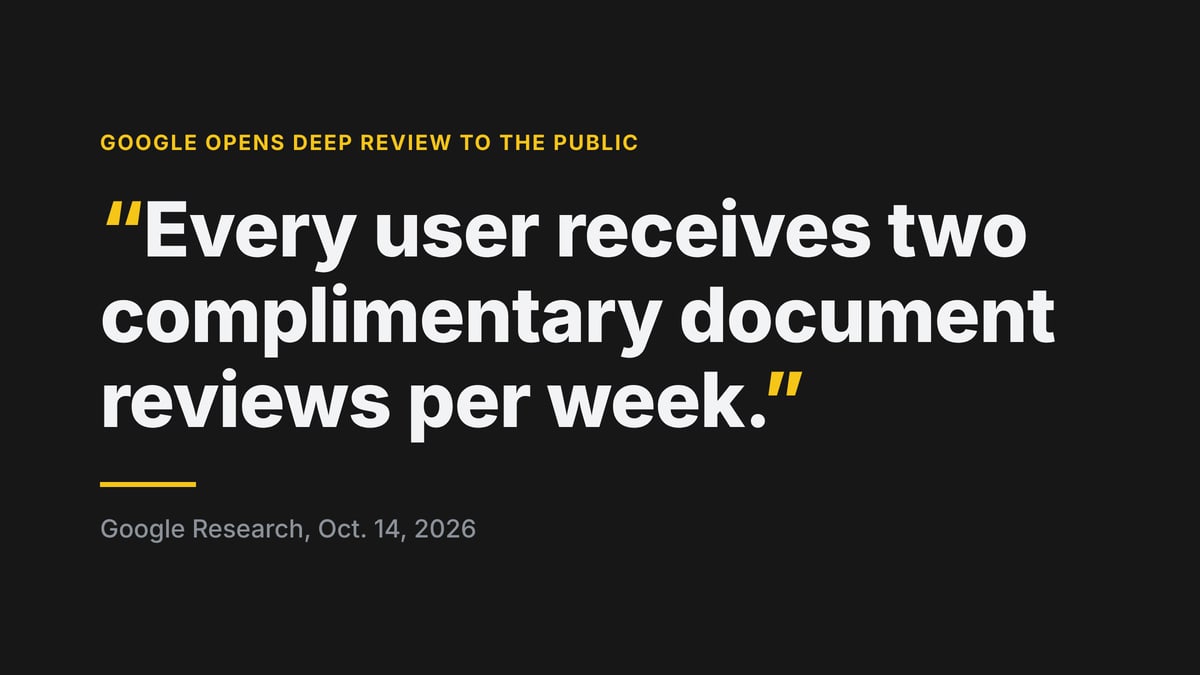
Anyone can sign in with a Google account and get two free reviews a week, run on Google's Gemini 4 Argon AI model at a medium effort setting. People who want more can link their own paid Gemini developer key and pay Google's standard rates for the computing each review uses; Google estimates a 40-page document costs from about $3 to $20, depending on which model and effort level the user picks, though it says actual charges vary with the document. It takes PDFs and plain text, and Google's product page also lists Google Docs and Slides; Google says checking several files at once is coming soon. Google says uploaded documents are not used to train its AI models and are kept for up to a year so users can see them, then deleted, though users can choose to let the research team use them to improve the tool.
Instead of asking a chatbot to read a whole paper at once, Google says, Deep Review splits the document into sections and gives more computing power to the hard parts, such as proofs. The work is shared among AI agents, AI that can carry out tasks on its own, such as using apps and websites, instead of only answering questions. Separate agents check each section at the same time while keeping the whole document in view. A final agent combines their findings and, according to Google, searches the web to make sure the review itself doesn't cite papers or theorems that don't exist.
The tool grew out of a trial version Google offered at major computer science and AI conferences, including NeurIPS and ICML, where, Google says, authors of more than 15,000 papers chose to get private feedback before submission. That feedback was kept separate from the conferences' official review. In Google's own test on 26 math and computer science papers with 29 known errors that later led to corrections or retractions, the trial version found about nine in ten of the errors, against just over half when the same Gemini 3.1 Pro model read each paper in one go. That set is small, an AI program graded the results with one of Google's researchers checking each grade, and Google has not published the same test for the public version, which runs on a newer model.
Authors in the trials also reported that the tool sometimes claimed a correct proof or argument was wrong. Google's researchers say that problem comes with any system built on the kind of AI behind chatbots and that they are working to reduce it, so authors still need to check what the tool tells them. Google says Deep Review can also check legal and financial documents, design plans and slide decks, but it has not published results on how well it does there, and it is not yet clear whether journals or conferences will let their reviewers rely on it.