
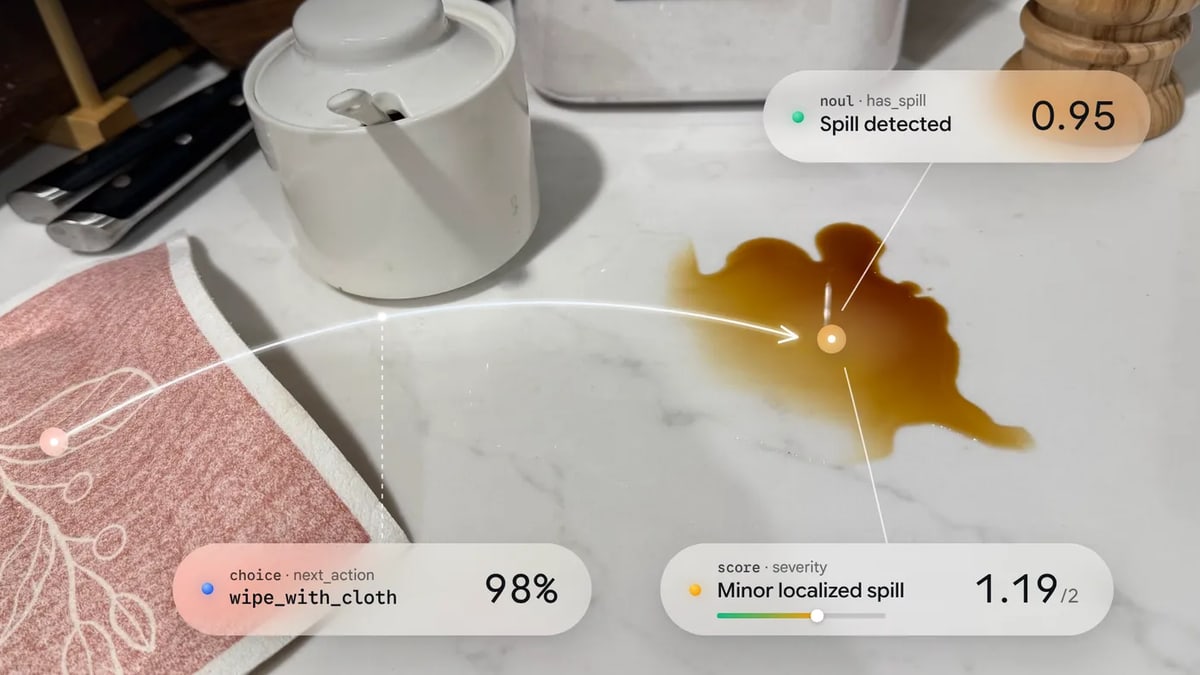
Google on Wednesday, Nov. 11, released Gemini Decision 1, an AI model that doesn't write anything. A developer gives it something to look at, such as a message, a photo, a recording, a video or a PDF, plus up to 1,000 questions about it. Each question is a yes or no, a pick from a fixed list of answers, or a rating on a scale. The model returns how likely each answer is, plus a confidence score from 0 to 1 that tells the app how sure it is. Chatbots write their answers one small piece at a time. This model rates all the answers it is given in a single step instead, which Google says keeps it fast, and because it writes no text, Google charges nothing for answers.
Google built it for the small, quick decisions inside apps and AI agents, AI that can carry out tasks on its own, such as using apps and websites. Examples are which tool an agent should use next, whether a request breaks a rule, or which AI model should handle a question. Because every answer comes with a confidence score, Google says, an app can act on its own when the model is sure and pass unclear cases to a person or another check. Google says its own products already use it. Google's Gemini Notebook uses the model to send each incoming question to a fitting model, and Google says that cuts the wait for everyday questions by up to 40 percent.
Developers can use it now through the Gemini API, a connection that lets developers plug a service into their own apps, and can try it free in Google AI Studio, Google's website for trying its models. On the paid tier, Google charges 10 cents for every million tokens the model reads, the small chunks of text, often parts of words, that AI models read and write. Photos, sound and video are counted in tokens too. Google's terms say what people send on the free tier is used to improve Google's products, except in the European Economic Area, the UK and Switzerland, and on the paid tier it isn't. Google says support in Google Cloud, its service for businesses, is coming soon, with no date given.
Google is not first: OpenAI and Microsoft already sell similar tools. OpenAI's Decisions API also costs 10 cents per million tokens for new input, with discounts for repeated input and no charge for answers. Its guide says it reads text, images and structured data. Microsoft's Microsoft-Decision-1, released on Oct. 9, costs 4.2 cents per million tokens it reads, and its answers are free.
Google says a typical answer comes back in 150 to 250 milliseconds, up to a quarter of a second, for inputs of up to about 12,000 words, and barely slows from one question to 100. It also says running its set of test questions cost about a fifth as much with the new model as with Gemini 3.5 Flash-Lite, a Gemini model that writes out its answers. Those figures come from Google's own tests.
Google's guide also lists weak spots developers need to plan for. On pick-from-a-list questions, the model always spreads its odds across the answers it is given, even when none fits. So the guide suggests adding a catch-all answer such as "other", a separate yes-or-no check, or a rule to set aside answers it is unsure about. The guide also warns that a message can contain wording meant to talk the model into a particular answer. It advises keeping a person or a second check on high-stakes steps such as payouts. It is not yet clear how well the model does on companies' own tasks, or what Google Cloud customers will pay.