
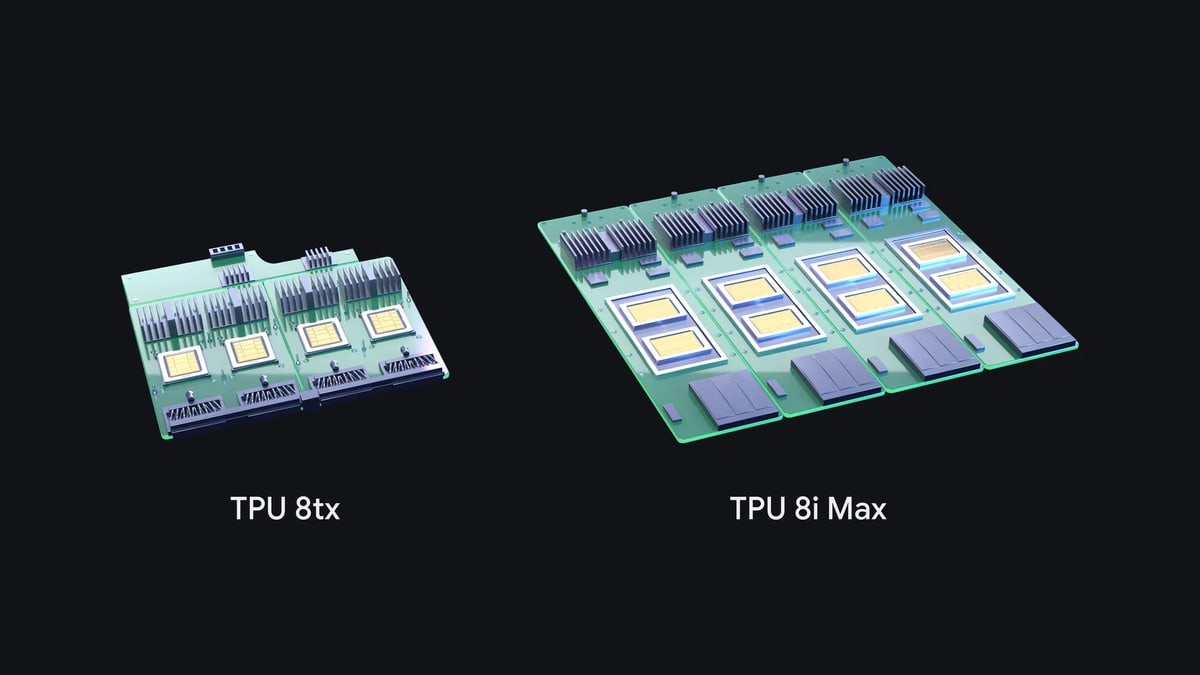
Google on Monday, Nov. 9, added two systems to the eighth generation of its TPUs, the AI chips it designs itself for its own Gemini models and for Google Cloud customers. They are not new chips: Google rebuilt the hardware around the two eighth-generation chips it introduced in April, changing how they are packaged, connected and secured. The TPU 8tx is built for confidential work: Google says it keeps sensitive data and the AI model itself protected and isolated even while the chip is working on them. The TPU 8i Max joins two chips in one package for AI jobs that must handle a great deal of information at once. Counting the TPU 8t and 8i from April, Google says it is the first time it has introduced four TPU systems in a single year.
Computers normally keep data encrypted while it is stored or sent over a network, but have to unlock it in memory while they work on it. Google says the 8tx closes that gap with security built into the hardware itself, so data stays protected even while the chip is working on it. Because the 8tx uses a faster network Google built for AI that has to answer in real time, Google says it cuts delays by up to half compared with the TPU 8t, at almost no cost to its performance. It is made from the same chip as the TPU 8t, Google's chip for training AI models, and runs alongside main processors from AMD. Google is aiming it at governments and regulated businesses that run AI on their most sensitive data.
Google says those customers can also use the 8tx to fine-tune a model on their private data, giving it extra training that adapts an already trained model to a specific job, without moving that data between separate machines.
The 8i Max tackles a different problem: moving data to the chip fast enough. It is built for AI agents, AI that can carry out tasks on its own, such as using apps and websites, instead of only answering questions. Google says that when dozens of them work together through a whole program's code or hours of video at once, the chip can't get data from memory fast enough. So Google combined two of its TPU 8i chips, which run trained models, in one package. Google says that, compared with a single 8i, it doubles the computing power, the amount of fast memory on the chip and how quickly data moves from its main memory. It also fits twice as much chip hardware into the same space in a data center rack.
Google also released free, open tools meant to make its chips easier for developers to use. One set, in an early test version, works inside coding tools such as Claude Code and Cursor to help get code running well on Google's chips. Google says TPUs are a fast-growing business with nearly 100 customers, among them leading AI labs, trading firms, retailers and universities.
Google's post gives no prices, release date, outside test results or customers for the two new systems themselves. According to a news report, Vahdat said both will be available in 2027.