
Meta on Thursday, Oct. 15, published Muse Spark Open, a version of its Muse Spark AI model that it calls "the most capable US open-weight model to date." Open weights means the model's trained files are published, so people can download it and run it on their own computers. Meta says the model is built for coding and for long, multi-step jobs it can carry out on its own, and it reads text, images, video and audio and answers in text.
The model is very large: it has 816 billion parameters, the numbers a model tunes as it learns. It is a mixture-of-experts model, a design that switches on only part of the model for each piece of text, so it runs faster than its full size suggests; here about 42 billion are used at a time. The whole model still has to fit in a computer's memory, though. Meta says it can work with about 1 million tokens at once, the small chunks of text, often parts of words, that AI models read and write: about 750,000 words.
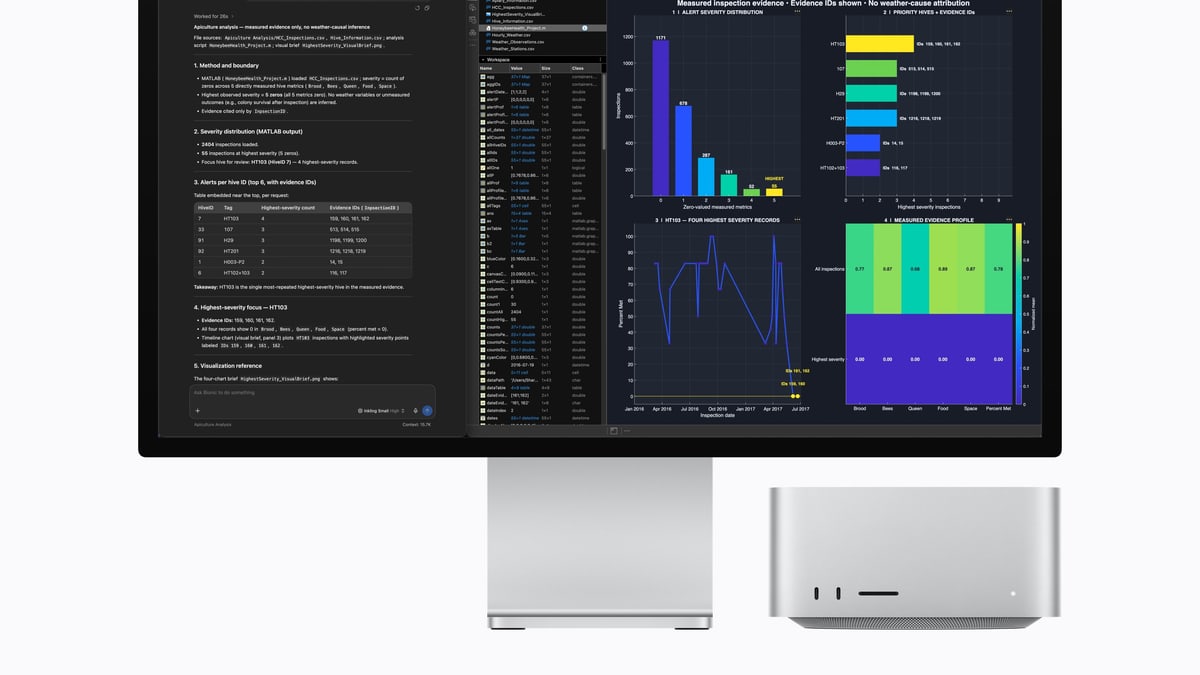
Meta says the model was optimized to run on two Mac Studio desktops with Apple's M5 Ultra chip and 512 GB of memory each, and Apple published its own guide to running it the same day. That setup runs a compressed copy of the model that takes about 493 GB, against more than 1.6 TB for the full version, Apple says. Apple says four linked Mac Studios write more than 36 tokens a second, well above average reading speed. Apple says a Mac Studio with the M5 Ultra starts at $5,499 in the U.S. and that the 512 GB version is coming in late October. Apple has not said what that version will cost, according to a news report, which says the model can also run on four 256 GB machines costing roughly $38,000.
Developers can download the model now or use it through seven cloud services that run it for them. Meta's license is free of charge and lets people change the model and sell products built on it, with conditions. Those products, including ones built on changed versions, must clearly show "Built with Muse Spark Open" in the app or its documentation, and users must follow Meta's list of banned uses. Some big companies need a separate deal. A company offering others access to AI models through an API, a connection developers plug into their own apps, or a similar service must tell Meta and sign an agreement before putting Muse Spark Open in it, if its total revenue, counting its affiliates, tops $20 million a year. Meta says the model is not meant for anyone under 18.
Meta's own table compares Muse Spark Open with seven rival models it calls leading open-weight models, and the model does not lead everywhere. On Terminal-Bench 2.1, a coding test, four of the rivals score higher, led by Kimi K3 at 85.0 to its 76.4, and on an outside firm's overall score that Meta includes, GLM 5.3, Kimi K3 and Qwen 3.8 all rank above it. GLM 5.3 and Kimi K3 are leading Chinese models, according to a news report.
Meta says this version got extra safety training to make it harder to misuse when it runs without added safeguards, and that it refused 99.2% of attempts to trick it into helping with cyberattacks on Meta's own test. Meta also warns that changes others make to the model could weaken that safety, and Meta says a full report on its testing is coming soon. It is not yet clear how the model will hold up in outside testing.