
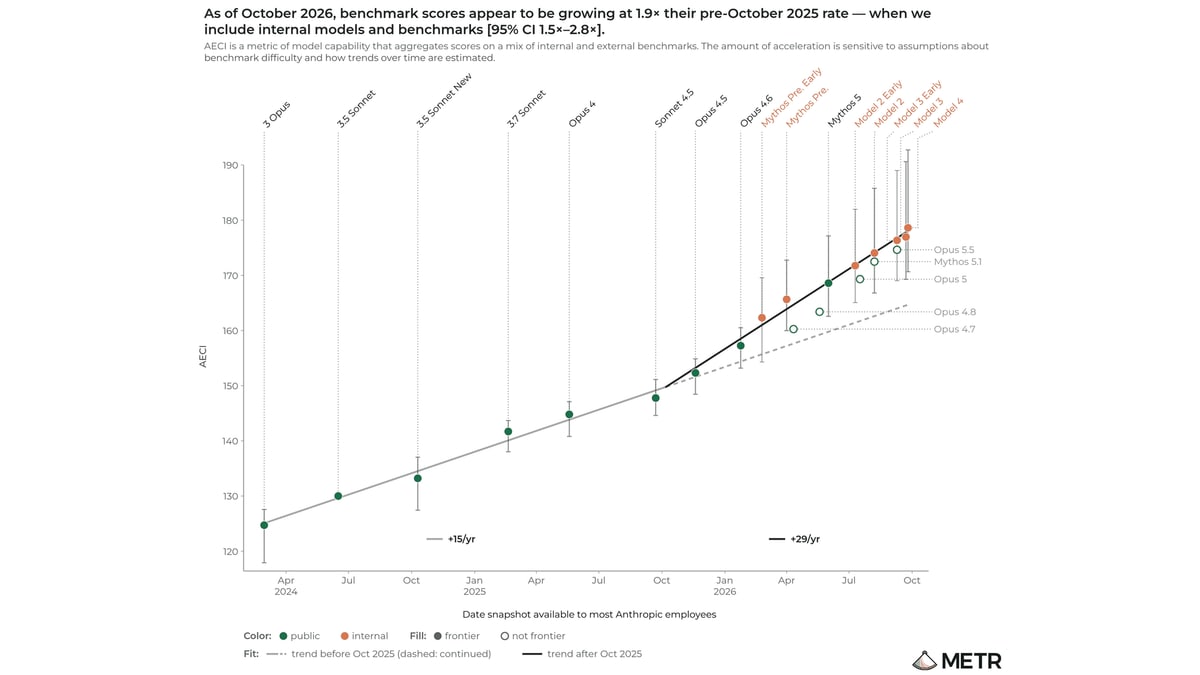
On Thursday, Nov. 5, METR, an outside group that tests advanced AI models, published its estimate of how fast Anthropic is improving its AI. Anthropic set up the review, and from Aug. 12 to Oct. 29, METR staff studied private data the Claude maker shared, including test scores for models it has not released, and held about 15 interviews with key staff. The worry behind the study is AI that speeds up the building of better AI. METR warns that this could lead to extreme and risky abilities appearing suddenly.
METR estimates that, as of October, Anthropic is likely improving its models about twice as fast as it did between March 2024 and October 2025, on tasks with clear answers. It calls that estimate highly uncertain and says it would not be surprised if the true figure were closer to 1.3 times or 3 times the old pace. The key evidence METR could make public is Anthropic's own combined score, built from many benchmarks, standard tests used to compare AI models. Since October 2025, Anthropic's models have climbed on that score about 1.9 times as fast as before, roughly two years of progress at the old pace made in a single year. Anthropic's own reports had already pointed to a speedup: one put it at 1.7 times on the same score, and METR says its higher figure comes mainly from adding newer unreleased models. METR cautions that the speedup may be limited to tasks that are easy to grade. It adds that the score could also understate real-world gains, and it is not yet clear how much carries over to messier work.
METR is confident the speedup did not come from faster growth in the computing power used to train the models. It guesses that perhaps 80% of the current speedup comes from Anthropic's heavy use of AI in its own research, though it says other causes likely played a large role in late 2025. METR was told that AI mostly helps researchers rather than working on its own, with some signs that could change soon. In informal polls on the company's internal chat, answered by an unrepresentative group of staff, Anthropic staff put their average speedup from the newest internal model at about 12 times, which METR treats as very loose evidence.
METR found no clear limit, such as a shortage of data or computing power, likely to slow progress over the next 12 months, though it is not confident of that. It sees a significant risk that progress could speed up even more. In a second report, METR says Anthropic's public August risk report, its own assessment of the dangers of its models, understated how fast progress was speeding up. METR adds that it is plausible Anthropic had already crossed, by July 15, the early-warning line its own safety policy sets for a doubling in pace driven by AI doing research. Researchers at both METR and Anthropic lean toward it not having been crossed. METR agrees that, as of July 15, the models Anthropic used internally posed a low risk of causing a catastrophe by speeding up AI progress.
Anthropic kept most of the evidence METR found most telling out of METR's published report, saying the details could help other AI developers go faster. METR says that leaves the public relying on its judgment more than would be ideal. Midway through, Anthropic also dropped a planned check of how it splits computing power between making its AI more capable and safety work. Anthropic said it wanted to keep the work focused on risk and would revisit that check later. METR says it took no payment, though Anthropic supplied free use of its AI for the work.
Sam McCandlish, an Anthropic co-founder who leads much of its safety work, wrote on X that many of METR's conclusions match his own: "AI is speeding up our research, but it's hard to say exactly how much." He said Anthropic plans to share its own analysis of its pace in the coming weeks, including where it stands against its safety policy.