
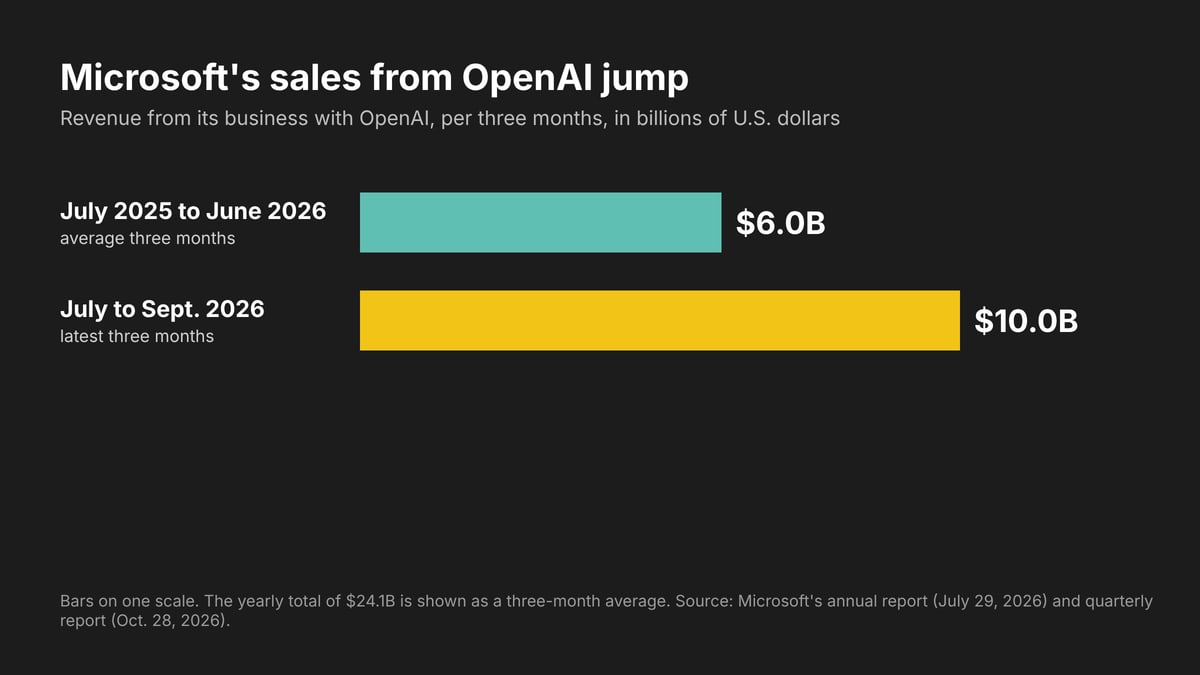
Microsoft recorded $10.0 billion in sales from its business with OpenAI in the three months to Sept. 30, according to the quarterly report it filed on Oct. 28. That is more than a tenth of the $92.3 billion in sales Microsoft reported for the period. Over the full year to June 30, Microsoft recorded $24.1 billion from OpenAI, an average of about $6 billion every three months.
Microsoft reports the figure because it owns about 24% of OpenAI, which makes OpenAI a related party under accounting rules, and those rules require Microsoft to report its sales to OpenAI and what OpenAI owes it. The $10 billion combines two kinds of money: a share of OpenAI's own sales that OpenAI pays Microsoft, and payments from other deals between the two companies. Microsoft does not say how the total splits between them. OpenAI owed Microsoft $7.2 billion in unpaid bills at the end of September, up from $6.0 billion at the end of June, and Microsoft has paid in $12.0 billion of the $13.0 billion it promised to invest.
Sales from Azure, Microsoft's cloud service that rents out computing power, rose 48% from a year earlier. Microsoft's capital spending, mostly on its computing build-out, came to $45.2 billion in the quarter, about three quarters of it on short-lived equipment, mainly chips, including memory and storage. Finance chief Amy Hood said the figure reflected some outside computing capacity Microsoft expected that quarter being delayed to the second half of its financial year, which ends in June. She expects the spending to top $50 billion in the current quarter and to reach about $170 billion for 2026, and said demand for Azure "continues to exceed available supply."
Microsoft's quarterly report also adds a new line to its warning about the outside companies whose AI it relies on: Microsoft has "limited visibility into or control over" how their models are designed, trained, secured, tested and behave. The warning already said that some of the companies behind them are big Azure customers, and that the benefits Microsoft expects from those ties "may not be realized or sustained."
Chief executive Satya Nadella said Microsoft aims for its own models to match leading models within three to six months of their release, for a fraction of the cost to train them. He said he wants Azure's AI business to rest on many business customers rather than "four customers who buy a lot of capacity from you" to show a few quarters of growth, which he said is "not a business, as far as I'm concerned." Microsoft says OpenAI will keep sharing its sales with it, but it does not say how much of Azure's growth came from OpenAI or whether this quarter's total will hold.