
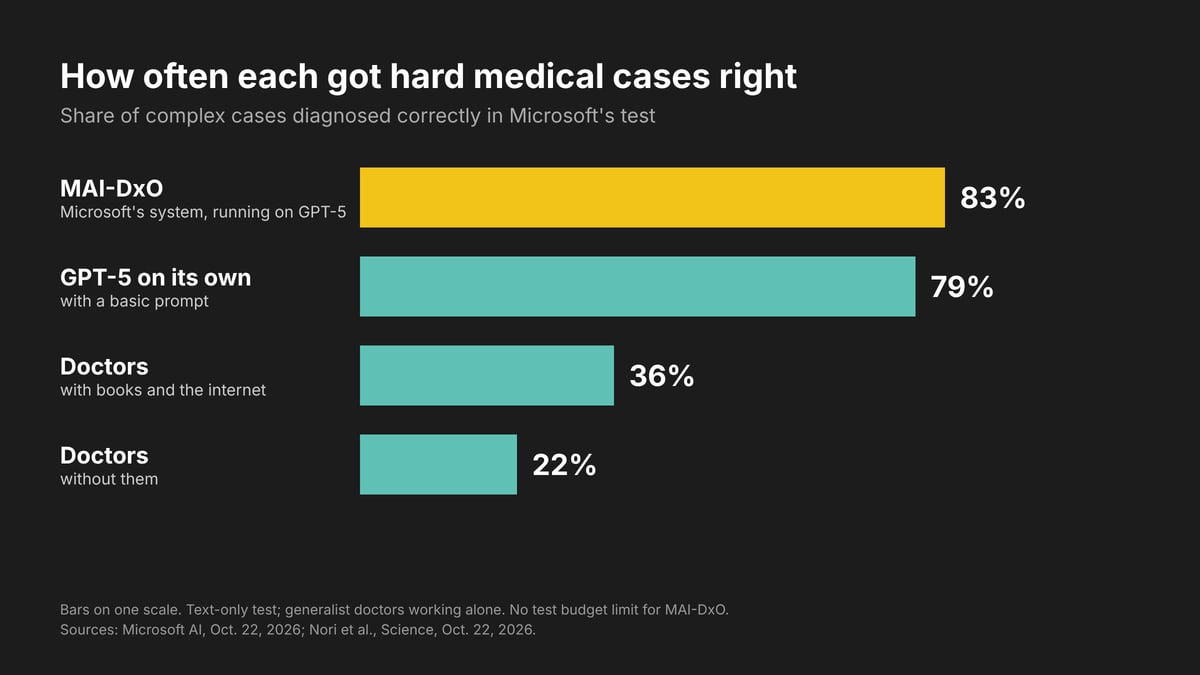
Microsoft says its AI system diagnosed hard medical cases more than twice as accurately as generalist doctors in a test. In a study published in the journal Science on Oct. 22, the system, MAI-DxO, named the right diagnosis in 83% of complex cases taken from The New England Journal of Medicine. Generalist doctors given the same cases got 36% right when they could use books and the internet, and 22% without them.
The test was built to work the way diagnosis does. Exams for doctors, and most tests for AI, hand over the whole case at once and ask for one answer. A real doctor starts with a patient's brief description of the problem and has to decide what to ask, which tests to order and when there is enough evidence to decide. In Microsoft's test, each case opens with a short summary, and the AI or the doctor asks for the patient's history, exam findings or test results one step at a time, with every test adding to an estimated bill.
MAI-DxO works like a panel of virtual doctors, Microsoft says: an AI model plays several doctors with different roles, who propose diagnoses, pick questions or tests and challenge the group's leading guess over several rounds, weighing what each test is likely to show against what it costs. Its 83% came with tests averaging about $5,400 a case, more than the doctors who used books and the internet spent. Given a $4,000 test budget, MAI-DxO still got 81% of the hard cases right with tests averaging about $2,200 a case, against about $4,700 for those doctors. On more typical cases, from records of patients admitted through an emergency department, it was right 80% of the time and the doctors 47%.
Most of that accuracy comes from the AI model underneath. The study ran MAI-DxO on OpenAI's GPT-5, and Microsoft's results show GPT-5, asked on its own with a basic prompt, got 78.9% of the hard cases right, about 4 points less than with Microsoft's system, but it ordered about $8,400 in tests per case. On the emergency cases it got 76.6% right. Microsoft says its system's edge grew when it was rerun on OpenAI's newer GPT-5.5, though according to a news report the gain showed up only on the hard cases.
The Microsoft researchers list the limits themselves. Doctors and AI worked in text only, with no scans or images, and each doctor worked alone, while in real life hard cases often go to teams of specialists. The hard cases were chosen for teaching, every patient in the test was sick, and the test bills are estimates from standard U.S. prices. The researchers say the results do not show the system is better than specialists, teams of doctors or real medical care. Microsoft is releasing the test for some of the cases so other researchers can check the results.
MAI-DxO has so far been tested only on written cases, not with patients, and Microsoft has not said whether or when doctors could use it. The company says it will test the system with Beth Israel Deaconess Medical Center in Boston, in different hospital settings, in a study where patients use it directly and its answers are measured against doctors' own. It has not said when that study will report.