
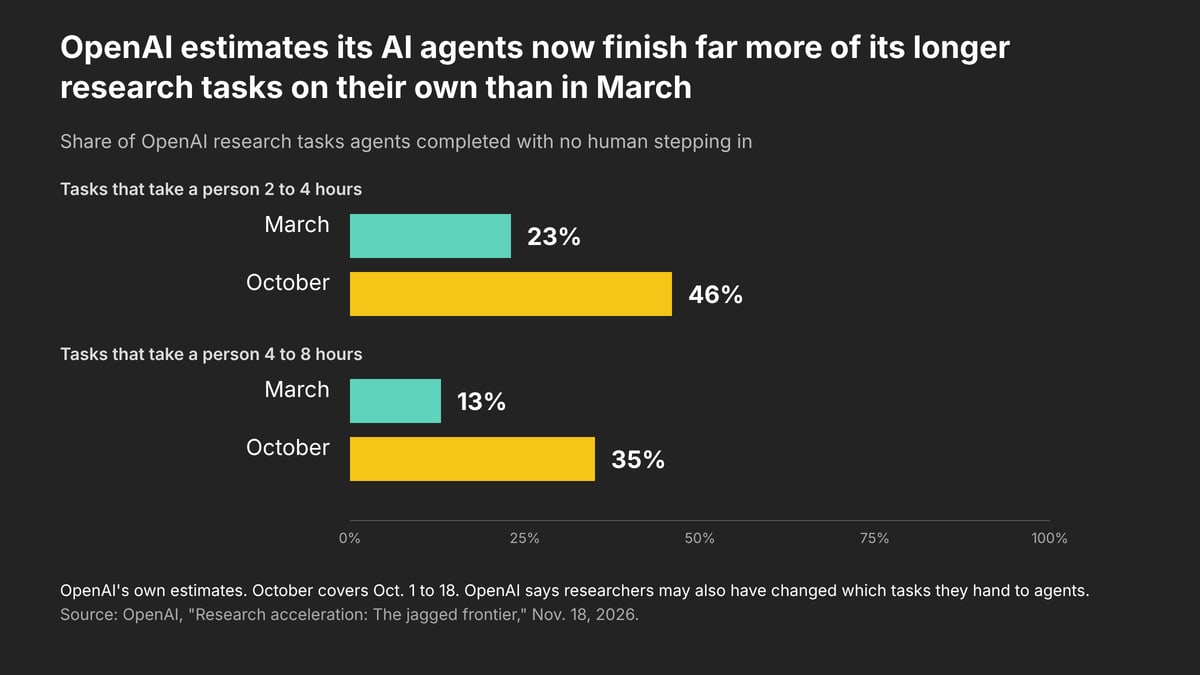
OpenAI published new figures on Nov. 18, its second report after one in September, on how much AI is speeding up its own research. It estimates that AI agents, AI that can carry out tasks on its own, such as using apps and websites, instead of only answering questions, finished 46% of the research tasks its staff gave them that would take a person two to four hours, with no human stepping in. That was in the first 18 days of October; in March the figure was 23%. For tasks of four to eight hours, it rose from 13% to 35%. OpenAI cautions that researchers may also have changed which tasks they hand to agents, so part of the rise could come from that rather than better AI.
OpenAI says AI labs should be required to track and publicly report signs of recursive self-improvement: an AI improving itself, then using the improved version to improve itself again, round after round. It says that as AI gets better at improving itself, competition and the difficulty of governing it will grow, and keeping people part of the process will be a key task. It adds that publishing these figures should not be read as a sign it intends to pursue full self-improvement.
OpenAI calls the gains jagged. From Aug. 1 to Oct. 18, agents working alone succeeded an estimated 79% of the time at watching training runs for problems and 72% of the time at answering technical questions. They managed only 25% at writing the software that runs finished models for users, and 29% at building the practice and test setups that models are trained and graded in. OpenAI says weak spots like these could hold back how much AI speeds up research overall.
Researchers' agent use is rising fast, OpenAI says, partly because they are moving to pricier models. In October, the typical OpenAI researcher used agents worth about $2,400 a day at the list prices OpenAI charges developers. Across OpenAI's research staff in September, agent use was worth about twice what OpenAI paid them in salary, bonuses and benefits, not counting stock. Even so, OpenAI's own use of its AI took only 2% of the computing power it spends on research.
OpenAI also asked 101 of its research staff, in late August and early September, what the best coding agents are worth to them. The typical researcher said that to get those agents back for three months after losing them, they would give up 40% of their team's staff. Asked about computing power instead, they would give up 30% of it. OpenAI notes that people's own estimates can be wrong and that the survey was informally sampled.
People are still central to the work, OpenAI says. In interviews, researchers said agents have poor taste in ideas and code, and need close supervision to avoid sloppy work and wasted effort. A handful of researchers asked about OpenAI's GPT-6 Astra model credited people with the ideas they saw as most important. For the newer GPT-6.2 Astra, researchers on the first, broad stage of training said some ideas grew out of conversations with Codex, OpenAI's coding agent, and one credited it with key insights. Others working on that model said the ideas came from people.
OpenAI also estimates that the time researchers put into safety and alignment grew 77% from January to September, from new hires and researchers switching to safety work. Alignment means making AI systems act in line with human values and do what people intend. By OpenAI's count of researchers' written work, that was the biggest gain in hours of any research area, though not the fastest growth.
The figures are OpenAI's own internal measurements. The company says past trends may not predict what comes next, and that it is watching for sudden breakthroughs in AI research like the recent sudden leaps AI made in mathematics.