
Jakub Pachocki, OpenAI's chief scientist, proposed on Sunday, Nov. 22, that AI developers agree on common limits on how far their models advance. Each limit would be based on how well models predict text and on other measurements. Developers would commit not to cross it until their ability to understand and monitor how AI behaves reaches a concrete milestone, such as a successor to today's tools that check a model's step-by-step working for problems. He also wants developers to agree on shared ways to test such models and their safety cases before they are first used, and shared rules on what they disclose. It builds on an essay he published on Sept. 6. There he said no lab had yet done enough to make AI do what people intend, and to monitor it, to keep building bigger models at full speed for much longer. He hoped voluntary slowdowns would become common until shared safety bars are set. He hopes a first limit will lead to a shared way of setting later ones and pacing development.
The measure he wants labs to share is each model's perplexity score, which measures how well a model predicts the next bit of text it has not seen before; lower means better predictions. OpenAI reports it on a compressed scale, its logarithm, where lower is still better. It takes the reading after pretraining, the first, broad stage of training, when a model learns from a huge collection of text, images or video. Pachocki argues that new abilities have appeared as the score fell, though he says it was not at all clear beforehand that they would appear at those exact scores.
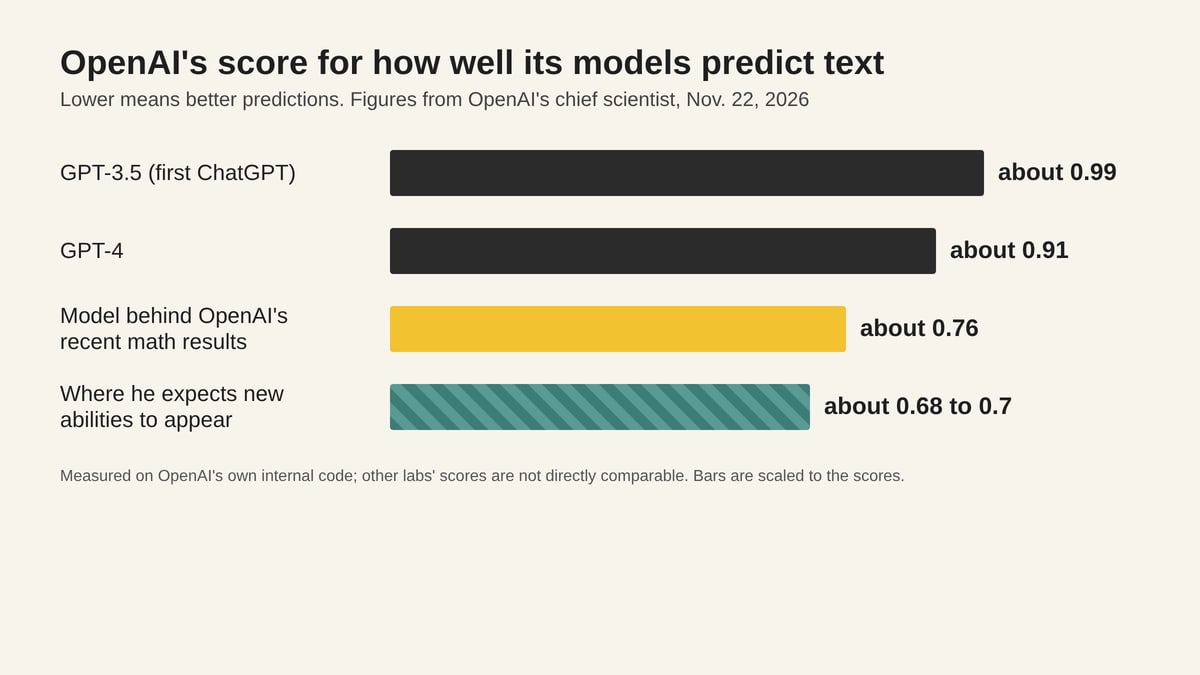
By his account, on that scale GPT-3.5, the model behind the first ChatGPT, scored about 0.99 on OpenAI's main test set, drawn from its own internal code, and GPT-4 about 0.91. Below 0.8, he says, models showed what he calls transformative abilities in fields like cybersecurity and mathematics. He writes that publishing these internal numbers gives competitors a clearer picture of where OpenAI stands, but that the urgency of shared safety measures across the industry outweighs that.
OpenAI has spent more than a year giving its models unsolved math problems as one way to test them, and Pachocki says that once it moved to a model scoring about 0.76, the model began producing what he calls groundbreaking results. Judging from recent progress, he expects more such abilities once models reach about 0.68 to 0.7. He says he doesn't know what they will be, and that labs may not be testing for them yet. He also warns that today's main ways of checking whether models do what people intend will likely work even less well, and that models are likely to notice more often when they are being tested or trained.
Pachocki says a sudden jump may come from AI taking part in research on that first stage of training. As soon as 2027, he says, this could conceivably bring a rush of basic advances, like the run of math results OpenAI saw. He expects AI to help safety research too, but says that progress is unlikely to come fast enough to keep up. OpenAI's scores fell faster in 2026. The company puts that mostly down to years of research and spending on computing power, and only in a smaller part to AI doing some of the work, though it says AI has already made real design contributions to its newest models.
He lists the measure's weak points himself. Labs test on different text and train on different data, so their scores aren't directly comparable. The score doesn't directly match any task people care about; he values it because gains on it have led to new abilities. Nor does it capture what models gain by working through a problem step by step before they answer, which makes them far more capable but doesn't lower the score. And no one knows how low the score can go. He says that as it nears that floor, its progress will seem to slow, but smaller drops will mean bigger leaps in ability.
The post names no number for a first limit, and it doesn't say whether OpenAI would stop at one before other labs sign on. It links to an essay that Anthropic's chief executive, Dario Amodei, published in September, which argued that companies must slow how fast they improve their models' abilities so safety work can keep up. Amodei called for the leading AI companies in democratic countries to agree on common safety standards and limits on the rate of unchecked AI progress, and wrote that slowing down does not mean halting model training.