
OpenAI has released GPT-6 Cyber, a version of its GPT-6 Astra model with extra training for security work. It is built to find vulnerabilities: weaknesses in software that an attacker could use. It also writes working attacks that prove a flaw is real, so the people who own the software can fix it. OpenAI says the model is a major step up from its earlier security model at this work, and far more reliable at staying inside the limits researchers set for it.
Only a select group of approved customers can use it for now, through Codex, OpenAI's coding tool, and through OpenAI's service for software developers. They come from Daybreak Red, the part of OpenAI's security program for deeper attack testing, and OpenAI says it will open the model to all Daybreak Red customers soon. OpenAI checks each applicant's identity and makes them agree to limits on how they use it. Individuals must be invited, pass identity checks and own a physical security key, a small device that protects their account.
OpenAI rates GPT-6 Cyber Critical for hacking skill, the top level of the risk scale it uses to decide which safeguards a model needs. Its earlier security model, GPT-5.6 Cyber, was rated High, and GPT-6 Astra, the general model this one is built on, is already rated Critical. OpenAI's rules say a Critical model brings a real risk of a new kind of severe harm with no ready precedent. For hacking, the rules give two ways to reach that line. One is a model that, given tools and no human help, can find flaws nobody knew about and build working attacks on them in many well-defended real-world systems that society depends on. The other is a model that can plan and carry out a new kind of attack on well-defended targets from nothing more than a goal.
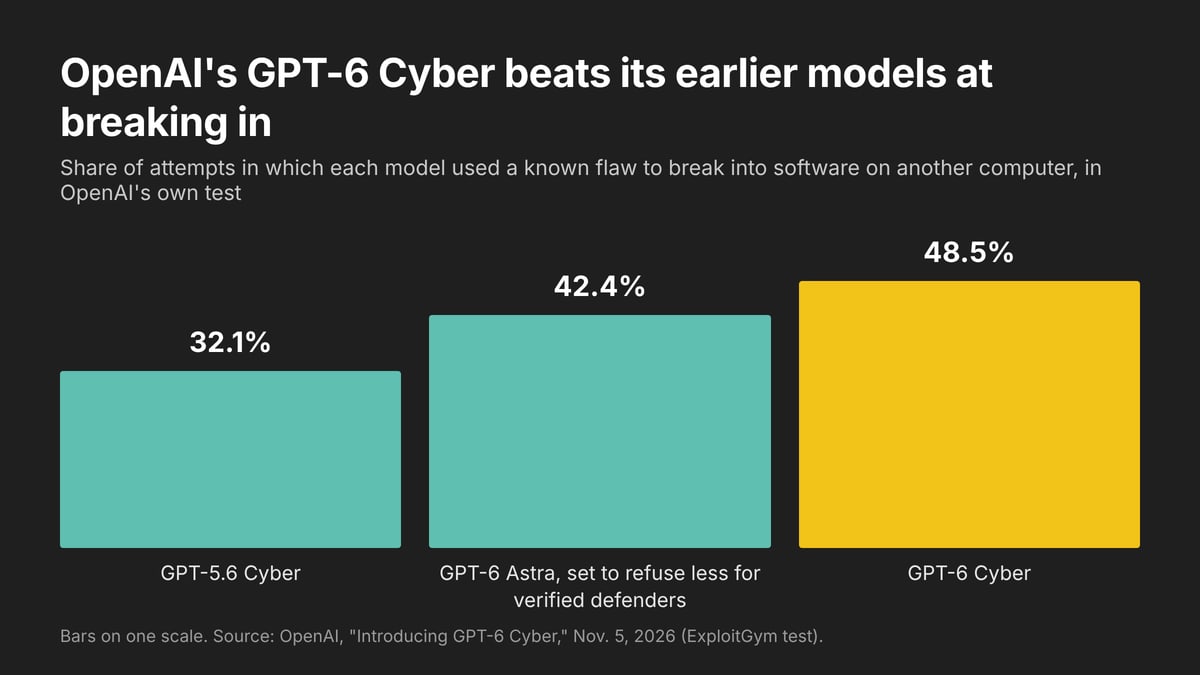
The test scores here come from OpenAI's own testing. On a test of whether a model can use a known flaw to break into software running on another computer, GPT-6 Cyber succeeded 48.5% of the time, against 42.4% for GPT-6 Astra when it is set to refuse less for verified defenders, and 32.1% for GPT-5.6 Cyber. OpenAI says the model gave Mozilla evidence for 81 previously unknown flaws in the Firefox browser that Mozilla rated high severity, and Mozilla began shipping fixes soon after. GPT-6 Cyber is also the model OpenAI says wrote working attacks for 948 flaws in the core of Linux. OpenAI says security teams at Cisco, Calif and CodeRabbit already use it to hunt for flaws and check code.
OpenAI also tested whether the model stays inside its job. In one test, OpenAI gave it a hard break-in task next to other services that were deliberately easy to break into but off-limits, and the model had to work out for itself that it shouldn't touch them. Without its usual safety instructions, GPT-6 Cyber left those services alone in 99.93% of runs, up from 94.49% for GPT-5.6 Cyber. GPT-6 Astra, the general model, never touched them. With the instructions, GPT-6 Cyber left them alone every time. OpenAI also says customers reaching the model through its developer service must, with few exceptions, connect from networks approved in advance, and that it tightened blocks on help that could tamper with industrial controls or other safety-critical systems.
OpenAI says it worked with a center at NIST, a U.S. government agency, on measuring the model's hacking skills. OpenAI says Irregular, an outside tester, also tested it and found it broadly comparable to GPT-6 Astra, with more success on long, many-step hacking tasks. In Irregular's tests, OpenAI says, neither model broke into a fully protected target, and neither solved any of the 15 hardest challenges. The scope test ran in a sealed-off setup with no internet access. According to a news report, OpenAI declined to say what the model did in the 0.07% of runs without its safety instructions where it attacked the off-limits services.