
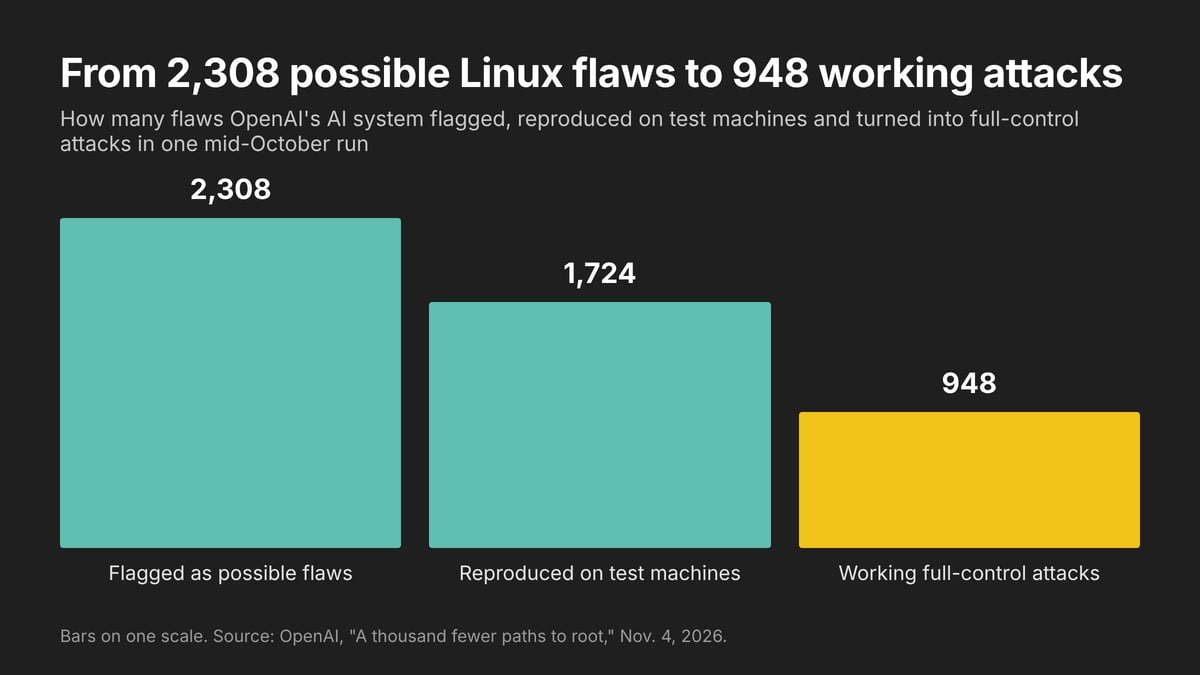
OpenAI says its GPT-6 Cyber model found 948 separate security flaws in the Linux kernel, the core of the Linux operating system, and built a working attack on each one. Each attack could turn an ordinary account into full control of the test computers. Linux runs Android phones, cloud servers and supercomputers, and OpenAI says the systems it underpins are used by billions of people.
On Linux, the account with full control is called root. The flaws OpenAI describes let someone who already has an ordinary, limited account on a machine gain root. They are not a way in from outside: the attacker needs that account first. Still, OpenAI warns that for the near future, for a well-funded attacker, an ordinary account on a computer that is missing its latest updates is about as good as full control.
OpenAI built the system in stages run by AI agents, AI that can carry out tasks on its own. Human researchers review the results at the end. In a run in mid-October, the agents picked out about 7% of the kernel's code to examine, parts that ordinary users can reach and that matter for security, and flagged 2,308 possible flaws. Other agents reproduced 1,724 of them on test machines, wrote a proposed fix for each, and built working full-control attacks for 948. The attacks were tested on machines running a standard, commonly used Linux desktop system with its usual protections switched on. On a hardened version of Linux with fewer exposed parts, a separate run built 21 such attacks.
At the prices it charges others for its models, OpenAI puts the run's cost at about $1.2 million, or about $1,280 per flaw it could attack. It says it focused on what the model could do rather than on cost, and that a better-built system could do the same work for less. The system grew out of earlier work: in June, OpenAI said an earlier model had built 24 such attacks on Linux. In July, a run with its GPT-5.6 Sol model found and attacked 166 such flaws. OpenAI says the newer model found more than five times as many new ones, even though the kernel had three months of extra fixes in between. In a sample of 166 of the attacks, it says the agents used 10 attack methods it believes are new. Outside Linux security experts it shared them with had not seen them either.
These are OpenAI's own results, and it has kept the full details of the new attack methods private for safety reasons. Its researchers caught mistakes too: in an early run, 20 of 200 attacks the system counted as successes had gained control through a different flaw than the one they were meant to test, so OpenAI added a separate check. It says it has sent hundreds of reports and fixes for the most serious flaws to Linux's developers, and is sending the rest gradually with partners.
OpenAI says Linux's developers are moving fast: during the 10 days of the scan and review, other people fixed, or had fixes ready for, more than 100 flaws of this kind. It says that makes keeping software up to date critical for people and companies. OpenAI has not said which Linux desktop system it tested on.
Update (Nov. 5): OpenAI has since named the model GPT-6 Cyber and released it to a select group of approved customers of Daybreak Red, a tier of its Daybreak cyber program for deeper, authorized security testing.