
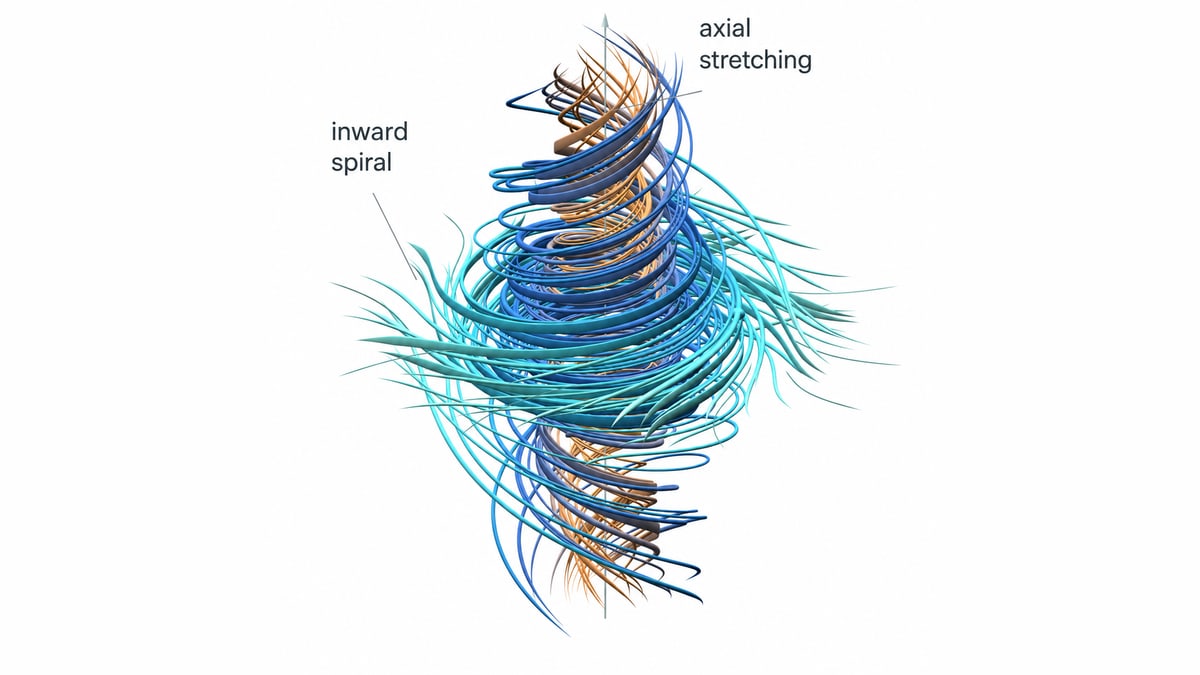
OpenAI on Sept. 8, 2026, published what it says is a resolution of the Navier-Stokes Millennium Prize problem, an open question about the equations that describe how fluids such as water and air move. The company says its mathematical proof, plus a version formalized in Lean, shows that a smooth 3D flow of a fluid that can't be compressed can develop a singularity, a point where the equations break down, in finite time. If the claim holds, it would answer one of the Clay Millennium problems. For now it faces review by other mathematicians, and fights over credit and process have already begun.
OpenAI says the work came from a large internal multi-agent system: many AI agents, AI that can carry out tasks on its own, working together. The Lean version means the proof was also checked by Lean, software that verifies each step of a proof, rather than only written out in prose.
The same week, New York University's Tristan Buckmaster and Anthropic's Levent Alpoge posted related results on the Euler equations, which describe fluids without internal friction. They allege that OpenAI raced ahead with their approach after a Sunday call with an OpenAI researcher. OpenAI's post congratulates them on priority for the forced Euler result and says the proofs differ. After an internal review, the company also denies that data from users of Codex, its coding tool, influenced its result.
Mathematician Terence Tao has warned that swarms of AI agents racing on rumors could chill the open sharing of math. It is not yet known whether the Millennium Prize claim will hold, whether the disputed Sunday call changes who gets credit, or whether any outside researcher's data shaped the proof. Until those points are settled, OpenAI's statements and the mathematicians' own accounts tell different stories.