
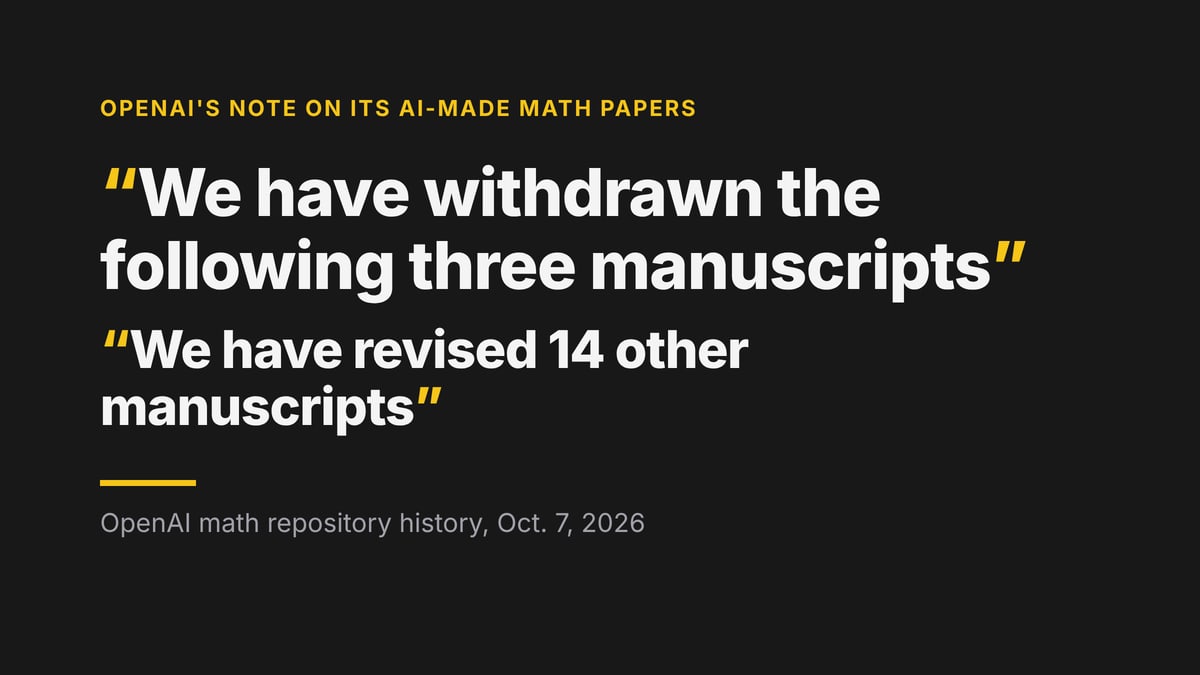
OpenAI has withdrawn three of the math papers it published on Oct. 6, which it says an unreleased internal AI model produced. In an update to its public collection of the papers dated Oct. 7, the day after the release, the company said a sign error, a plus where there should have been a minus, broke a key step in one proof. Two other papers were built on part of that proof, so OpenAI withdrew all three.
The mistake sits in a paper titled "Algebraicity of Weil classes on split abelian eightfolds," in an advanced area of geometry. The proof started with a count below zero and added pieces it scored as plus one each, so the total came to exactly zero. Each piece should have counted as minus one, which pushes the total further below zero instead, and a theorem the proof relied on only works when that total is zero. OpenAI says the withdrawal does not claim the result itself is false: it may still be true, but this proof does not show it. Each withdrawn paper now carries a notice explaining the problem, with a link to the old version.
OpenAI also revised 14 other papers with repaired proofs, corrected statements and clearer conditions, and updated 13 more so they cite the corrected versions. The collection now lists 719 papers in 372 groups of related results, down from 722.
OpenAI also shared some proofs in Lean, a programming language that lets a computer check a proof step by step. OpenAI says about 42% of the main results now have such a computer-checked version, after it added six more, which leaves most of them resting on proofs that people still have to read and check by hand. The collection's own guide warns that some of the unchecked results could have problems and says OpenAI will try to fix them quickly.
A company spokesperson said OpenAI found the errors in its own audit, according to a news report. A Cornell University mathematician said in that report that he suspects more errors will be found, and that OpenAI should have announced the computer-checked papers first. An MIT mathematician called the quick withdrawals the responsible thing to do, but added that it will take a lot more than that for OpenAI to win back mathematicians' trust. OpenAI says it is working to release the model that produced the results, but has not said when.