
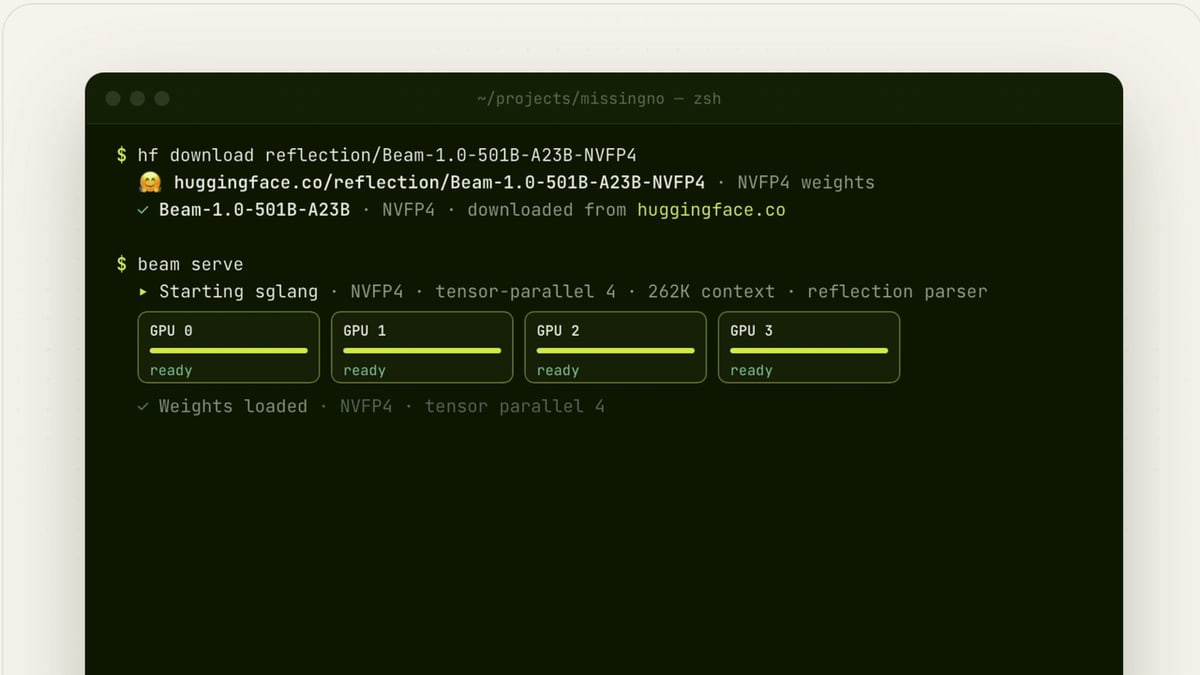
Reflection, an American AI startup, on Friday, Oct. 16, released the open weights of Beam, its first AI model: it published the model's trained files, so anyone can download it and run it on their own computers. The files are on Hugging Face under the Apache 2.0 license, a license that lets anyone use, change and share them free of charge. Reflection built Beam mainly for writing and fixing software and for multistep work it carries out on its own. When the company unveiled Beam on Oct. 5, only a select group of early users could try it.
People who don't want to run it themselves can try Beam through Reflection's own online service, which Reflection says is free to start during a public test period, or through cloud companies including Amazon Web Services, Google Cloud and Microsoft Azure. Reflection has not published a price for its own service. Reflection says Dell and HPE offer Beam for companies' own data centers, including systems cut off from the internet.
Beam is large. It has 501 billion parameters, the numbers a model tunes as it learns, but it is a mixture-of-experts model, a design that switches on only part of the model for each piece of text, so it runs faster than its full size suggests: only about 23 billion of those numbers are used for each piece of text. It still needs enough memory to hold the whole model. Hugging Face, which hosts the files, says the most compressed version of the files takes about 280 gigabytes. Two of NVIDIA's B200 data-center chips can just hold it, but Hugging Face's guide suggests planning for four.
Reflection says Beam reaches answers about as good as other leading free-to-download models while using about a third as many tokens, the small chunks of text, often parts of words, that AI models read and write, as it reasons. Fewer of them can mean a smaller bill, since a company's AI bill is the price of each one times how many a task takes. But according to a news report, Reflection concedes that rival models may run more efficiently on the chips, so a shorter answer may not mean a lower bill. On Terminal-Bench 2.1, a test of carrying out tasks by typing commands into a computer, the way programmers do, Reflection's published comparison gives Beam a score of 80.1, behind 88.3 for Kimi K3 and 90.6 for DeepSeek V4.1 Flash, models from the Chinese companies Moonshot and DeepSeek.
Beam's scores come from Reflection's own runs, and Reflection says it took its rivals' scores from outside sources. Reflection says outside groups, including Gray Swan and SecureBio, helped test Beam's skills and safety before release, and it has published a safety report alongside the files.
Beam arrives a day after Meta released Muse Spark Open, a larger free-to-download model. According to a news report, Reflection has not compared the two directly. It is not yet clear what Reflection will charge for Beam on its own service, or what one finished task will cost compared with rival models.