
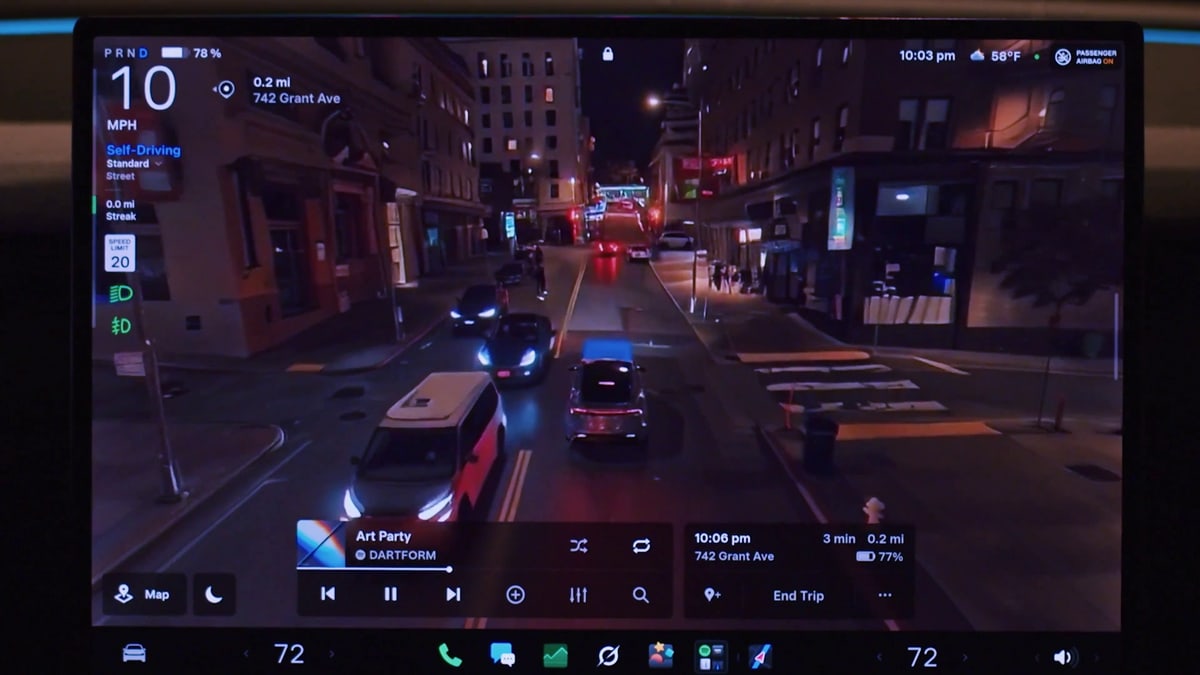
Tesla said on Saturday, Nov. 21, that version 15 of FSD (Supervised) has started rolling out. FSD stands for Full Self-Driving, but despite the name, the software only drives the car while a person watches. Tesla says it can steer, change lanes and make turns almost anywhere, and that it does not make the car autonomous or replace the driver. Tesla says the new version upgrades every part of the AI that drives the car.
Tesla's release notes start with the part of the software that makes sense of what the car's cameras see. They say it is now shared by FSD, Tesla's Robotaxi service and its Optimus robot, and was trained on millions of videos from the internet. Tesla says this made what it calls critical interventions, times when the driver has to step in, 25 times less frequent, and its main post calls it "25x better handling of safety critical cases." Tesla's announcement and release notes do not say how it counted these moments or over how many miles, and no outside group has checked the figure.
Tesla says its new Reality View swaps the old driving display for a live, computer-generated picture of the street around the car, drawn as if from a camera above it, and lets the driver see and control what the car plans to do. Tesla says the car can now slow down for speed cameras, and pressing the accelerator cancels that. Tesla also says the software is better at spotting signs, animals, road debris, potholes and deep standing water, and at choosing speeds in school zones and bad weather. Drivers with a bike rack can now use it too, though in that mode the car pulls over near the destination and will not reverse, and Tesla says its self-parking and summon features and its backup chimes and warnings are switched off.
One change makes the attention check less strict. Tesla says the camera that checks whether the driver is paying attention now works more often when the driver wears a hat or sunglasses, and that the check is less strict in the settings that make the car drive faster. Tesla's own help page says FSD (Supervised) is meant only for a fully attentive driver, who stays responsible for the car's speed and control at all times.
Tesla has not said which cars or countries get version 15 first. Tesla's chief executive, Elon Musk, wrote on Nov. 21 that it would go to wide release in December. In the U.S., FSD (Supervised) costs $99 a month and is sold only as a subscription, and Tesla says the price may change.
The U.S. auto safety regulator, the National Highway Traffic Safety Administration (NHTSA), still has at least two open investigations into the software. One, opened on Oct. 7, 2025, looks at reports of cars on FSD going through red lights and into lanes of oncoming traffic, and covers about 2.9 million cars. The other, a deeper inquiry NHTSA started on March 18, 2026 from an earlier one, looks at whether the software notices when glare or something in the air keeps the car's cameras from seeing clearly, and warns the driver in time. It covers about 3.2 million cars, and NHTSA lists nine crashes, one of them fatal. NHTSA says both reviews will consider Tesla's updates to the software, and it has not said whether version 15 changes either case.