
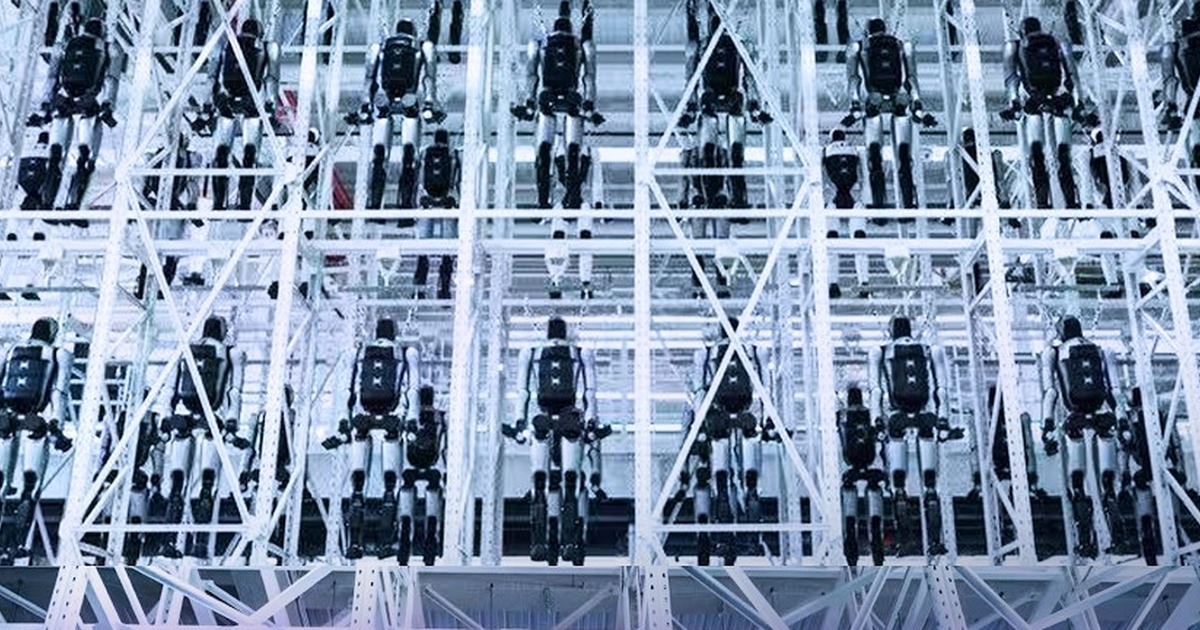
UBTECH on Sept. 12, 2026, held a production-commissioning ceremony for its Industrial Humanoid Robot Super Smart Factory in Liuzhou, Guangxi, with municipal leaders and founder and CEO Zhou Jian attending and a Walker S2 joining the start device, according to the Liuzhou Investment Promotion Bureau. The plant matters because industrial humanoid makers are racing from workshop batches into claimed automotive-grade volume, and a design line rate near one finished unit every 10 minutes would, if sustained, put Chinese factory iron far ahead of Western one-per-hour showcases even before order books catch up.
Planned capacity here is not confirmed 2026 shipments. Liuzhou officials and UBTECH describe a design takt of one robot every 10 minutes and annual planned capacity above 10,000, framed as the company's first industrial humanoid smart-manufacturing benchmark at that scale. "Robots building robots" on this floor mainly means wheeled Cruzr logistics platforms and collaborative arms moving parts and aiding assembly of Walker S and Cruzr products, not a claim that bipedal Walkers alone assemble Walkers end to end without humans or conventional automation.
Global Times, citing a company WeChat statement, says the plant covers 14,000 square meters and stands 13.8 meters high, primarily producing Walker S and Cruzr series units, with Cruzr Y1 and Cruzr S2 on depalletizing, palletizing, loading, and handling. Each finished robot, the company says, undergoes more than four hours of whole-machine testing, and a 65-square-meter automated warehouse can store 112 robots. UBTECH and Siemens Digital Industries Software jointly built a manufacturing operations management "smart brain," and Interesting Engineering reports more than 2,000 screws across roughly 50 specs, unique serial-number traceability, and a Siemens Plant Simulation 1:1 digital twin.
Independent coverage put harder edges on the same disclosure. Humanoids Daily on Sept. 13 framed the commissioning against H1 2026 context of 921 full-size bipedal deliveries and a 1,445% rise in full-size humanoid revenue, while warning that manufacturing capacity is only as valuable as an order book's ability to absorb it and that industrial clients accounted for more than 96% of that income. Interesting Engineering's video brief notes H1 sales near 900 full-size units alongside a company still loss-making at about 339 million yuan, casting the 10,000-unit 2026 target as a bet. "World's first" 10,000-scale framing remains company and government language, not an independently audited ranking.
What remains open is whether Liuzhou runs near design takt through year-end, whether enterprise absorption keeps pace with hardware output, and whether embodied software generalizability keeps up with the screwdrivers. Design capacity figures from government and company statements should be weighed against independent delivery and loss context until utilization and shipment data land.