
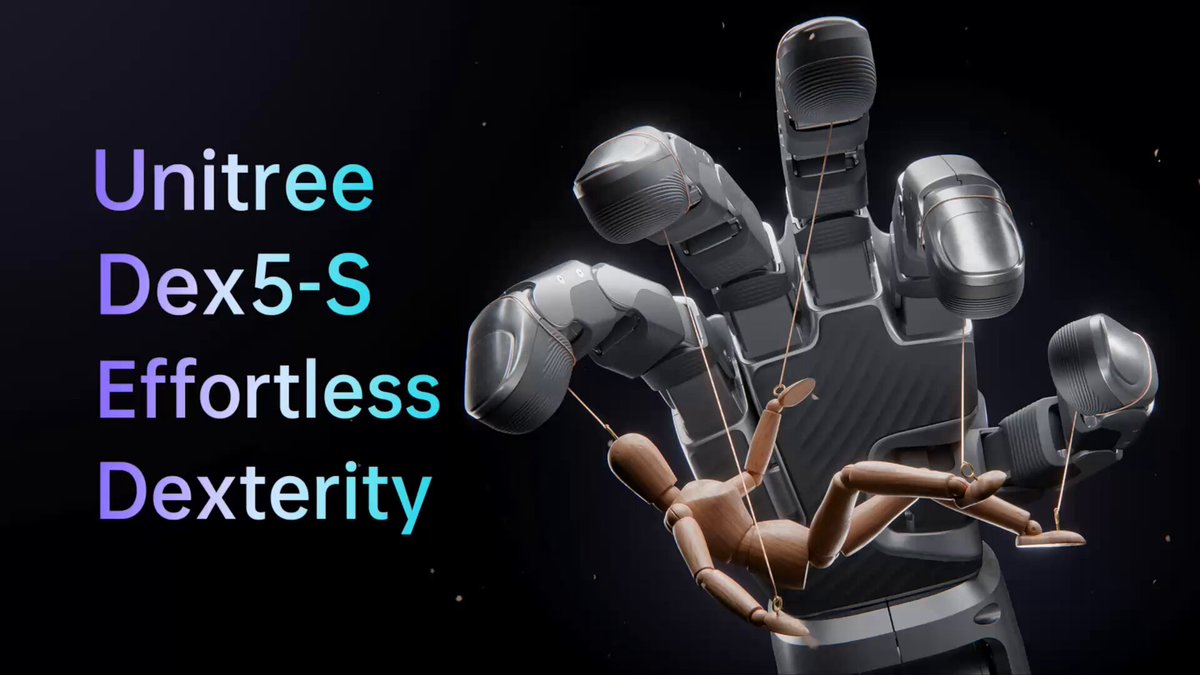
Unitree said on Sept. 21, 2026, that it is selling the Dex5-S, a five-finger robot hand at 1:1 human-hand size with 22 degrees of freedom, the separate ways its joints can move, from $6,500 before tax and shipping. The company says all 22 joints are backdrivable, meaning they give way smoothly when pushed, and that each has protection that limits torque from impacts. Hands this capable remain a bottleneck for humanoid robots, both when a person steers the robot remotely, as with a remote control, and in the systems that teach robots new skills. At that list price, Unitree would come in under many quotes for research-grade hands, if the base kit ships and works with existing robots as described.
The Dex5-S mounts on a robot's wrist; it is not a new humanoid body. Unitree's earlier Dex5-1 hand has 20 degrees of freedom, 16 driven by motors and four that move passively, while Unitree says the S model has all 22 driven. Unitree says they include a new rolling motion for the little finger.
Unitree's product page says the hand weighs 620 grams and measures 102 by 187 by 26 millimeters. It says the hand can hold up to 2 kilograms at peak and 1 kilogram continuously, runs on 15 to 65 volts and can be controlled at up to 1000 Hz, or 1,000 times a second, over T1s Ethernet or USB. Each joint reports its position, speed, torque and temperature, and touch sensing comes only on a Pro version.
Unitree announced the hand in a post on X with a demo clip of about 43 seconds, giving a starting price of $6.5K before tax and shipping. Unitree's Chinese-language product page gives a starting price of ¥39,900, and its product pages break the 22 degrees of freedom down by finger: five in the thumb, four each in the index, middle and ring fingers, and five in the little finger. Unitree's website had no Dex5-S product page on Sept. 22; one has since gone up.
Unitree had not published force and speed curves, a software development kit, documentation for the ROS robot software, or durability data at launch, according to an industry newsletter that compared the Dex5-S with SharpaWave and Shadow-class commercial hands. Until Unitree publishes those details, the newsletter said, the $6,500 figure is better seen as an entry price than as the cost of a hand fully ready for research.
Nobody outside Unitree has yet published figures on the hand's force control, how quickly it responds or how it holds up over repeated cycles. It is also unclear how mounting, power and software will work on Unitree's G1, H1 and H2 humanoids.
Update (Oct. 5): Unitree has since put up a Dex5-S product page, which lists the hand from $6,350 and gives the specifications above.