
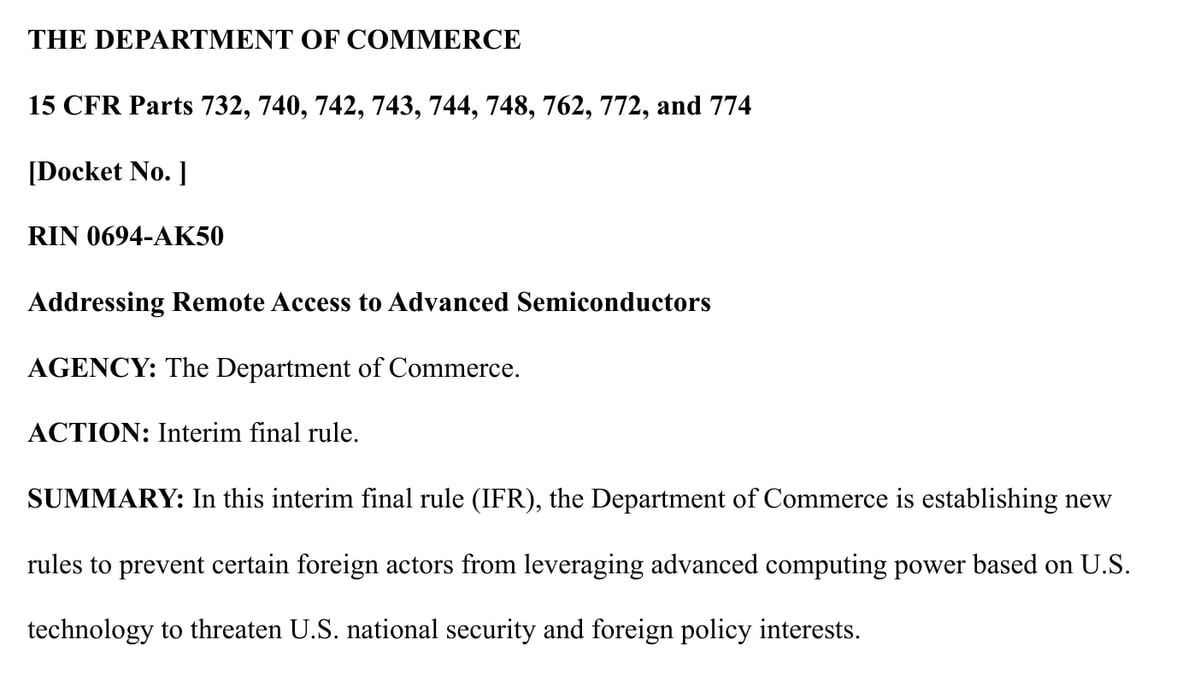
The U.S. Commerce Department's Bureau of Industry and Security, which writes the country's export rules, released a new rule on Nov. 16 aimed at Chinese companies that rent time on American AI chips instead of buying them. The department says the rule is meant to ensure that existing limits on sensitive American technology "cannot be circumvented through remote computing arrangements involving data centers in third countries." The department says the rule was written by, and at the direction of, the Treasury Department and the National Security Council.
The United States already requires a license to sell advanced AI chips to companies based in China or Macau, or to companies whose parent company is based there. Those rules already cover chips bound for a data center whose main user, taking more than half its computing power, is such a company. The new rule reaches any data center that gives them more than a set amount. But a company can rent computing power over the internet from a data center in another country, the way businesses use cloud services. The department says cloud computing has made that increasingly possible, including through data centers outside the countries U.S. export rules restrict.
Under the new rule, sending advanced AI chips to a data center anywhere in the world needs a license when the sender knows the center will serve certain customers with computing power above a set level. Those customers are companies based in China, Macau or other countries on a U.S. list of countries of concern, or owned by a parent based there, and anyone that helps train AI models for them or supplies AI models to them. The rule says that level of computing power is enough to train or run advanced AI models. It counts data centers together when networking links them to share work and data as one, even when the link is digital rather than physical. A sender whose data center customer won't or can't share enough information to check who it serves is treated as knowing, unless the sender clears that up first.
A data center already serving such customers at that level must get a license within 90 days of the rule taking effect to keep doing so, or face future export limits. A center that later starts serving such customers needs approval first. Data centers, chip factories abroad and chip exporters must check who owns and controls their customers. AI built and used only to recommend products or content, like an online store's suggestions, is exempt from the new license if it is reported to Commerce. But a data center whose main user is such a company may keep doing that recommendation work for it for only 90 days without a license, the rule says. AI that writes text or software or makes images, audio or video is not exempt, even when it also recommends things.
Separately, sending those chips to Indonesia, Malaysia, Singapore, Thailand or Brazil will need a license once the rule takes effect, because the rule says those countries carry a higher-than-normal risk that chips get passed on to places they are barred from. Commerce can add more countries to that list. It says it will judge license requests case by case, and for these five countries will weigh how well each enforces export controls and works with U.S. enforcement. Chips going to companies there that are based in the United States, or owned by a U.S. parent, are exempt if the shipper lists them in a monthly report to Commerce. Commerce says it will watch for countries that tolerate evasion. It may answer with import limits, new license requirements for chip sales to those countries, or trade blacklisting and temporary export bans for the people and companies involved.
The rule also formally scraps the AI Diffusion Rule, a set of country-by-country chip limits issued in January 2025 that was never enforced and that Commerce said in May 2025 it would drop. With it go that rule's limits on sharing model weights, the files that hold a trained AI model. The new rule takes effect the day it is published in the Federal Register, the government's official journal of rules, and the public then has 60 days to comment. Commerce expects about 100 more licenses a year.
The rule comes four days after Jensen Huang resigned as NVIDIA's chief executive, on Nov. 12. A news report says he stepped down after admitting to an affair with an executive at Megaspeed, a Singapore cloud company that worked with NVIDIA, and that the rule was issued as President Trump began a trip to China to meet President Xi Jinping. Commerce did not mention Huang or Megaspeed in announcing the rule, but Singapore is one of the five countries it covers.
Update (Nov. 17): The Federal Register now lists the rule for publication on Nov. 19, so it takes effect that day. Comments are then due within 60 days, by about Jan. 18, 2027, and a data center already serving such customers has 90 days, until about Feb. 17, 2027, to get a license.