
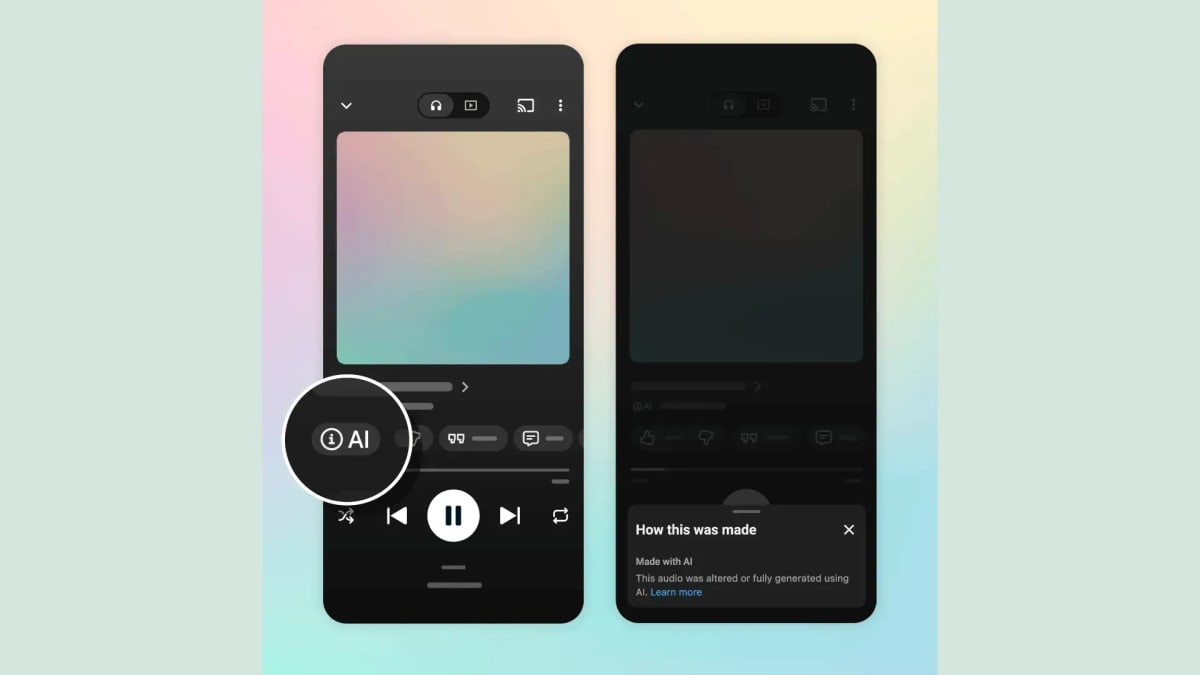
YouTube Music has started labeling songs that were made mostly with AI. The company said on Wednesday, Oct. 14, that the label goes on tracks "created primarily using generative AI," AI that creates new material, such as music, voices or pictures, often from a typed request. Its example is a song whose music and vocals were both made with an AI tool. The same labels will come to the main YouTube app, though YouTube has not said when.
The label sits on the player screen while the song plays. Tapping it opens a short menu with more information. YouTube says listeners told it they want to know when they are hearing an AI-made track.
To decide which songs get the label, YouTube says it is working with music partners, the music companies that send songs to YouTube, and using its own detection tools. Partners can mark each track as fully made with AI, partly made with AI, or made without it. YouTube's guidance, which it calls suggestions, puts a song made by typing a request into an AI music generator in the fully AI group. An AI-made bassline under live singing, or using AI to brainstorm lyric ideas or come up with melodies and then recording the song in a studio, counts as partly AI. Ordinary pitch correction, or AI software that does the final polish of a track's sound, counts as made without generative AI. When a partner says nothing, YouTube says it relies on its own signals and may mark a song as fully or partly AI on its own.
Spotify has taken a different route. It said in August that it would start putting an "AI Persona" badge on some artist profiles from mid-September. That badge is about whether the artist behind the music is a real person, not how a song was made, and by default Spotify leaves artists with the badge out of its recommendations, unless a listener follows them. For how a song was made, Spotify offers credits where artists can say how they used AI.
YouTube has not said how accurate its detection tools are, how many songs carry the label so far, whether every listener can see the labels yet, or whether songs a partner marks as only partly made with AI get one. It also has not said whether a labeled song is recommended or paid any differently from other music.