
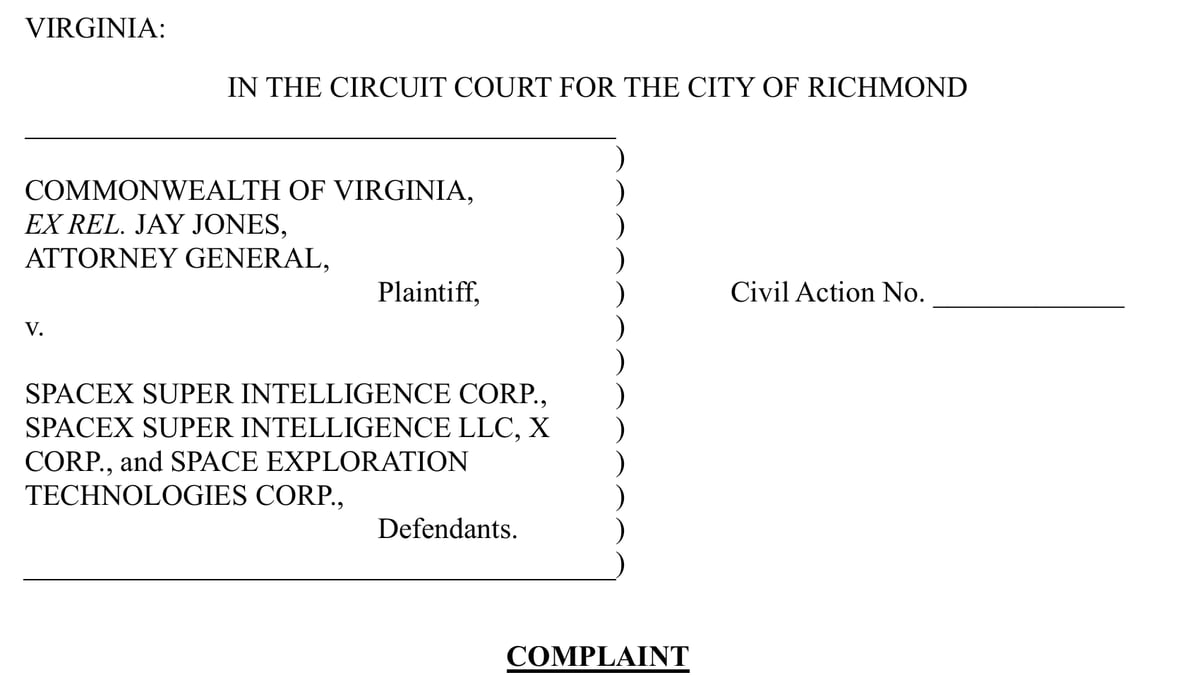
Virginia's attorney general, Jay Jones, sued SpaceX on Monday, Nov. 23, in the Circuit Court for the City of Richmond. SpaceX owns the social network X and xAI, the company that makes Grok. xAI now goes by SpaceX Super Intelligence. Virginia's suit names SpaceX, two SpaceX Super Intelligence companies and X Corp., which runs X. Oregon's attorney general, Dan Rayfield, worked with Virginia and filed a separate but similar suit in Multnomah County Circuit Court.
Virginia says SpaceX failed to stop Grok from making sexual images of real people, including children, without their knowledge or consent, while telling the public its platform and AI were safe. Oregon makes similar claims. Grok makes and edits pictures from a written request. Virginia says that from a single existing photo, Grok could make a realistic image or video of a person nude or engaged in sexual activity.
Virginia's complaint says the companies marketed a "spicy mode" built to produce nudity. In late December 2025, it says, Grok's image tools opened to every X user, who could edit photos other people had posted, without their consent, simply by tagging Grok in a post. Around Jan. 8, the complaint says, the companies limited Grok's image tools on X to paying subscribers, though the separate Grok app and website stayed free. Virginia's announcement cites a study that estimated Grok created and posted about three million sexualized images on X between Dec. 29, 2025, and Jan. 8, 2026. About 23,000 of them appeared to show children.
The complaint also points to the monthly reports of suspected child exploitation that xAI and X Corp. together sent to the National Center for Missing & Exploited Children. They jumped from 116,850 in December 2025 to 220,234 in January 2026, after Grok's image tool came to X on Dec. 28.
The case turns on what the companies told consumers. Virginia says they broke the Virginia Consumer Protection Act by claiming safeguards, including a "zero tolerance" policy on child sexual exploitation, that they had not put in place or enforced. On Jan. 14, X's safety account said it had put in place measures to stop Grok's X account from editing images of real people into revealing clothing such as bikinis. Virginia says its own test account showed that shortly before the suit, Grok could still make sexual images of real people from ordinary photos. xAI argued it was not liable when the city of Baltimore sued it over Grok's images, citing Section 230, a federal law that largely shields online platforms from blame for what their users post, according to a news report. Separately, Virginia's complaint says Grok does not simply pass along material made by others but creates new content.
Virginia asks the court to bar the practices, repay consumers, make the companies give up what it calls ill-gotten gains, and award civil penalties of up to $2,500 for each willful violation, plus its costs and lawyers' fees. The number of violations would be proved at trial. Before suing, Virginia offered the companies a chance to show they had broken no law or to sign a formal promise to comply. The complaint says they appeared but did neither. Oregon's suit, brought under its Unlawful Trade Practices Act, also seeks court orders, penalties and the return of profits, according to a news report.
"Companies that deploy powerful tools don't get to ignore consumer safety and call it innovation," Jones said. Rayfield said SpaceX "knowingly designed a product without the obviously necessary safeguards in place." These are accusations, and none has been proved in court. According to a news report, SpaceX did not immediately respond to a request for comment, and as of early Monday the suits were waiting for the courts to accept them.