
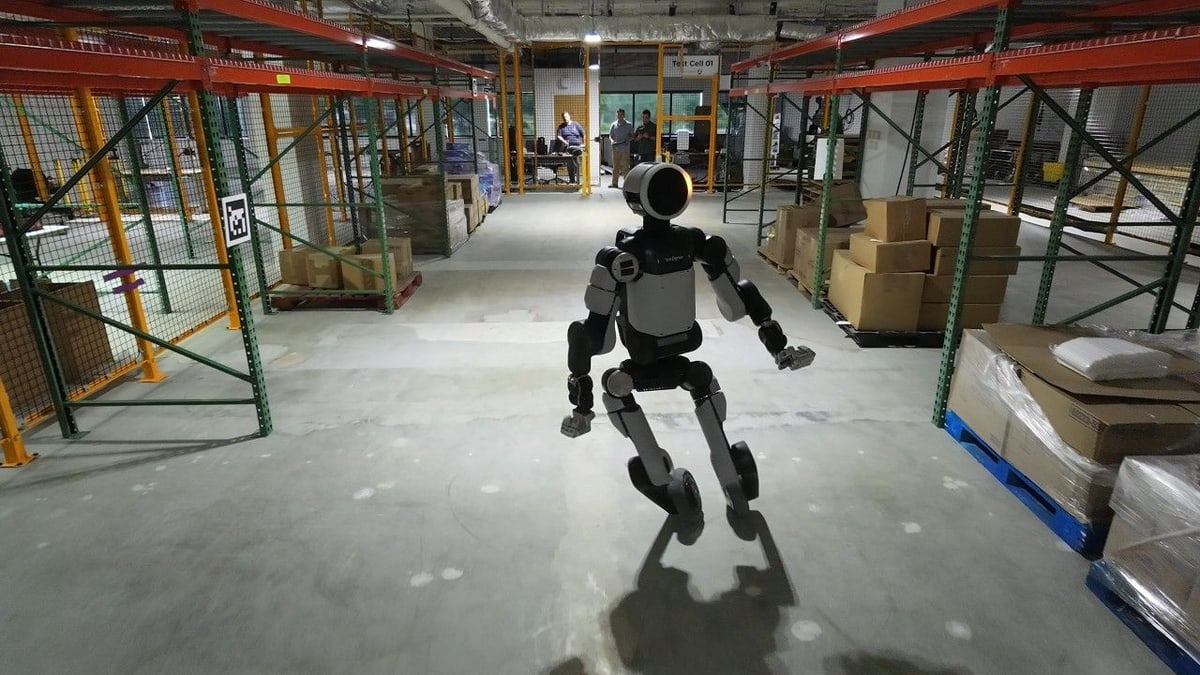
Boston Dynamics has taken the feet off its Atlas robot, a humanoid built in a human shape, and put wheels in their place. In a video and blog post on Nov. 9, the company shows Atlas rolling through a warehouse, sliding to the side in quick dashes and doing a full spinning jump on its wheels. The company says a wheeled Atlas is a research test, not a product.
The point was not the wheels, says Andy Wu, a Boston Dynamics engineer on the Atlas team who wrote the company's post about the project. Rolling makes the motors in the robot's joints work hard and fast the whole time, so it was a way to push them to their limits and see whether the robot's learned control software could still work well with them. Wu says the change itself was simple: a single custom adapter, the only new part, fixes an ordinary scooter wheel to each ankle, and in the software each wheel is treated as an ankle that can keep spinning.
Atlas learned to drive on wheels in a computer simulation, where it practiced on what Boston Dynamics calls millions of simulated floors before it rolled across a real one. It learned with reinforcement learning, by trial and error, with a reward for getting it right. Wu says the hard part is carrying skills a robot learned in a computer simulation over to a real machine. He spent much of the project making the simulated motors behave like the real ones, so the robot would not learn moves the real hardware can't make.
Some moves came from recordings of people. Wu picked clips where a person slides their feet, and the training worked out on its own that Atlas could roll through those moments instead. The spinning jump copies a recording of a person jumping and turning all the way around. Wu says that, for all its flash, it was one of the less risky moves, and it worked on the first try.
Boston Dynamics says what it learned, mainly that the robot learns better when its simulated motors behave like the real ones, is already going into the standard, walking Atlas, though it has not named specific changes. It says it keeps working to make the robot hold up when things go wrong. Wu says he has already started his next project: improving how the robot responds when one of its motors fails.