
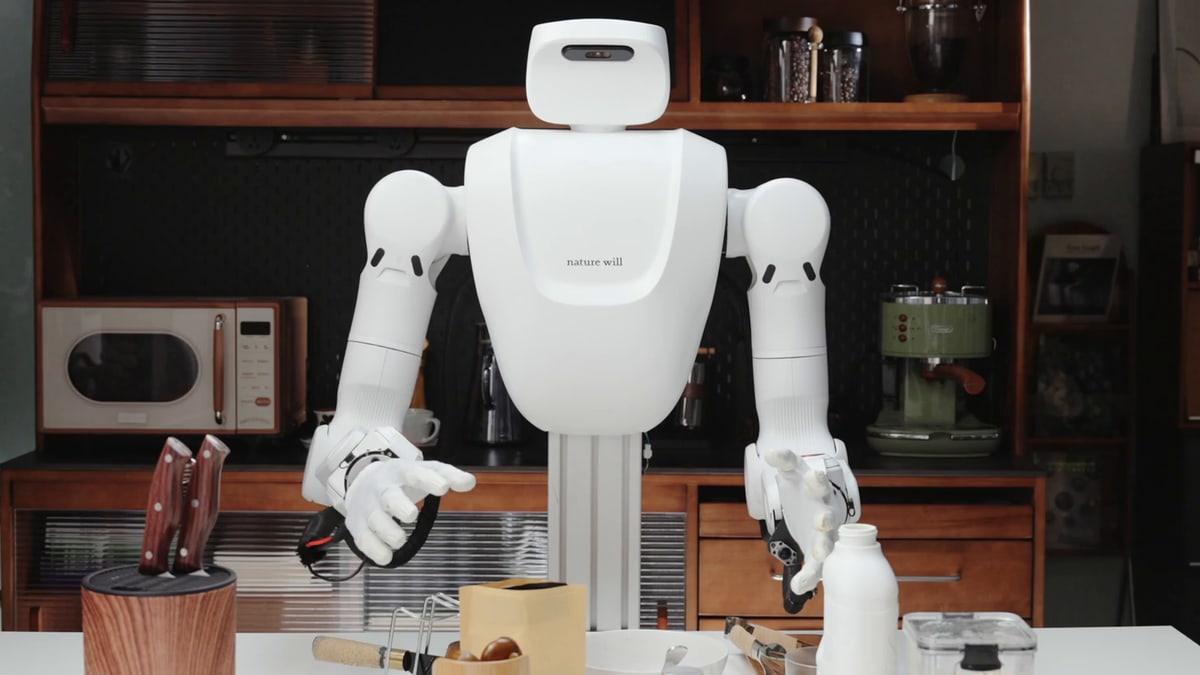
Robot hands are hard to teach. A human hand can grip, pinch, press and turn things in endless ways, and robots have little recorded practice to learn from because, as Nature Will puts it, a robot can only gather that practice in places where it already works. Nature Will, a robotics AI lab with an office in San Francisco, is trying another route. On Oct. 13 it introduced Natura-1, an AI that first learned from more than a million hours of video filmed from people's own point of view as they used their hands. After that, the lab says, a limited amount of robot practice was enough to adapt it to a pair of robot hands. No robot hand works exactly like a human one, so the lab uses robot hands built like ours, which it says are the closest match available today.
The lab's videos show the hands doing fiddly kitchen and household work. They separate one thin wonton wrapper from a stack, cup it in one palm while adding filling with a long-handled tool in the other hand, then fold and seal it with both hands. They scoop tea leaves, pour from a kettle and pinch the small knob of a glass cover to lift it off. Packing a box, one hand holds the springy flaps down while the other pulls the tape tight. The robot even writes Chinese calligraphy with a brush. Nature Will says these runs, several lasting minutes, happened without a person stepping in. Some clips in its film play at two or three times real speed.
The lab also tried requests its researchers made up on the spot, with objects and scenes that, the lab says, were unlike anything in its robot practice. Asked for a bottle that was "not blue, pink, orange, green, yellow, or purple," the robot picked the one that matched and handed it over. When a researcher pushed a lemon and a bin around with a long stick, the robot kept adjusting and still put the lemon in the bin. Given a coconut shell after a researcher had eaten the coconut, the robot spooned beans into the shell.
The long chores come with a catch. Nature Will says its six long demonstrations, including the wontons, the tea and the calligraphy, got extra training for those jobs on top of the general model, while the short made-up requests all used the same model. The lab says writing well with a brush is still hard, and its own tests show Natura-1 is weakest at shifting or turning an object within one hand. Natura-1 is built for hands, and the lab has said nothing about walking or balance.
All of these results come from Nature Will itself, and no outside group has reported testing the model yet. Nature Will has not said whether other companies or researchers will be able to use Natura-1, or on what terms. It calls the work early evidence that a single AI can learn hand skills from people and use them on unfamiliar tasks, and expects the road ahead to be a long research and engineering effort.