
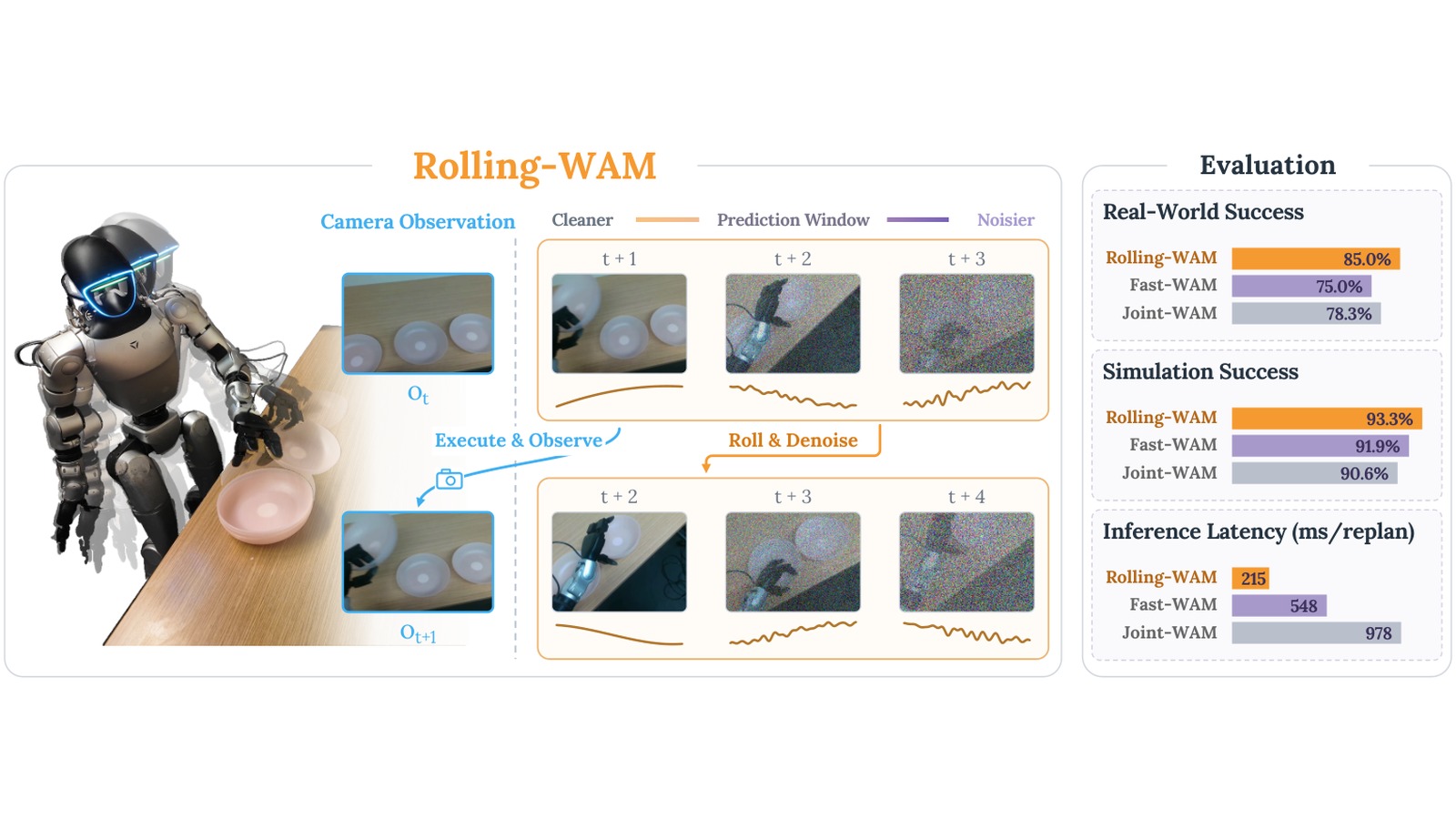
Joint world action models redo full-horizon video-action denoising on every replan, which slows closed-loop updates when the scene keeps changing. On Sept. 24, 2026, a USC-led team with Brown, Fudan, and Toyota Research Institute posted Rolling-WAM (arXiv:2609.30247) to keep visual imagination while cutting that steady-state latency.
In plain terms, Rolling-WAM is not InternW0's asynchronous duplex design and not a geometry-native latent method. It maintains a sliding window of aligned video-action chunks at staggered noise levels. Each cycle fully denoises only the imminent chunk for execution, then rolls retained futures forward with a newly appended noisy chunk and a fresh camera observation. Video and action experts sit in a Mixture-of-Transformers stack, with action tokens attending to partially denoised visual futures across the window.
Authors report a LIBERO average success rate of 98.1% (Spatial / Object / Goal / Long 98.2 / 98.0 / 98.2 / 97.8) without embodied pretraining, within 0.4 percentage points of Joint-WAM and LingBot-VA at 98.5%. On RoboTwin 2.0 they report 93.5% clean / 93.0% randomized / 93.3% average, the highest among listed compared methods in the paper tables. The fuller per-suite and per-task scoreboard stays in the paper.
On a single NVIDIA A100 under a controlled RoboTwin setup, authors report steady-state replanning latency of about 215 ms for Rolling-WAM versus about 978 ms for Joint-WAM and about 548 ms for Fast-WAM, roughly 4.5 times and 2.5 times speedups. Timing covers visual encoding and denoising, excludes warm-up and initialization, and uses no torch.compile, TensorRT, or custom CUDA kernels. On a Unitree G1 humanoid across Doll Placement, Plate Stacking, and Bead Pouring (20 trials each), authors report average success of 85.0% versus 78.3% for Joint-WAM and 75.0% for Fast-WAM.
The project page hosts the method overview plus G1 qualitative rollouts; some baseline comparison videos are still marked coming soon. All scoreboard figures are author-reported from the paper and project page. Independent reproduction outside the authors' protocol is not yet available in the materials reviewed for this article. alphaXiv indexes the same arXiv record. As of Sept. 26, 2026, Hugging Face Papers had no card for 2609.30247.