
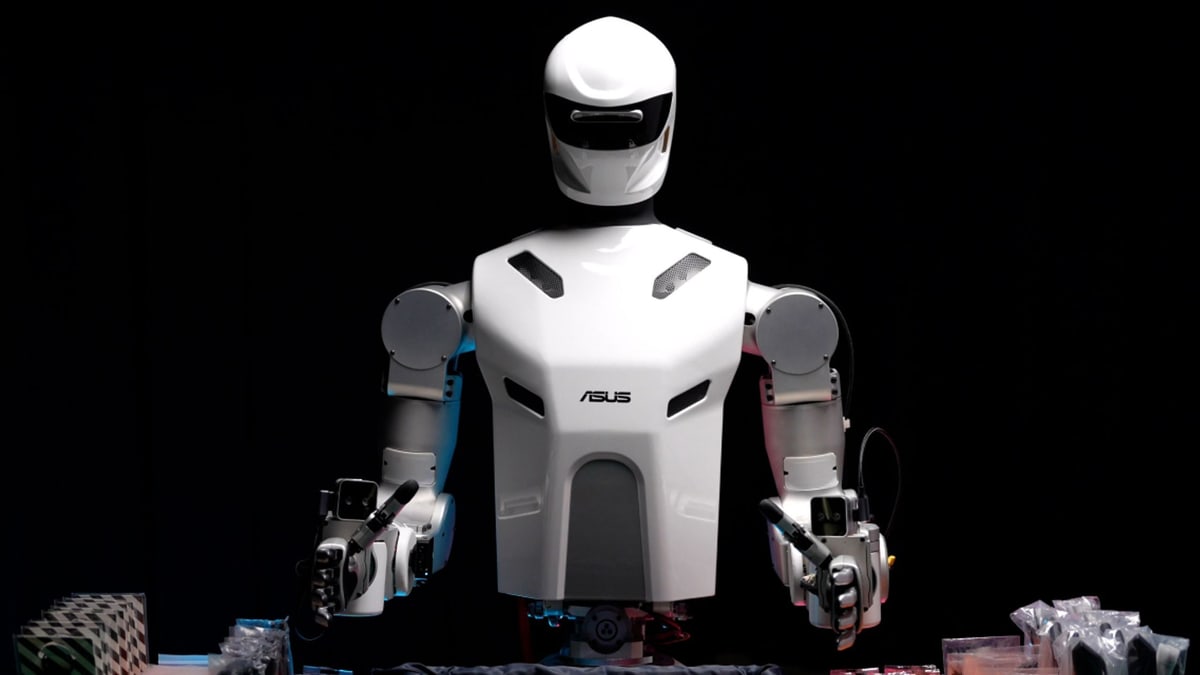
ASUS, which has spent decades making motherboards, PCs and servers, has shown its first humanoid robot, a robot built in a human shape. This one has two arms and hands on a base that stays in one place, so for now it neither walks nor rolls; ASUS says a version on wheels comes next. Called Gallop, it is learning its first job at an electronics factory in the ASUS group: packing the accessories that go in the box with a motherboard. ASUS co-chief executive S.Y. Hsu introduced the robot in a TV interview, and on Nov. 13 the company explained how the robot is built and taught in a post by Albert Chang of ASUS.
ASUS picked a job that is hard for a robot. The packing station has 15 small parts, many in thin, clear bags, and the job takes about 20 seconds per motherboard. ASUS says its target is for Gallop to get it right 99.5% of the time within those 20 seconds, the standard it holds a person to. It chose the station, it says, because small, thin and soft parts are exactly what a simple robot gripper can't handle.
ASUS says Gallop learns much as a new colleague would, mostly by watching the workers who do the job. It starts from publicly shared AI models made by others, which ASUS says already understand how hands and objects behave. Experienced workers wear a small camera on their heads, with their consent, so the robot can learn how the job is really done. Computer simulations then make slightly changed versions of each example, so small changes on the line don't surprise the robot. A person wearing a virtual reality headset and gloves then guides the robot through the task, using the same parts and cameras as the real station. Once the robot is at work on the line, ASUS says, what it records goes back into its training.
The software that runs Gallop at work, which plans each step, checks it and moves the arms and hands, runs on one computer inside the robot, NVIDIA's Jetson AGX Thor, part of NVIDIA's robotics platform. ASUS says it designs the robot's body itself and builds its own robot hand with a sense of touch. In 2027 it plans to fit its own hand to Gallop, put the robot on wheels, and show it to customers at the Computex show. ASUS says Gallop's strength for now is picking parts up and placing them at one workstation. ASUS says the robot is only worth having if it takes on most of a job without a person standing beside it the whole time, and it has not said whether Gallop does that yet.
ASUS says Gallop is meant for repetitive, physically demanding jobs that are hard to staff, not to replace workers. It plans trials with customers in 2027 and aims to start selling Gallop in the second half of 2028, first to electronics factories and later, it says, to hospitals and service sites. The project began only in early 2026. ASUS has not said how close Gallop is today to its 99.5% target, what the robot will cost, or which customers will try it first.