
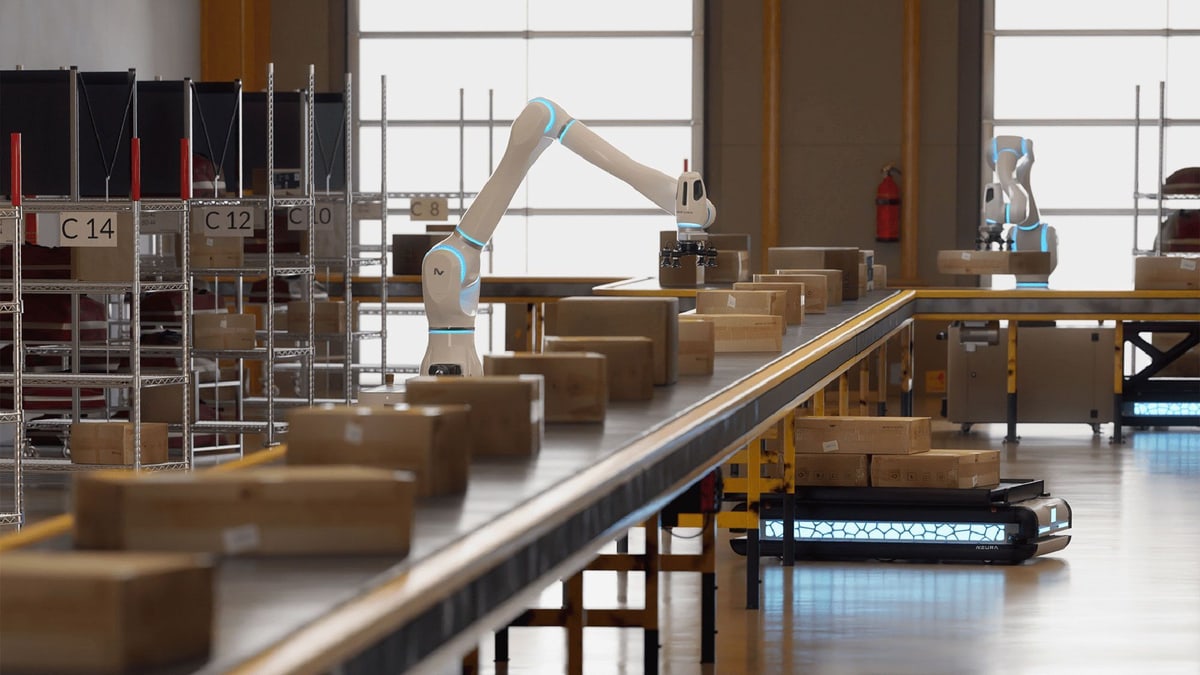
Amazon Web Services, Amazon's cloud computing business, has released a kit for companies building what it calls physical AI: AI that senses and acts in the real world through machines such as robots and self-driving cars. Called the Physical AI Toolchain on AWS, it is a set of blueprints and ready-made code for setting up that work on Amazon's cloud. The code is open source, meaning anyone can use, study, change and share it. Amazon announced the kit on Thursday, Oct. 8.
Robots are hard to teach. Chatbots learn from the huge amount of text on the internet, but a robot needs recordings of machines doing real tasks, and AWS says that kind of data is expensive to collect. Building a robot's AI also means stringing together several jobs, each with its own tools: making extra practice scenes on a computer, training the robot's AI model, testing it in a simulated world before it touches real hardware, and loading it onto the robot. AWS says the handoffs between those steps are where most teams lose months of engineering time.
The kit links those steps. It runs NVIDIA's robot software on Amazon's cloud. That includes Isaac Sim, which builds simulated worlds; Isaac Lab, where a robot's AI learns by trial and error, with a reward for getting it right; and Cosmos, which generates extra practice scenes. AWS says the kit works with any robot and any task, and that each part can be used on its own. The training example comes with 27 recordings of a person steering a robot arm by remote control to pick up and place objects, so teams can check that it works before adding their own data.
The code is published on GitHub, a site where programmers share code, but running it is not free. Users need an AWS account approved to use its GPUs, advanced AI chips, the hardware AI models are trained and run on, as well as accounts with NVIDIA and Hugging Face, a site that hosts AI models. AWS tells users to shut the setup down afterward to avoid charges. AWS also says the kit offers building plans and guidance, not finished robot skills: companies still bring their own robots, data and tasks.
Amazon says the kit draws on lessons from running more than 1 million robots across its own operations, and that it can help manufacturers get robot AI working in weeks rather than the years it would take starting from scratch. Those are Amazon's claims. NEURA Robotics, which is building humanoid robots, says through its chief executive, David Reger, that the kit helps it move much faster from learning to real-world use. NEURA Robotics is the only outside company Amazon quotes about the kit.
Amazon has not said how much a typical project costs to run on its cloud. It is also not yet clear how much of the speedup it promises holds up outside its own examples.