
Google DeepMind on Tuesday, Nov. 10, released Gemini Robotics 2.5, the newest version of its AI model for controlling robots. It is a robot model that combines what the robot sees with instructions in words and turns them into movements. Google says it is its most capable such model so far, and it is rolling out to the robot makers Google works with.
The idea behind it is a robot that can do many jobs instead of one. Google says most robots are trained to do one specific task over and over, while its models can take on a variety of tasks, even ones they were not trained on. Google tested the new version on more than 200 tasks, such as serving food with tongs, tying a bow on a gift box and using a pipette to move liquid. Google says the model works with many kinds of robots, from Apptronik’s Apollo 2, a robot built in a human shape with five-fingered hands, to Franka’s Duo robot, which has two-fingered grippers.
Google says the new version succeeds 30% to 100% more often than its earlier models in its own tests, depending on the type of task, and finishes tasks 20% to 30% faster. In its charts comparing it with Gemini Robotics 2, packing pastries with tongs went from 5% of tries to 100%, and closing the lid of a toolbox went from 0% to 93%. Some jobs remain hard: folding pants succeeded 40% of the time, up from zero.
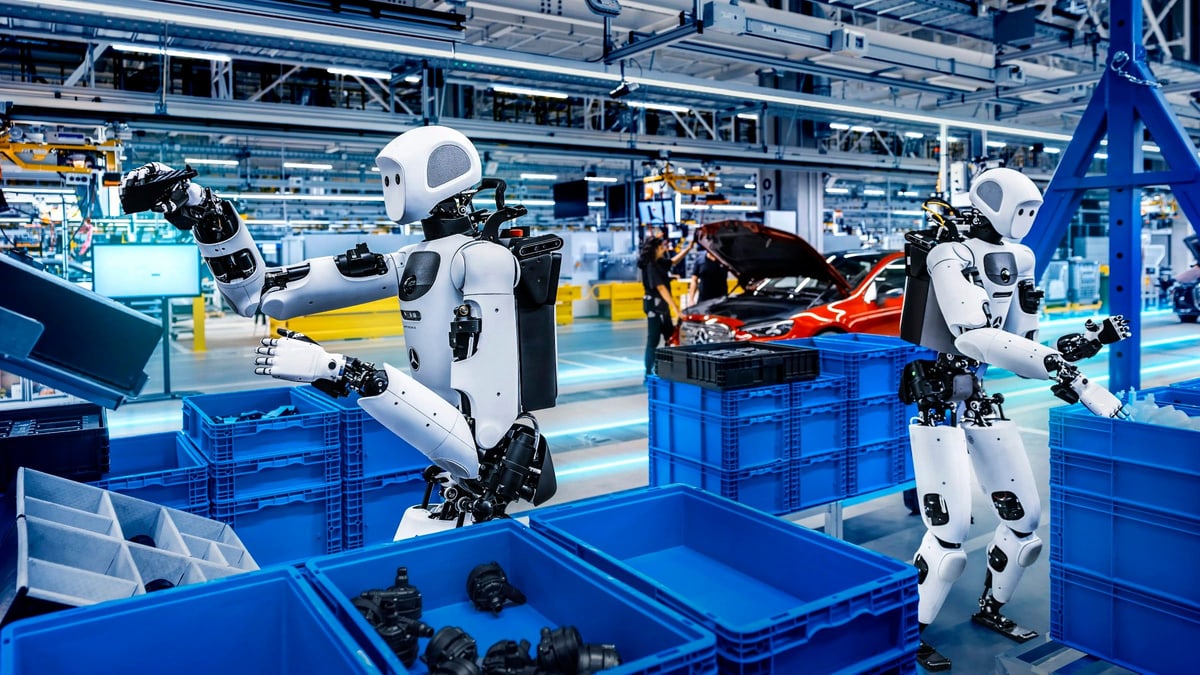
Google’s main real-world test was in car factories. Google, Apptronik and Mercedes-Benz put Apollo 2 robots on working car production lines in Kecskemét, Hungary, and Sindelfingen, Germany. There the robots did kitting: picking metal brackets out of bulk bins and placing them into trays in the exact order each car needs. A second Google model kept track of the steps while Gemini Robotics 2.5 moved the robots' hands and arms. Google says they succeeded 96% of the time. Google calls the trial a proof of concept and has not said how many tries it covered. A human doing the same job gets it right almost every time, and a Google DeepMind director called closing the last 4% a "steep road," according to a news report. Google’s robotics head said in the same report that a robot built for many jobs may not reach near-perfect results at every one.
Google says Gemini 4 Argon, one of its most advanced AI models, sped up the work. Argon can turn one real camera scene into thousands of varied practice runs in a computer-made copy of that scene. Google mixed those with real demonstrations so the robot could adapt to new scenes and objects faster.
Google says improved safety steering, which guides the robot around hazards as it works, raised how often the robot finished tasks safely by 33% around obstacles and 43% around nearby people, without saying what it compared against. Google also released hundreds of trick requests that hide unsafe orders, so others can test whether a robot AI can be talked into doing harm. The set is free under an open license, though people must sign in and accept its conditions to download it.
The public can’t use the model. Google is rolling it out to its robotics partners, which Google names as Agile Robots, Apptronik and Boston Dynamics, and others can join a waitlist for early access. Every result so far comes from tests by Google and its partners. The model still runs on remote computers reached over the internet, not on the robot itself, according to a news report. Google has not said what it costs or when robots running it will go on sale.