
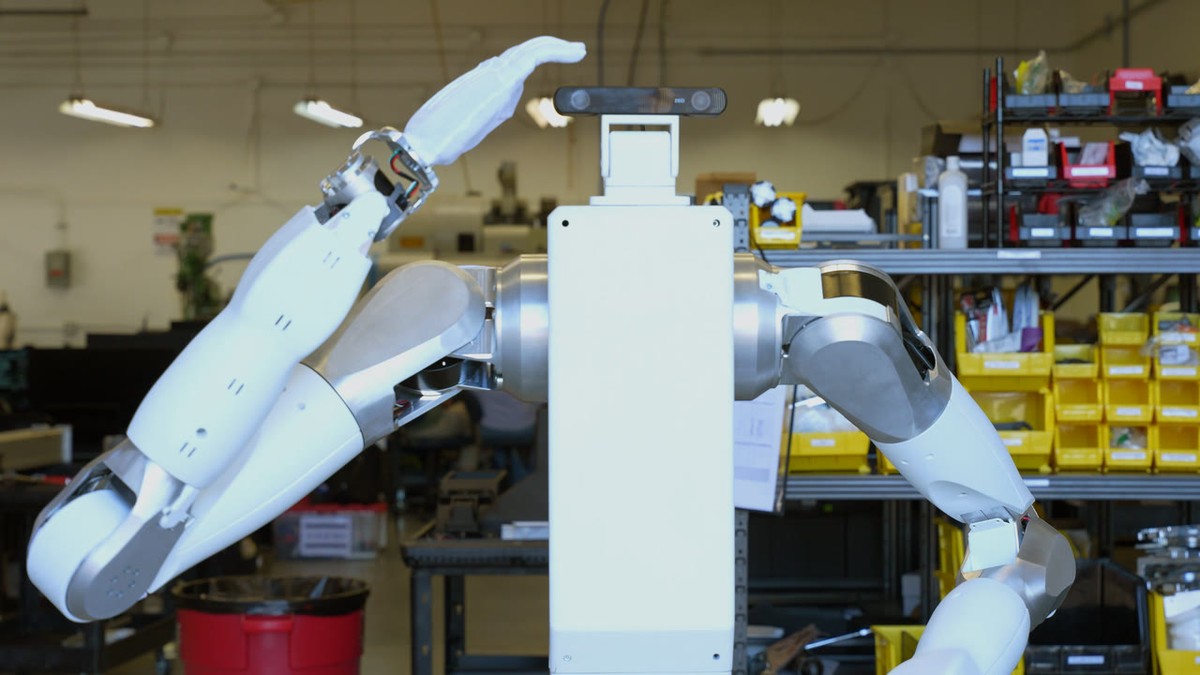
Feather, an East Palo Alto robotics startup, is selling a wheeled bimanual humanoid aimed at third-party developers and physical-AI teams, not a closed factory stack. The company lists the platform starting at $29,990 on feather.dev. TechCrunch and a Seed Innovations AIM Reach update say Gradient Ventures led a $7.6 million pre-seed. At that price point, small labs can buy a full dual-arm mobile platform instead of assembling one from industrial parts.
The machine is wheeled and holonomic, not a biped Optimus-style clone. Feather says the base turns 360 degrees and rolls up to 1.3 meters per second, with about 1 meter of reach, 600 mm of vertical travel, and dual hot-swappable batteries claimed for about 10 hours of work. End effectors and compute are modular. An open SDK covers Python and ROS2, with teleop, inverse kinematics, collision checks, and simulation hooks on the company site.
TechCrunch reports founders Hoa Mai, formerly of Kind Humanoid and later 1X, and Parsa Bakhtiari, who worked on Tesla's Model 3. The AIM Reach note dated Sept. 25 reproduces Feather's Sept. 24 announce: a pre-seed SAFE led by Gradient, with Builder Capital, Geometry, SEED, and Virgo VC participating. SEED says its $1.0 million converts at the next qualifying round or liquidity event subject to a $60 million valuation cap.
Feather frames the product as developer hardware, closer to an Android-style platform than a single vertical robot. The company says it built a first prototype in two months, took a first order within nine months, and has already booked more than $1 million in revenue, with early use in cooking and lab settings and models from Nvidia, Skild, and Physical Intelligence in the mix. Those revenue, customer, and timeline figures are company claims repeated in TechCrunch, AIM Reach, and The AI Insider.
Announce materials also compare the $29,990 online price with higher list prices for Unitree's H2 Edu, Agibot's G2, and Dexmate's Vega. Those comps are Feather's, not independent price audits. The design sits apart from Tokyo O-ID's modular biped raise and from bipedal Optimus clones. What is still open is how many paid developer seats stick, whether the Gradient round funds a real third-party app layer, and whether independent desks verify the revenue claim beyond company statements.