
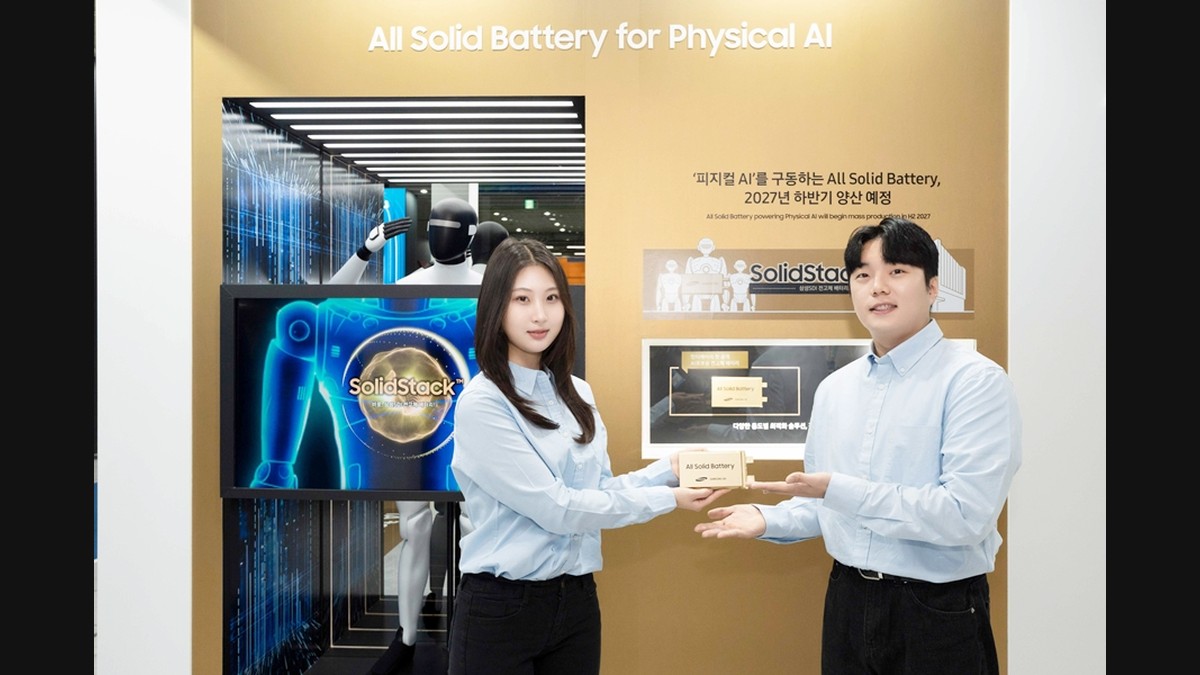
The first commercial proving ground for solid-state batteries is looking less like a car lot and more like a humanoid torso. BigGo reported over the Sep. 27 to 28 window that industry sources say Samsung SDI has officially designated robots as a primary solid-state application, with mass production targeted for the second half of 2027. For a technology long sold as the dream EV pack, that robots-first turn is the stake: denser cells in a tight cavity, untethered shifts, and safer chemistry beside people.
Herald Business, in a Sep. 21 interview, quoted Samsung SDI senior vice president Hyun Jang-seok saying the company chose the robot market as the first target for its SolidStack all-solid-state batteries. Hyun framed the sequence as absorb early robot volume, stabilize yields, set standards, then expand into EVs. Samsung SDI's own InterBattery 2026 newsroom post unveiled the SolidStack brand and publicly showed a pouch-type sample for physical AI uses including humanoid robots and drones, with the same second-half 2027 mass-production target.
The hardware logic is blunt. An EV can tile its underbody with cells. A humanoid has roughly a torso-sized bay and cannot stay plugged in. BigGo notes current runtimes of about two to four hours per charge, citing Tesla Optimus Gen2 at roughly two hours on 2.3 kWh and Hyundai Motor Group's Atlas at roughly four hours on 3.7 kWh. Solid-state density and non-flammable electrolytes are the pitch for longer untethered work beside humans.
Cost still gates the bet. SNE Research, cited by BigGo, estimates initial mass-production and pilot-stage solid-state prices next year at $400 to $600 per kWh, about three to four times common LFP levels. POSCO Research Institute, also cited there, says prices need to fall to about $350 per kWh to keep the battery within roughly 15 percent of a $5,000 robot. Those figures are analyst estimates, not Samsung SDI guidance. Separately, South Korea's robots-first path contrasts with Japan's EV-first solid-state timeline at Toyota and Idemitsu, a secondary geography note rather than the news core.
A June 2026 Frontiers Perspective by Dongsoo Lee of Gachon University adds lab color under the same frame. The paper argues solid-state discourse has been overwhelmingly EV-skewed and that robotics demand uniquely fits solid-state traits, estimating one commercial robot's cumulative hot-swap battery use over seven to ten years at 60 to 88 kWh, roughly one passenger EV pack. H2 2027 remains a company target, not shipping product. Outside coverage reviewed for this article has not confirmed commercial solid-state humanoids on the market today. This card is the hardware and lab rail, not a capital-raise story, and it is separate from Feather's price-and-raise coverage and from O-ID's modular raise.