
Three researchers, Dror Aiger and Goran Žužić of Google and Sariel Har-Peled of the University of Illinois, posted a paper on Nov. 24 that claims to settle a geometry question for solid shapes that the mathematician Hugo Hadwiger posed in 1957. They say an experimental system at Google, built on its Gemini 4 Carbon AI, found the proof with minimal human steering from the two Google researchers. A second system on the same AI then wrote the proof out in Lean, a programming language for proofs that lets a computer check every step.
The question is about convex shapes: shapes where the straight path between any two points inside the shape stays inside, such as an egg, a pyramid or a brick. Hadwiger asked how many smaller copies of such a shape are always enough to cover it, with each copy shrunk and slid into place but never turned or flipped. For solid shapes, he guessed that eight would always be enough. A cube shows why the answer can't be lower than eight: a smaller copy of a cube can cover at most one of its eight corners. Two years earlier, in 1955, the mathematician Friedrich Levi had proved that four copies always do the job for flat shapes.
The paper says the question had stayed open in three dimensions and above for nearly seven decades. Earlier work, by Marek Lassak in 1984, had shown that eight copies always suffice for shapes that are symmetric around a center point, like a brick or a ball, where every point has a twin directly opposite it through the center. For all other solid shapes, the best guarantee, from 2023, was 14 copies. The paper covers only solid shapes; the question had also been open in four or more dimensions, which the paper does not address.
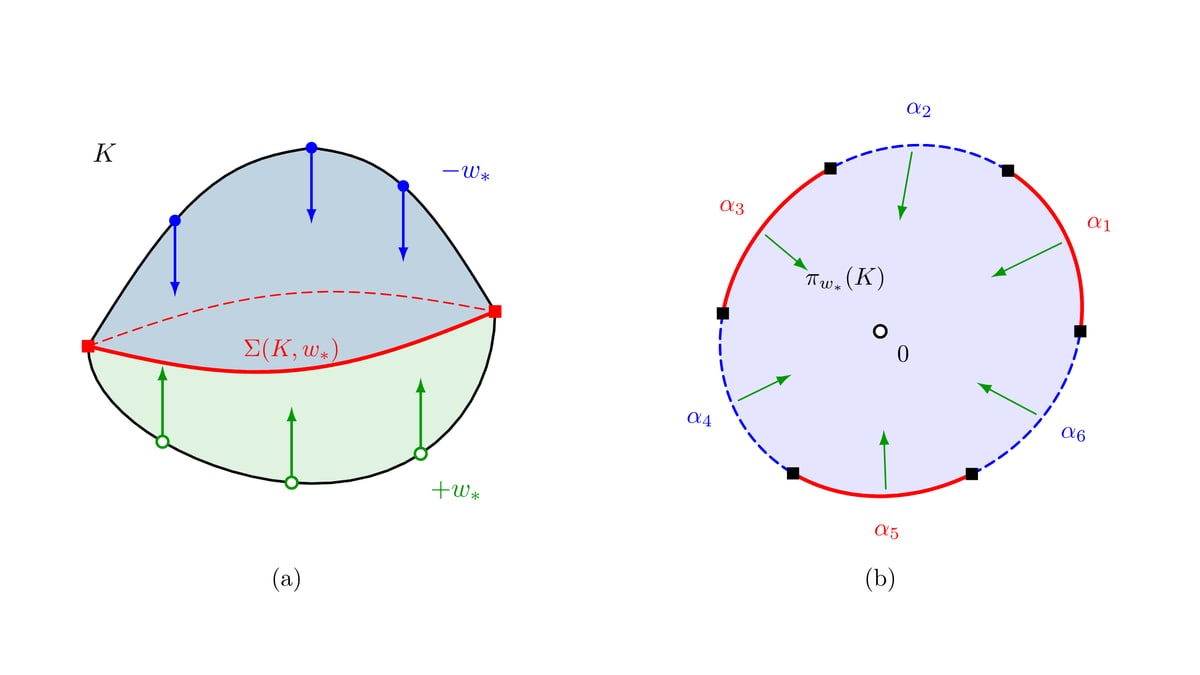
The proof uses a 1960 restatement of the problem, by the mathematician Boltyanski, as a question about light. Each lamp shines in one fixed direction, the way sunlight does. A point on the surface counts as lit when a ray from it, pointing the way the lamp shines, passes into the inside of the shape rather than just skimming its surface. The fewest lamps that light the whole surface is always the same as the fewest smaller copies that cover the shape, so showing that eight lamps are enough settles the question.
Two lamps pointing in opposite directions light every point except the shape's outline as seen from the lamps' direction, where its shadow begins. From almost every direction, that outline is a single closed loop around the shape. Boxes, including slanted ones, are covered directly by eight smaller copies. For every other shape, the paper shows that a direction can be found where that loop is short enough to cut into six pieces, each small enough for one more lamp to light, for eight lamps in all.
The researchers say the computer-checkable version has no unproved steps and rests only on Lean's standard starting rules, and they posted its files with the paper so others can rerun the check. A computer check shows the proof is right for the problem as it was typed into the computer, not that the typed version matches the problem mathematicians meant. The paper says further computer checks confirmed that its typed statement matches the usual ways the problem is written. The three authors say they checked the mathematics themselves and prepared the paper. The paper does not say whether any mathematician outside the team has checked it.