
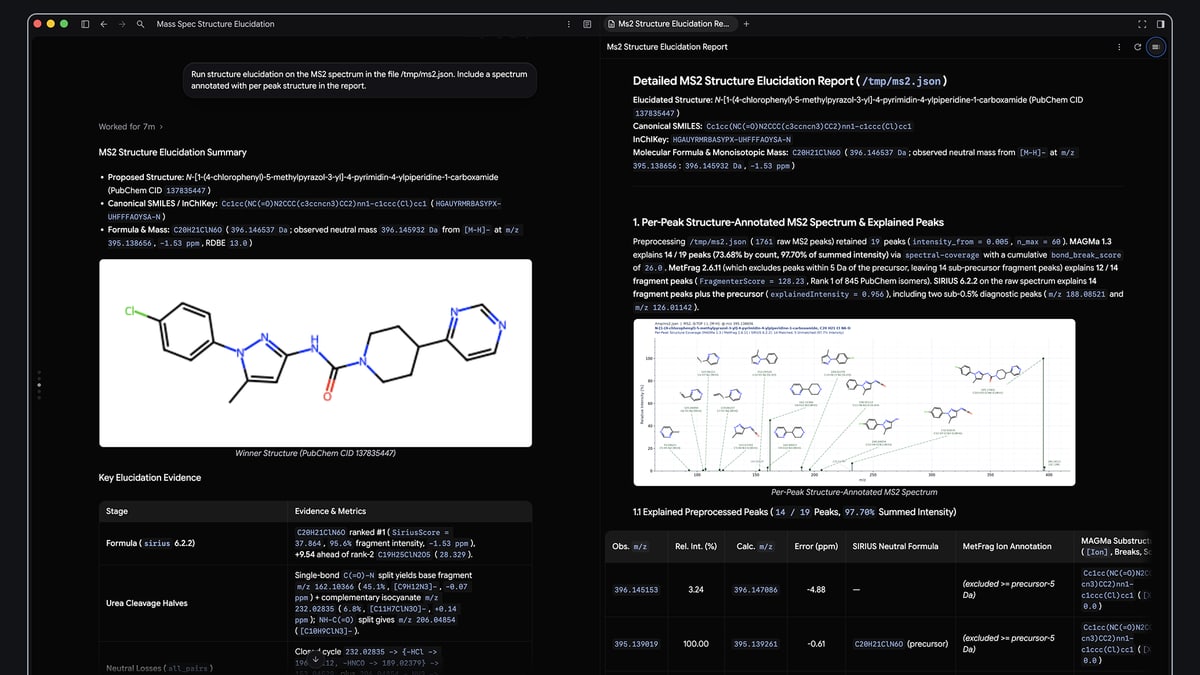
Google DeepMind said on Nov. 25 that it is releasing Mass Spec Skills (mass spec is lab shorthand for mass spectrometry), add-ons for Antigravity, Google's app for building software with AI. The add-ons help scientists work out which molecules are in a sample of blood, soil or plant tissue. Labs measure such samples with a mass spectrometer, an instrument that weighs charged molecules and the fragments they break into. Those readings do not show a molecule's structure directly. The usual method is to match them against a library of readings from molecules measured before, and Google says that finds a match for only about 5% of readings on average, and about 10% for human samples. Many of the rest come from molecules already listed in chemical databases whose readings were simply never recorded.
Antigravity works as an AI agent: AI that can carry out tasks on its own, instead of only answering questions. With the skills, it runs established, openly available chemistry tools and searches public chemical databases for the scientist. Researchers describe the task in plain language, and Google's Gemini models then weigh the results and lay out the evidence for a chemist to review. In one example Google gives, with the library search switched off, the agent sorted through all 845 structures in a public database that share the molecule's chemical formula and singled out one as its top candidate.
Google tested the setup on 100 molecules whose readings are already stored in public reference libraries, with three tries for each. Google drew the molecules from a single collection in one public library and left out readings where the molecule barely broke apart. Tries that ran past an hour counted as misses, and tries that failed because of errors on Google's own systems were left out. With no internet access and no skills, Google's three test models, Gemini 4 Argon, Gemini 4 Carbon and the smaller Gemini 3.8 Flash, were right less than 4% of the time. With internet access alone, Argon and Carbon missed a quarter to a third of the molecules, and Flash missed more than three-quarters. With the skills added to that internet access, all three named and checked the exact molecule in around 97% of attempts.
Google lists limits. Mass spectrometer readings cannot tell apart mirror-image molecules or some closely related ones, which need other lab measurements. Genuinely new molecules, including many made by plants and other living things, are in no database, so Antigravity cannot find or confirm their structure on its own. For those, Google says it gives chemists a starting point, such as a likely formula.
To use it, scientists install the skills as a plugin in the Antigravity app, and business users can sign in with Google Cloud accounts. Antigravity's free plan runs Gemini 4 Hydrogen, a model Google did not include in the test, and Gemini 3.8 Flash only until Nov. 30, 2026. The larger Gemini 4 Argon and Carbon models need a paid Google AI Pro or Ultra plan. Google is still taking applications, first opened on Nov. 13, for 10,000 scientists (academic researchers, Google said then) to get its highest usage tier free for six months, admitted on a rolling basis and subject to eligibility, capacity and selection.
The 97% figure comes from Google's own test. Because the test used only molecules whose readings were already on file, it does not show how often the tool is right on the large majority of readings that match nothing in the libraries. Two scientists Google quotes, Phanankosi Moyo of the University of Pretoria and Scott Jarmusch of the Technical University of Denmark, say it could speed up the search for new medicines from plants and other natural sources.