
Meta on Monday, Nov. 9, released Muse Ember, which it calls its smallest and most efficient AI model. Meta built it for the work AI agents repeat all day. AI agents are AI that can carry out tasks on their own, such as using apps and websites, instead of only answering questions. That work includes handing jobs to other software, such as a search, handling small coding jobs, pulling out details and reading long documents. For hard jobs, Meta suggests pairing it with Muse Wonder, its bigger model for the hardest problems: the big model works out how to tackle the job and hands the many small steps to the cheap one. In Meta's words, "Muse Wonder plans, Muse Ember handles the volume."
Developers can use Muse Ember now through Meta's API, a connection that lets developers plug a service into their own apps, and in Muse Code, Meta's coding tool, as well as through Google Cloud and Oracle Cloud. Meta charges developers 10 cents for every million tokens Muse Ember reads and 50 cents for every million it writes. Tokens are the small chunks of text, often parts of words, that AI models read and write. Muse Spark 1.3, Meta's model for coding and agent work, costs $1.25 and $4.25 for the same amounts. Meta says Muse Ember can take in a million tokens at once, enough for all the code of a software project or a whole set of documents in one go. Meta says it handles images, sound and video as well as text, so it can read screenshots, charts and scanned pages or work from voice memos and meeting recordings.
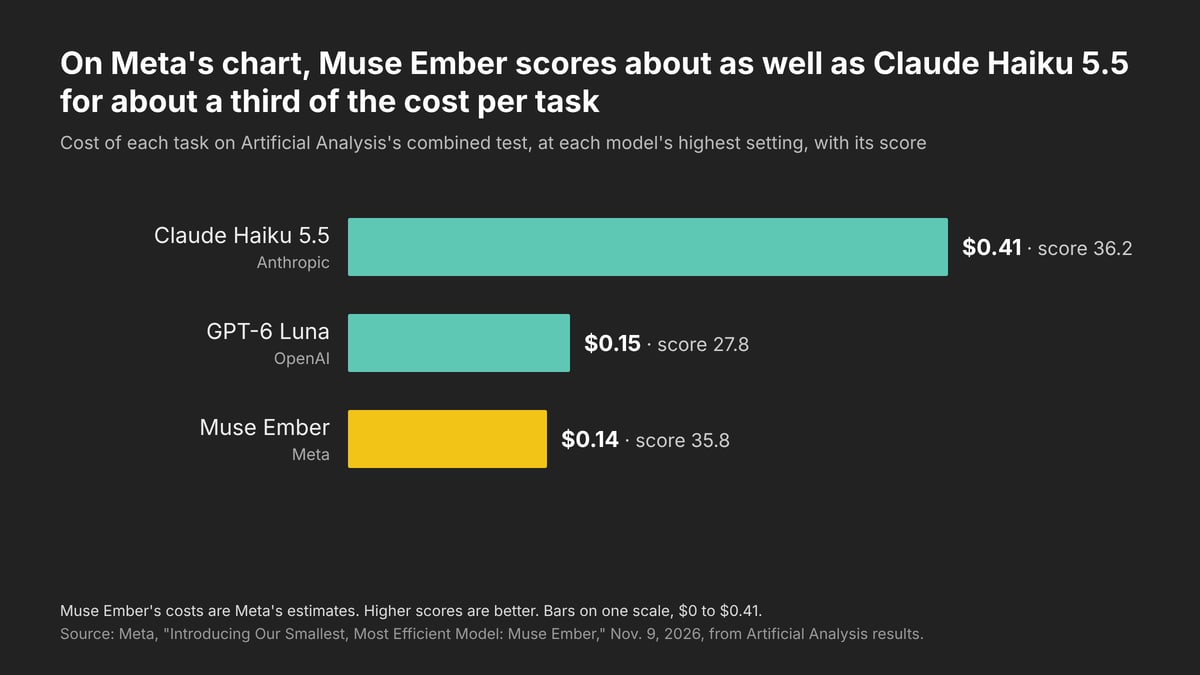
The price per token is only part of what a job costs, because some models work through a problem at greater length and use more tokens to finish it. So Meta's main comparison sets each model's score on a combined set of standard tests against what each task cost to run. Artificial Analysis, a company that tests AI models, ran the tests. These models can be set to work through a problem for longer. On Meta's chart, Muse Ember at its highest setting scores 35.8, on a scale where higher is better, for about 14 cents a task. Anthropic's Claude Haiku 5.5 scores 36.2 at its highest setting for about 41 cents, and OpenAI's GPT-6 Luna scores 27.8 at its highest setting for about 15 cents. Meta says that means Muse Ember matches Haiku's best, which is slightly higher, at about a third of the cost, and beats Luna at every setting. Meta says Muse Ember's costs on the chart are estimates.
Not every result goes Meta's way, and Meta ran several of the other tests itself. On FrontierCode 2.0, a coding test run by Artificial Analysis that judges real engineering work by whether a project would accept the code, Claude Haiku 5.5 scored 34.9% to Muse Ember's 27.2%, both at their highest settings. Five companies that tried the model early praise it in Meta's announcement: Box, Cline, Oracle, Cloudflare and You.com. Cloudflare says Muse Ember ran up to 30% faster on its slowest responses than a comparable model it tested, which it did not name.
Meta says Muse Ember is the first model it trained using Muse Wonder Full, one of the two Muse Wonder models it introduced earlier, though it has not said how. It says its own safety tests found the model below the high-risk levels Meta sets for chemical and biological threats, cyberattacks and AI slipping out of human control. Meta has not said how large the model is. Developers can reach Muse Ember through Meta's own API and Muse Code, and through Google Cloud and Oracle Cloud. Meta calls its cost of about 14 cents a task low enough "to run in every product, for everyone," but it has not said whether or when its apps for everyday users will use the model.
Correction (Nov. 10): an earlier version said Meta offers Muse Ember only through its own API and Muse Code. Meta's announcement says it is also available on Google Cloud and Oracle Cloud.